Health
1459
“Diseases have roots and seeds” Akşemsettin brings a different perspective to germs, epidemics, and
contagion
Akşemsettin (d. 1459, Göynük), also known by his real name Mehmed Şemsettin, is recognized as a versatile Turkish scholar, medical practitioner, and the teacher of Fatih Sultan Mehmed. Akşemsettin gained great renown not only in science and Sufism but also in the fields of medicine and pharmacy.
Sources indicate that Akşemsettin, recognized as a medical doctor of his time and renowned as a skilled physician, also had a reputation for his contributions to medicine. He is credited with writing in the field and is notable in medical history for being the first to bring up the topic of microorganisms and suggest that diseases are spread by them. He is regarded as the first doctor to discuss this subject, having done so at least a century before the Italian doctor Girolamo Fracastoro, who offered conclusive information
in this field. Some historians, such as Adnan Adıvar, may show some hesitation at first, as pointed out by Dr. Osman Şevki Uludağ on this matter. However, Bedi N. Şehsuvaroğlu has convincingly and clearly demonstrated its authenticity.63
Because it suggests the existence of germs and the transmission of disease through seeds, Akşemsettin has a noteworthy place in medical history. Even in the 16th century, when Fracastoro stated that contagious diseases spread from individual to individual, from animal to animal, from plant to plant, and from plant and animal to human through “seminals,” he did not abandon the notion that such diseases were a divine punishment. About a century before Fracastoro, Akşemsettin explained this view in his own book.
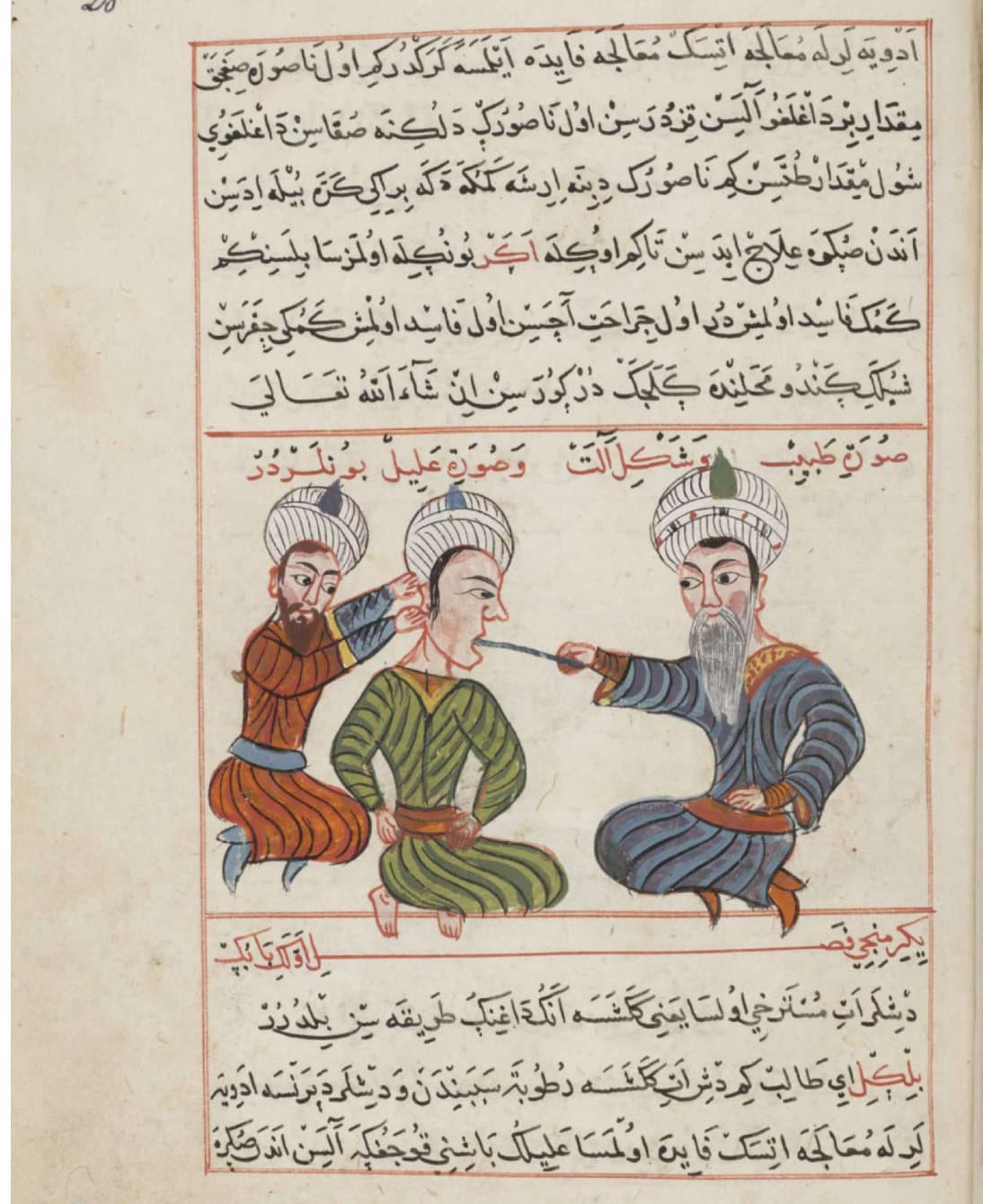
Picture 1 Şerefeddin
Sabuncuoğlu, Cerrahiyyetü’lHaniyye, p.
The 17th century is a period of significant developments in all sciences, including biology. The microscope, which emerged in the early 1600s, brought about a radical change in the field of biology, leading to the development of new theories. The widespread use of the microscope as a scientific observation tool dates back to the 1660s. The fact that cells make up plants was initially discovered by Robert Hooke (1635-1703) with the use of a microscope.
In 1879, Pasteur, during a discussion at the Paris Academy of Medicine about puerperal fever, challenged the prevailing belief that the disease was caused by miasma (bad air) and instead proposed that it was microbial, spreading through the involvement of doctors and midwives. He illustrated the concept of microbes on the chalkboard and substantiated his idea through laboratory studies. Subsequently, in Germany, Robert Koch (1843-1910) made significant contributions to the development of microbiology with his studies on microorganisms causing diseases.64
Akşemsettin's most significant contribution to medicine was his early recognition of the microbial nature of diseases and the way infectious diseases spread, which forms the basis of modern medicine. He vehemently attacked outdated notions about malarial attacks. “Be aware that, due to the fact that physicians were unable to understand what was happening during these attacks, some of them ascribed them to warfare, and others argued that they were caused by the motion of the moon or some other celestial body,” he said. These words, in Akşemsettin's language, conveyed genuine insights that were not in line with the medical knowledge of his time. Malaria was a common disease caused by a specific factor, and the influence of celestial bodies and the moon's
motion on hostilities, as claimed by those involved in astrology, was undoubtedly baseless.
Akşemsettin went beyond expressing his views, reaching the most concealed corners of medicine. According to the medical understanding of the time, this was a commendable quality for the Ottoman Turks. He said, “Major diseases have seeds and roots according to their types, like the seeds of plants and the roots of herbs. Some diseases, such as scabies, jaundice, and leprosy, which are inherited from parents, may reappear even seven years after the disease is first observed. Diseases caused by food and drinks manifest their seeds quickly and grow.” Giving due value to these words and making efforts to investigate the matter would be worthwhile. Seeing that five hundred years ago, OttomanTurkish doctors had sufficiently incorporated the concepts of contagion and heredity into their medical beliefs is quite enough to demonstrate the correctness of the path followed by our ancient medicine.
The proof that all diseases have seeds came centuries later in the field of medicine. The only flaw of that era was not having the means to discover and contemplate these seeds. However, searching for the seeds of a disease to be able to form in an era dominated by intellect, despite the inadequacy and even absence of resources, was a theory first noticed by an investigative Turkish physician. The occurrence of the same disease successively or at different intervals among various individuals within a household could not be a mere coincidence. There had to be an unknown cause for the disease to occur, and this hidden cause was the seed that disrupted people's health.65
Source: Innovation, Inventions and Quests Among the Turks