
Science & discovery
1575
Takiyüddîn and his Observatory The pinnacle of 16th century science sacrificed to parochialism
The emergence of the first observatory in the Islamic world aside, it is noteworthy that three out of the nine significant observatories established from the 9th century onward were founded by Turks. The contributions of many Turkish scientists to astronomy have been considered a distinct and remarkable topic. The observatory established in İstanbul by Takiyüddîn, the first observatory of the late Ottomans, holds particular importance in our scientific history. Takiyüddîn was born on June 14, 1526, into a Turkish-origin family in Damascus. Around the year 1550, when his family moved to İstanbul, he completed his education under the guidance of scholars such as Çivizâde Mehmed Efendi, Ebussuûd Efendi, Kutbüddinzâde Mehmed Efendi, and Saçlı Emîr. After this period of learning, during which his knowledge expanded and he delved particularly into astronomy and mathematics, he traveled to Egypt and served as a professor in the madrasahs of Cairo. Later, he returned to İstanbul and was appointed as a professor at the Edirnekapı
Madrasa during the tenure of Grand Vizier Semiz Ali Pasha. However, due to family reasons, he returned to Cairo and continued his role as a professor there. During this time, he acted as a deputy for Çivizâde Mehmed Efendi, who was appointed to the position of Qadi in Egypt. Encouraged by Qadi Molla Abdülkerim Çelebi, who was appointed as the Qadi Asker in Egypt, and his father, Kutbüddin Efendi, Takiyüddîn focused intensively on astronomy and mathematics. Takiyüddîn held great respect for Abdülkerim Çelebi, whose influence deeply shaped his scientific personality, and dedicated his book on optics to him.155
While advancing his research in mathematics and astronomy, upon his return to İstanbul in 1570, Takiyüddîn drew the attention of his sultanate teacher Sadeddin Efendi and Grand Vizier Sokullu Mehmed Pasha. A year later, he was appointed as the chief astronomer by Sultan Selim II. In 1574, after the death of Sultan Selim II and the
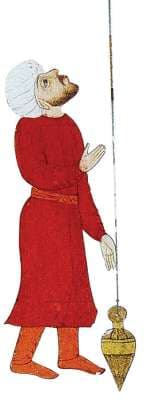
Picture 1 Takiyüddîn in front
of the observatory (Takiyüddîn, Alatı Rasadiye, Topkapı Palace,
H. 452)
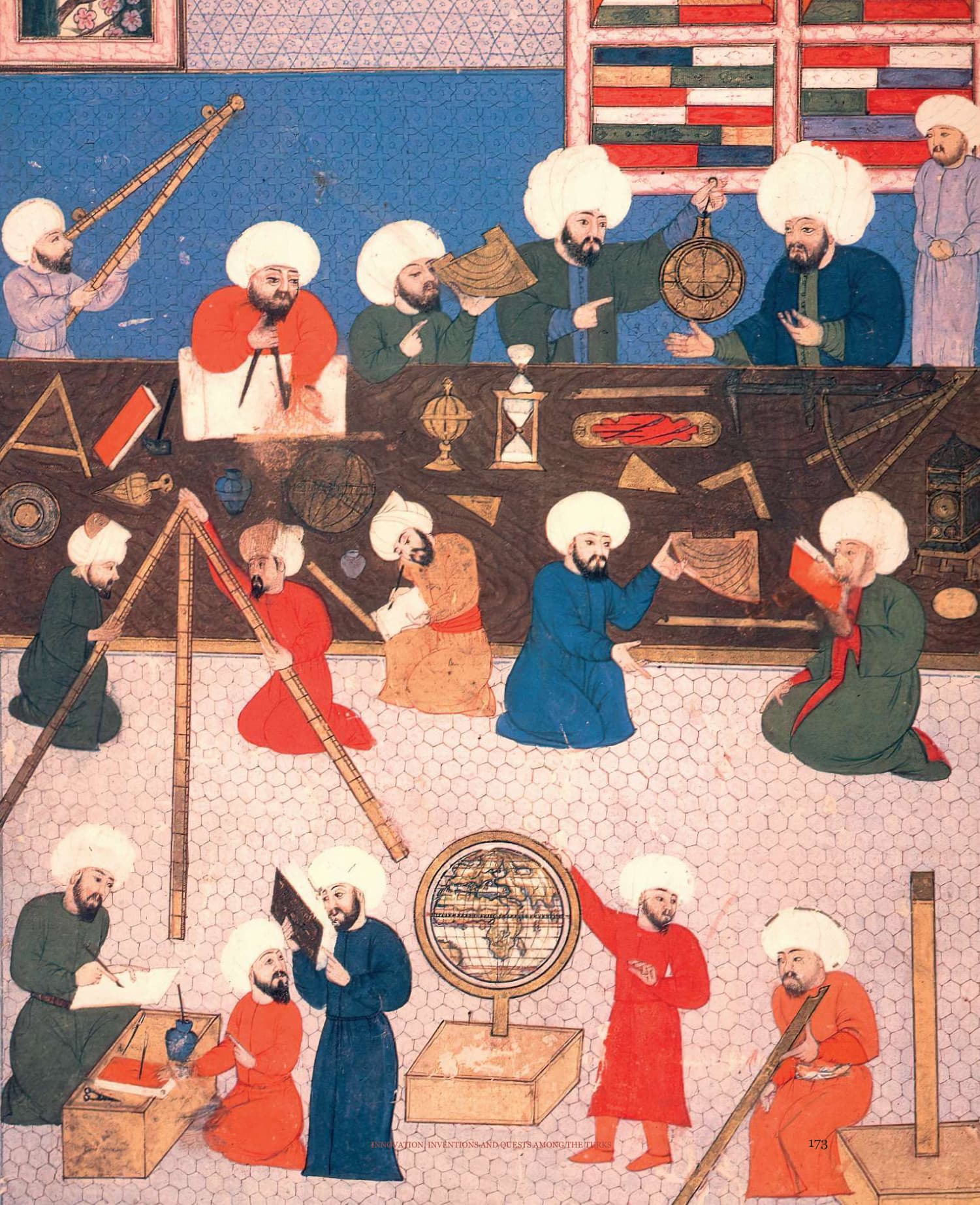
Picture 2 Takiyüddîn
working inside the observatory built on the Tophane ridges, (Seyyid Lokmân, Şehinşehname.)159
accession of Sultan Murad III, Takiyüddîn presented a proposal to establish an observatory in İstanbul. Sultan Murad III accepted Taqiyyüddin's proposal and appointed him to establish the observatory, covering all expenses from the state treasury. Additionally, Takiyüddîn was granted a monthly salary of 3,000 gold coins and an allocation of 10,000 gold coins for the observatory's expenses. In the imperial edict given to Takiyüddîn, Sultan Murad III expressed his pride in granting such an honor that none of his ancestors had experienced before and emphasized that Takiyüddîn was the first to achieve such an honor. Furthermore, Takiyüddîn was awarded the income of the town of Konya Ereğli, amounting to seventy thousand akçes.156
Takiyüddîn commenced his observational studies at the Galata Tower and continued them at the observatory he established on the hills of Tophane from the year 1577 onward.157 According to some sources, construction of the observatory began in 1575, and once completed, it was equipped with all necessary astronomical instruments. Other accounts mention the excavation of a well approximately 27 meters deep for observations. Large instruments were placed in this well to shield them from the wind. A library was also established, housing books related to astronomy. The observatory featured a lead-coated dome and four chimneys, with the roof covered with tiles. Inside the observatory, there were two rooms, one of which was larger. The underground floor of the observatory was paved with hexagonal bricks. Observers and their assistants worked on a large and low table. On the table, various instruments such as clocks, astrolabes, hourglasses, a celestial globe, dividers, rolled paper, rulers, an inkwell, and pens were present, along with some astronomical tools and a large terrestrial globe. The observatory employed 15 people, and it was mentioned that one ascended to the observatory
tower through 150 steps, which had 9 windows.158
However, on one hand, the political connections and, on the other, the rivalries among the statesmen with whom he had close friendships led to rumors and allegations against him and the observatory. In 1577, a comet was observed, and in 1578, a plague outbreak occurred. Detractors took advantage of these events, claiming that disasters followed the establishment of an observatory, citing the death of Ulugh Beg as an example.160
This event was recorded in history books as follows:
Some time ago, a comet appeared. In 1578, the plague spread. Many people fell ill. Mihrimah Sultan, Grand Vizier Hamid Efendi, and Piyale Pasha were among them. Complaints increased among the people. The observatory became a subject of gossip. They claimed that wherever such an observatory was built, disaster followed, supposedly proving it with historical examples. They asserted that the comet and the plague were its precursors. The Sultan became fearful. He ordered the destruction of the observatory.161
Swayed by political rivalries and not delaying to lay a religious groundwork, Şeyhülislâm Kadızâde Ahmed Şemseddin Efendi is said to have issued a fatwa stating, “Making observations brings bad luck.” Upon these events, the İstanbul Observatory, the only observatory in the history of the Ottoman Empire and of great importance in Turkish scientific history, was destroyed on January 22, 1580, along with its instruments, through an imperial decree. Takiyüddîn, deeply saddened by this event, withdrew to his seclusion and passed away in İstanbul in 1585.
An Ottoman-era polymath and one of the most distinguished representatives of 16th-century Ottoman science, Takiyüddîn wrote various works on mathematics, astronomy, physics, optics, mechanics, and medicine. His works reveal a
primary interest in astronomy, and his scientific activities were predominantly shaped by this interest, with approximately one-third of his works dedicated to this field. Particularly noteworthy are his calculations, based on observations, that explain the irregularities in the movements of the moon, Earth, and other planets with measurements close to contemporary values. Takiyüddîn emphasized the need for a new observatory, stating that the old instruments162
were no longer sufficient for the requirements and that new observations were necessary to continue the astronomical studies in the Ottoman Empire. In response to his recommendations, Sultan III. Murad assigned Grand Vizier Sokullu Mehmed Pasha and Hoca Sadettin Efendi to assist him. The İstanbul Observatory, equipped with some of the most advanced observation instruments of the time, was established based on Takiyüddîn's designs. Despite its short lifespan, the observatory rivaled the Uranienborg Observatory established by Tyge Ottesen Brahe (d. 1601).
Takiyüddîn made significant contributions to the field of trigonometry. While the renowned astronomer of the 16th century, Copernicus, did not use the sine term, Takiyüddîn was known to define and prove sine, cosine, tangent, and cotangent. He also calculated sine and tangent tables at one-degree intervals from 1° to 90°. In the field of arithmetic, he developed a unique practical numeral system, introducing decimal fractions instead of the sexagesimal fractions and demonstrating that decimal fractions were known in the East before Simon Stevin (d. 1620) first used them in the West. It is worth noting that he did not use the fraction symbol (,) to distinguish between integers and decimal fractions, expressing decimal fractions verbally. Additionally, he delved into algebra and solved second-degree equations through arithmetic methods.
Picture 3 The comet
seen in the skies of
İstanbul after the observatory was built.
(Seyyid Lokmân,
Şehinşehname)
Picture 4 “Zât elHalâk,” also known as a
ringed instrument, was
used to measure the
width and length of celestial bodies and the
astronomers who worked on it. (Sayyid
Lokmân, Şehinşehname.)
Takiyüddîn excelled in the field of optics, reevaluating the arguments and problems reached through optical studies initiated approximately eight centuries earlier in the Islamic world in a causal and mathematical context. He supported these findings with new experiments. Notably, he explained for the first time the spherical dispersion of light and, also for the first time, mentioned a telescope—without naming it—in his optical book. He described an instrument he made as a “crystal” (lens) capable of showing things that cannot be seen due to their distance.
Takiyüddîn, considered one of the most important engineers produced by the Ottomans, designed various devices such as mechanical clocks, levers, and tools used to draw water from lakes, rivers, and wells. He detailed these inventions in one of his works. His book, where he described pocket, wall, table, and astronomical observation clocks, is the most comprehensive work on the subject in that century, including the Western world. One notable feature of the clocks he referred to as observation tools was their ability to display seconds alongside minutes. The fact that the construction of clocks showing seconds in the West, and their use in Brahe's observatory, occurred after the use of the observatory in İstanbul makes Takiyüddîn's work even more valuable.163
İstanbul Observatory's demolition in 1580 marked the end of its existence, and it wasn't until 288
years later, in 1868, that a new observatory, named Rasathane-i Âmire, was established in Beyoğlu as a branch of the Ministry of Education under the order of Sultan Abdülaziz.
Later, it moved to a building across from the Maçka Artillery School, where it established a center named Earthquake, placing instruments to measure the epicenter, intensity, propagation area, and duration of earthquakes. The observatory annually published summaries of weather forecasts and reports on earthquakes in the Ottoman territories, including their effects. Among its main tasks were determining and announcing prayer times, calculating lunar and solar eclipses, and adjusting the clocks of the towers in Tophane and Dolmabahçe. Unfortunately, Rasathane-i Âmire was damaged during the events of the 31st of March in 1909 due to artillery fire and was eventually replaced by the establishment of the Kandilli Observatory in 1911. According to Muammer Dizer, who mentions that the observatory, which had recently been moved near the Maçka Artillery School, was deliberately damaged by revolutionary soldiers during the events of the 31st of March; these soldiers were part of the Islamic law-oriented movement suppressed by the Action Army and referred to as the “reactionary movement.” The details of the incident are unknown, but it is possible that the observatory, situated between Taşkışla, where the main clashes occurred, and the Harbiye Military
Picture 5 Observation tower
(Takiyüddîn, Alatı Rasadiye, Topkapı Palace,
H. 452)
School and Maçka Artillery School (Arsenal), where the Action Army was stationed and where the rebels were shelled, fell victim to an unfortunate accident. If the event unfolded as described by Dizer, then it can be said that “the second observatory attempted by the Ottomans suffered the same fate as the first.”
Granting Astronomy and Geometry Books to Takiyüddîn
According to a decree sent to the Qadi of İstanbul, which is said to be in the hands of the imam and muezzin of the Mimar Sinan neighborhood in İstanbul, the astronomy and geometry books that belonged to a man named Lütfullah should be found and given to Mevlana Takiyüddîn, whether they are in their possession or not. The volumes are to be used for astronomical services, and Takiyüddîn is credited with overseeing the observatory.
April 20, 1578
The decree, intended to reach the relevant authorities, has been given to Şehla Musa Efendi.
To the Qadi of İstanbul, my command is as follows:
Upon receiving information that the books on astrology belonging to the deceased individual named Lütfullah are currently in the possession of the Imam and Muezzin of Mimar Sinan Neighborhood in İstanbul, I hereby order and decree that these be acquired and handed over to the Observatory. I instruct without delay that upon the receipt of this order, whether these books are in the hands of the mentioned Imam and Muezzin or any other individual, whoever possesses them should promptly present them all to Takiyüddîn, who is currently overseeing the Observatory's services.
[12 Safer 986]
A.DVNS.MHM.d, 34/272 Importing Wood from the Egyptian Region for Observatory Charts and Instruments
Upon the observation of Râsid Takiyüddîn, who pointed out that some angle-measuring charts and observatory tools made from the trees of this humid region became unusable after a while, it was suggested to import wood from the dry climate of Egypt for the construction of these items. An order was sent to the Beylerbeyi of Egypt to acquire and send a sufficient quantity of suitable wood from the Egyptian region for use in this matter.
August 6, 1579
Bestowed upon the aforementioned Gatekeeper Hasan.
In a missive dispatched by Takiyüddîn, the
overseer of the Observatory service, it was conveyed that some of the tools used in astronomical observations, including certain rulers and instruments for measuring angles, were crafted from the trees in this region. However, due to the humid climate, these instruments deteriorate shortly after being fashioned, necessitating frequent retooling for each observation. Moreover, it was asserted that if not refurbished in this manner, these tools prove useless, rendering astronomical observations impossible. Consequently, he requested the procurement of suitable wood for crafting anglemeasuring rulers from the dry climate of Egypt.
In light of this, I commanded that upon the arrival of Hasan, one of the gatekeepers at Dergâh-ı Mualla, he should promptly acquire the required
amount of suitable wood for astronomical instruments from the lands of Egypt and expedite its delivery to this side (İstanbul), exhibiting the necessary diligence.
A.DVNS.MHM.d, 40/372
Construction of New Rooms for the Observatory with Adobe
Upon the observation of the astronomer (Râsid) Takiyüddîn, who stated that the Observatory did not have a sufficient number of rooms and, due to the winter season, new rooms needed to be built, an order was sent to Topçularbaşı Sinan Agha to construct an adequate number of rooms with adobe using a communal effort at a suitable location.
August 30, 1579
Conferred upon Hasan Bey, one of the scribes of the Dîvânı Alîşân.
7 Receb 987.
To Topçularbaşı Sinan Agha, my directive is as follows:
In a missive sent by the observer (Râsid) Takiyüddîn, it was communicated that there is an insufficient number of rooms in the Observatory, and, due to the winter season, it is imperative to construct an ample quantity of rooms made of adobe. Therefore, I commanded that this matter be resolved through collaborative efforts and ordered that:
Upon receipt of this directive, you shall attend to this matter, employing the communal approach, and strive to construct a sufficient number of rooms made of adobe in a suitable location until its completion. Please articulate the quantity of rooms to be constructed and provide a written account of how this matter is to be resolved.
A.DVNS.MHM.d, 40/134
Source: Innovation, Inventions and Quests Among the Turks