
Culture & communication
1559
The Turks’ gift to the world Tulip, the favorite of gardens, poetry and ornaments
The term lâle (tulip), originating from the Persian language, denotes a perennial, bulbous, and herbaceous plant. Although its true homeland is believed to be in Central Asia, the lâle is fundamentally a wild plant.
Unrecognized during the Roman and Byzantine eras, the lâle began to be utilized as an ornamental plant in Anatolia from the 12th century onward. The exact time when the lâle was introduced from Türkiye to Europe remains uncertain. It is presumed that among the plants carried from İstanbul to Europe by the envoy of the AustroHungarian emperor, in the court of Sultan Suleiman the Magnificent, were tulip bulbs. In April 1559, a variety of tulip blossoming in Hewart's garden in Augsburg, Germany, was named tulipa turcarum (Turkish tulip) by the Swiss naturalist Konrad Gesner. The passion for tulips, known at times worldwide as “tulipomania,” reached extreme proportions. This fervor increased in 16th-century İstanbul with the
cultivation of numerous varieties through cultural practices and peaked in the 18th century, especially during the period later termed the Tulip Era (1718-1730). The word “tulip,” used in European countries for the lâle plant, is derived from Busbeke's memoirs, which noted that Turks called this plant “tulipan.” Murray suggests that this name is related to the turban the Turks wound around their heads. It is highly probable that the term originated from the word for “flower in the shape of a turban.”
About 450 years ago, the tulip embarked on an exhilarating journey towards Europe, sprouting as a wild flower in the steppes of Turkestan. It traversed the territories from the Volga with the Bulgars to the banks of the Syr Darya, reaching as far as India with the Timurids and extending through Iran and Anatolia with the Seljuks.164
The word lâlezar appears in the divan of Fatih Sultan Mehmed, who was also a poet. The historian of his era, Dursun Bey, writes in the
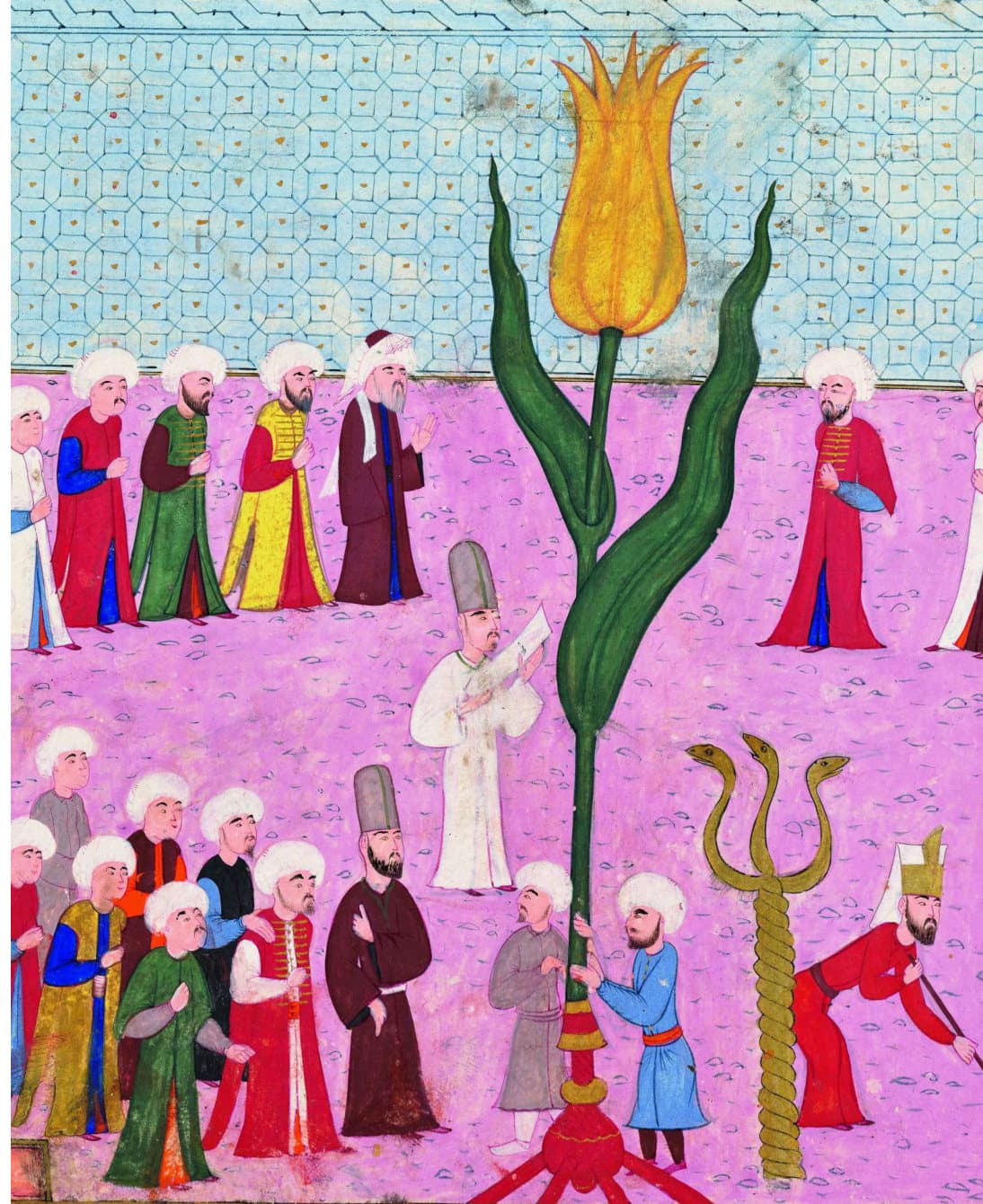
Picture 1 The passage of the
yellow tulip made of paper through Atmeydanı, around 1587, Surnâmei Hümayun, TSMK, H. 1344, 200.
Ebbülfeth History that after the conquest of İstanbul, Fatih placed significant importance on gardens and tulip gardens.165
The tulip made its way to Europe from İstanbul in the mid-16th century, acquiring the name “tulip,” derived from the Turkish word tülbent. It became a sought-after commodity, particularly in Holland and Germany. In the early 17th century, the absence of a collection of tulips in the possession of a wealthy individual was considered a sign of tastelessness. The fascination with tulips eventually reached the point of outright madness, referred to as lale deliliği (meaning tulipomania.) The wealthy flaunted their rare tulip bulbs, often paying exorbitant sums for them. There were even
those who invested their entire fortunes in a single tulip bulb. In 1636, the demand for rare varieties suddenly surged, leading to the establishment of regular markets in cities such as Amsterdam, Rotterdam, and Leiden to facilitate their sales. Over time, some traders resorted to various means, manipulating prices and creating fluctuations to reap excessive profits.
Tulipomania had engulfed the entire society like a contagious ailment. Not only tulips but also a myriad of enthusiasts for flowers such as hyacinths, roses, carnations, and violets were found in all major Ottoman cities, with İstanbul at the forefront. The appreciation for gardens and flowers, extending beyond tulips, had permeated the entire populace in 16th-century İstanbul, where Ottoman culture found its classical dimensions. Decrees from the reign of Sultan Selim II onward reveal the ordering of tulip and hyacinth bulbs from various regions for palace gardens.166
In a decree dated April 7, 1577, addressed to the Bey of Kaffa, a request was made for three hundred thousand tulip bulbs for the imperial gardens. The decree emphasized the imperative of prompt action upon its receipt, stipulating the procurement and immediate dispatch of aesthetically pleasing tulips, whether of single or mixed colors, that would be visually appealing.167
Enthusiasts from outside the palace were also finding ways to obtain new varieties by sourcing bulbs from various places. Flowers had become an indispensable part of daily life. Even the gardenless homes of the impoverished were adorned with pots of roses, geraniums, carnations, ear flowers, and basil in their windows. This taste gradually evolved into a form of art in itself. Indeed, the creation of the office of the Chief Florist in the 17th century, as evidenced by a decree of Sultan İbrahim, attests to the recognition of the need for an organized position to oversee floral affairs.
Picture 2 Various tulip
drawings from the Şukûfenâme manuscripts.
In the reign of Sultan Mehmed IV, who ascended the throne after Sultan İbrahim, a flower research institute named “Meclis-i Şükûfe” (Council of Delightful Things) was established, and Solakzâde Çelebi was appointed as its head. The institute's mission was to evaluate the tulips sent for examination in terms of their colors, shapes, leaves, and other characteristics and to identify any flaws if present. Heated debates among flower bowls and vases would ultimately decide whether the examined flower was baş güzide (head delight), orta güzide (middle delight), or serfîraz (excellent), while flawless tulips were recorded with elaborate names. Countless tulips were given unimaginable names such as berki rânâ, dürri yektâ, feyzi seher, güli ruhsâr, sîmendâm, nev peydâ, and many more.
During the Tulip Era, the surroundings of the Kağıthane stream and the shores of the Bosphorus were adorned with elegant mansions, waterfront residences, and gardens. The most cherished flower in these gardens was the tulip. Nevşehirli İbrahim Pasha was also a tulip enthusiast, and this passion demonstrated an inclination to spread across the entire populace. The fact that one of the greatest tulip masters of the era, known to the people as Tabak Ata, was Debbağ Ataullah Efendi, indicates that the love for tulips was not exclusive to the upper echelons of society.168
It is recorded that the first cultivated variety of tulip in İstanbul was obtained by Şeyhülislâm Ebussuûd Efendi. According to handwritten manuscripts providing information about the
Picture 3 Tulip of
Şukûfenâme
names, characteristics, and cultivators of tulip varieties grown in İstanbul during the 16th and 17th centuries, the number of these varieties is around 2,000. Starting from the 18th century, tulip cultivation became a veritable competition, leading to the emergence of hundreds of tulip species with distinct shapes and colors, each assigned a unique name. Around the year 1725, it is believed that an album named Lâle Mecmuası was compiled, containing colored images of around fifty varieties of İstanbul tulips. The shapes of tulip varieties cultivated in İstanbul, as depicted in this album, are markedly different from the tulip varieties known today as “European tulips” (common tulips). The blossom of the İstanbul tulip is almond-shaped, with dagger-like leaves that are thin, long, and pointed at the tips.
The most commonly mentioned varieties of tulips in Türkiye include the Rumî tulip, Lâle-i Nu‘mân, Manisa tulip, and the Girit tulip. The Rumî tulip is red in color. Lâle-i Nu‘mân, also known as the peony, comes in single and double layers, with variations in white, yellow, pink, red, and cream colors. The Manisa tulip, a type of peony, unfolds its white cup in the sun, with airy edges. The Girit tulip has a black-seeded center, and its petals are white; other colors have also been obtained. In Anatolia, tulips are known by various names such as mountain tulip, berrî tulip, black tulip, mountainous tulip, and red tulip, among others, reflecting the diverse varieties found in the region.
The word lâle is written with the same letters as the word Allah, and thus, both have a numerical value of sixty-six in the abjad system. Some sufis may have chosen to incorporate the tulip motif into tombstones due to this similarity. When the word lâle is read backward, it forms the word hilâl (crescent), so poets also use the phrase aksi lâle to allude to the crescent.169
After the first half of the 16th century, the tulip held a significant place in Turkish decorative arts.
Picture 4 Miniature of a person holding a tulip in the
hands of Levnî. Kara Memi, the head of the palace embroidery workshop during the reign of Sultan Suleiman the Magnificent, introduced a new style and approach in Turkish ornamentation with motifs depicting leaves and blossoms, including roses, carnations, tulips, and spring branches. This style quickly influenced the palace and artisans, becoming widely prevalent in bookbinding, ceramics, metalwork, woodwork, and weaving arts. These tulip motifs can be observed in various patterns under different names in designs until the 19th century.
The tulip motif, with its red color and elegant form, first appeared in ceramic art in the second half of the 16th century. It was initially seen in the tiles of the Şehzade Mehmed Tomb constructed in 1543 and later scattered within the inscriptions of the Hadım İbrahim Pasha Mosque tiles. The Rüstem Pasha, Sokullu Mehmed Pasha, Sultan Ahmed mosques, and the Haseki Hürrem Sultan Tomb provided the richest examples of tulip motifs in terms of color and pattern diversity in ceramic ornamentation. In the 17th-century ceramic art, the tulip motif gradually moved away from the rich variety and pattern beauty of half a century earlier, losing its significance by the 18th century. In the classic era, Turkish bouquets used in tughra decorations had no pattern without tulips. The tulip motif is expertly crafted in brass helmets from the reign of Sultan Suleiman the Magnificent, as well as in horse helmets found in the weapon collection of the Topkapı Palace Museum.170
Sending Three Hundred Thousand Tulip Bulbs from Kaffa
It is required to send three hundred thousand tulip bulbs from Kaffa city for the palace gardens. The prompt procurement and dispatch of tulip bulbs of all pleasing types and colors without delay are emphasized. A decree to the Bey of Kaffa
stresses the importance of not neglecting this matter due to its significance.
April 7, 1577
Assignment of novice apprentices to the chamber chief.
April 7, 1577.
Decree to Kaffa Bey:
Three hundred thousand tulip bulbs from Kaffa
are required for our imperial gardens. I command that upon the arrival of my decree, without any
delay, you promptly acquire and dispatch three hundred thousand tulip bulbs of every variety from Kaffa, whether single or mixed in color, ensuring they are of good quality and aesthetically pleasing. Pursue this matter diligently. It is of utmost importance. Let there be no neglect.
A.DVNS.MHM.d, 30/52
Source: Innovation, Inventions and Quests Among the Turks