
Health
1717
Smallpox vaccine A treatment method introduced to the West by the Ottoman Turks
The definition of smallpox first entered medical textbooks in the 10th century. Despite numerous works on various diseases before this time, not a single line had been written about smallpox, and the first information on this matter was mentioned by Razi in this century. Indeed, one of the more than a hundred medical books published by Razi is dedicated to smallpox. The great Turkish physician Ibn Sina later wrote extensively about smallpox as well. While there are some rumors that the disease has been known in China for a very long time, it is unclear how the Chinese described this illness.
Razi's work was printed in Venice in 1509 and later in Paris in 1528 and 1548. These editions were reprinted and remained in this form until relatively recent times, with new editions being published two centuries after these dates. The explanation of the disease and, with honor, the invention of vaccination belong to Islamic and Turkish physicians. Indeed, vaccination was
initially conceived and applied in the Turkish lands. While it is known that in China, they inserted the scabs of smallpox patients into the noses of healthy individuals, or in India, they applied pus taken from smallpox pustules to wounds opened on the arms of healthy people, the accurate information about the time and dates of these practices is not available.
In history, since India and China were more of a focal point of interest for Europeans, it would be expected for Europeans to receive the vaccine from them. However, it is not only possible but also easy to prove with credible documents that the smallpox vaccine was obtained from the Turks, particularly through the French ambassador in İstanbul in the seventeenth century and even through the English ambassador. The Turks performed vaccination in a very simple manner. When a child had developed smallpox, the contents of the swollen and filled pustules were taken, and a child who
had not yet developed smallpox would have their arm lightly scratched, completing the vaccination. This process, by mildly disturbing the healthy child, eventually conferred immunity. Typically, this procedure was repeated every year. In Türkiye, there were various methods of applying the smallpox vaccine, with the most commonly used being:
Vaccination was carried out by women, many of whom specialized solely in this practice. The most suitable time for vaccination was the beginning of autumn, after the intense heat had passed. Family heads would inquire among themselves whether there were individuals in their families who had contracted smallpox, and when someone was found, several families would gather and call one of these skilled women. This was a significant and ceremonial event, often taking place outside the city, in the countryside. The vaccinator woman would bring a walnutshell-sized amount of the most potent type of pustules. A vein to be opened was determined by the family head, considering that the resulting scar would be visible for a lifetime, and having a scar on the face, especially for girls, was undesirable. The vaccinator would then use a needle to open a vein based on the chosen area. Greeks, in particular, had adopted the belief of having marks resembling a cross, with one on their foreheads, one on each arm, and one on their chest.
Most families chose to have these enduring scars made on closed parts of the body, such as the veins on the arms and legs. The resulting scars did not harm the beauty if they appeared in these areas. Vaccinated children recovered within eight days. They rarely spent more than three days in bed, and even during this period, they did not forget their games and joy. Around twenty or thirty pustules would appear on their faces. As
these pustules were mild, they would extinguish shortly, and their faces would retain freshness as if they had never been sick. In this way, large populations were vaccinated in Türkiye, and the spread of the disease was effectively prevented.
This method in Türkiye was neither objected to nor criticized by anyone; it was widely accepted by everyone.
In the seventeenth century, the French ambassador in İstanbul, seemingly mocking the situation, said, “Just as people elsewhere take baths, here everyone catches smallpox for amusement.” In response to this sarcastic remark by the French ambassador, Lady Mary, the young wife of the English ambassador Edward Wortley Montagu, who valued the examination of Turkish social customs, attached extraordinary importance to this practice. Edward Montagu, in a long letter to Madam S.C. from Edirne in April 1717, concluded the letter as follows:
“No one has been seen to die from the vaccine. I believe so strongly in the goodness of this practice that I have decided to have my dear child vaccinated. Because I love my country so much, I wish for this method to enter our homeland. If I believed that our doctors would sacrifice their own interests for the good of humanity and work to the extent that a significant portion of their income would be lost, I would not hesitate to write this specifically to them. However, I fear the opposite, that I might anger them. Not getting along with them could be quite dangerous. Perhaps, when I return to England, I would dare to declare war on them.”
The vaccine was brought to Europe from Turkey because of Edward Montagu's letter, which is unquestionably a strong document. This practice was accepted in England as a result of Edward Montagu's letter and numerous studies carried
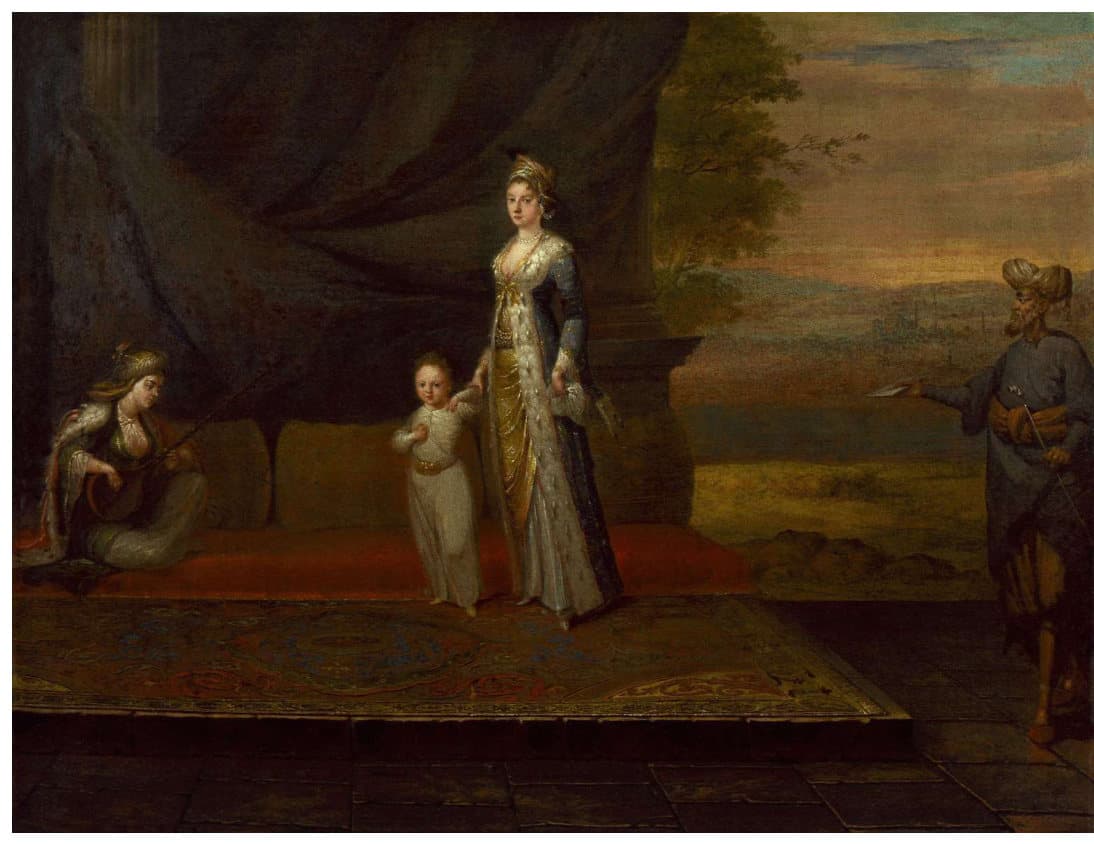
Picture 1 Lady Montagu and her son
in İstanbul
Picture 2 Edward Jenner
applies smallpox vaccine
out there; the findings then extended to other European nations. But this priceless import from the East, particularly Turkey, was unable to avoid the clergy's anathemas. The negative impact of claims like "making a remedy for a disease sent by God is against divine command" on the public's opinion of the vaccination was evident right away.
Although it is not known who first invented the smallpox vaccine in Türkiye and spread it to Europe, there are some historical rumors. According to one account, the vaccine was first applied by Anatolian Yuruks. A Yuruk (also known as Yorouk or Yörük), visiting İstanbul for business, observed a tremendous smallpox outbreak and told acquaintances, “This is a
harmless disease; in our homeland, no one dies from this disease. It exists in the udders of cows and is transmitted from there to the fingers of our shepherds. We take the smallpox from there and vaccinate our children every year, and they never get this disease again.” This statement drew attention, and some curious individuals tried it and found it beneficial. Lady Montagu explains this in detail in another one of her letters. According to another rumor, the first practitioners were Circassians, Abazins, or Georgians. As these nations were involved in the trade of slaves and concubines and needed their women to be free of any blemishes, they considered smallpox an enemy and discovered and applied the vaccine. However, this rumor is
Picture 3 Telkihhâne-i Şâhâne, a center for vaccine
production. Late 19th
century.
too weak to be considered because, until a century ago, smallpox vaccination was wellknown among the Yuruks in Anatolia, whereas there is no evidence of such a practice among the Circassians, Georgians, or Abazins.183
Historian Ahmed Cevdet Pasha's statement, “The subject of vaccination is included in medicine, and I learned from some elderly individuals that this matter existed in the Ottoman territories before it entered Europe. However, we do not know who the inventor is and when it was invented,” is also a document indicating that the vaccine is a genuine and pure Turkish product.
Towards the end of the 18th century, the English physician Jenner began experiments on this subject, and after twenty years of research, he
published his discoveries in the year 1798. The British government bestowed many gifts upon Jenner for discovering the vaccine obtained from cows, and Jenner's writings on this subject were translated into many languages, thus making the vaccine widely known. Jenner was rewarded with gifts and honors by numerous scientific institutions. The greatest advantage of this vaccine, which brought Jenner great fame, was firstly its easy and abundant production, and secondly, while there was one percent mortality from the smallpox vaccine, there was absolutely no mortality in this case.
In fact, America became aware of the vaccine applied in Türkiye before Jenner. In America, Cotton Mather, who engaged in religion,
preaching, science, and history in the city of Boston and treated patients despite not being a physician, was elected a member of the Royal Society of London in 1713 and regularly received the journal Transactions published by this society. Thus, in 1721, he read Lady Montagu's explanations and learned how the Turks treated smallpox. At that time, smallpox prevailed in Europe as well as in America and the city of Boston, causing significant deaths. Mather, who discovered the secret to combating this epidemic, was not a physician. Therefore, he avoided acting alone and reached an agreement with Dr. Zabdiel Boylston of Boston. When Dr. Boylston vaccinated his only thirteen-year-old son and two African American children, he achieved good results, and he wanted to apply this preventive measure to everyone. However, like Lady Montagu, he faced significant reactions. Nevertheless, a few years later, vaccination gained popularity in America, especially with the strong encouragement of Benjamin Franklin, and was widely used until the discovery of the smallpox vaccine in 1798.184
In summary, vaccination, initially a simple procedure practiced in our country, developed as it entered European medicine. Strangely, when the vaccine went from Türkiye to Europe, it faced vehement objections from the clergy. Similarly, upon its return to Türkiye after undergoing slight modifications, it encountered the same opposition.185 Indeed, in 1846, following a report prepared by the chief physician of the palace, Ismail Efendi, and discussions held in the highest state institution, the Meclis-i Vâlâ, it was deemed appropriate to expand the smallpox vaccination, initiated in İstanbul, to other provinces. In addition to the orders of the sultan, a fatwa stating that vaccination posed no religious objections was obtained from the Office of the
Chief Islamic Judge and sent to the provinces.186
Vaccination efforts against smallpox
There were rumors that vaccination efforts against smallpox were underway, with vaccination points prepared in Üsküdar and Eyüp in addition to Beyazıt for vaccinating children in İstanbul. It was also mentioned that doctors were assigned for this task in Bosphorus, and a fatwa was issued stating that there was no religious objection to getting vaccinated.
August 4, 1846
Esteemed Sir,
Upon the order of our sovereign, it was commanded to open vaccination points in Üsküdar and Eyüp, similar to the vaccination point in Beyazıt, to vaccinate children in İstanbul who have not yet shown signs of smallpox and have not been vaccinated. Locations have been
prepared at Ahmediye Madrasa in Üsküdar and a pharmacy in Eyüp for this purpose.
Additionally, suitable doctors will be appointed for the right and left sides of Bosphorus. It was conveyed in writing by the Palace Chief Physician (İsmail) Efendi that there is no religious objection to vaccination, and this information, along with the fact that the residents of İstanbul have already experienced its benefits, was to be publicly announced.
The received letter was referred to the Meclis-i Vâlâ187, and in the sealed memorandum prepared on this matter, it was stated that the permission for vaccination was granted by the Şeyhülislamlık (Office of the Chief Islamic Judge). It was also mentioned that the opening of these vaccination points and the appointment of doctors to the right and left sides of Bosphorus, as graciously decided by our sovereign, should be appropriately announced and publicized on special papers, considering the benefits previously experienced by the people of İstanbul. The memorandum and letter in question have been sent to you for review by our sovereign. If it meets with your approval, the necessary actions will be taken.
10 Sha'ban 1262 (August 4, 1846)
May it be presented,
His Excellency has been informed through this Sublime Memorandum and the aforementioned memorandum and letter. The opening of the designated locations, the appointment of doctors to the right and left sides of Bosphorus, and the announcement and publicity on special papers, as indicated in the report, have been deemed appropriate by our sovereign. It is the command of our sovereign that, as specified, the situation should be announced and publicized on special papers. The aforementioned memorandum and letter are returned to you once again.
12 Sha'ban 1262 (August 6, 1846)
İ.MVL, 79/1570
Source: Innovation, Inventions and Quests Among the Turks