
Transport & engineering
1720
The World’s First Submarine The Crocodile of Shipyard Architect İbrahim Efendi
In the true sense, designs for submarines began to take shape in the 15th century. Researchers such as Konrad Kyeser in 1465, Leonardo Da Vinci in 1500, William Bourne in 1578, Cornelius Van Drebbel in 1603, and Robert Fulton in 1797, along with the Ottoman shipyard architect İbrahim Efendi in 1720, dedicated their efforts to the development of submarine vessels. However, it wasn‘t until nearly the 19th century that the submarine remained an experimental device, progressing along a slow and arduous path.188
It is said that in 1620, Drebbel constructed the first submarine while working for the English Royal Navy. Drebbel reportedly even took King James on a test dive beneath the Thames in this submarine. However, despite these efforts, the submarine did not receive sufficient attention from the naval forces, and it is noted that Drebbel's creation was never used in warfare. In more recent accounts, it has been suggested that contemporary descriptions of the submarine may
have contained significant exaggerations. It is argued that the vessel, at best, was a partially submerged craft capable of navigating down the Thames River solely with the force of the current. During that era, partially or fully submerged ships were not groundbreaking innovations and were repeatedly featured in demonstrations, capturing attention each time.189
During the reign of Sultan Ahmed III (1703-1750) in the Ottoman Empire, there are accounts in both Hafiz Mehmed Efendi‘s surnâme and Vehbî’s surnâme that testify to the invention of the submarine, formerly known as tahtelbahir, by the shipyard architect İbrahim Efendi. These sources include firsthand information from witnesses of that era. Seyyid Vehbî, likening the submarine invented by the architect İbrahim Efendi to a crocodile, narrates in his surnâme an extraordinary event during the circumcision ceremony of Sultan Ahmed III‘s children.
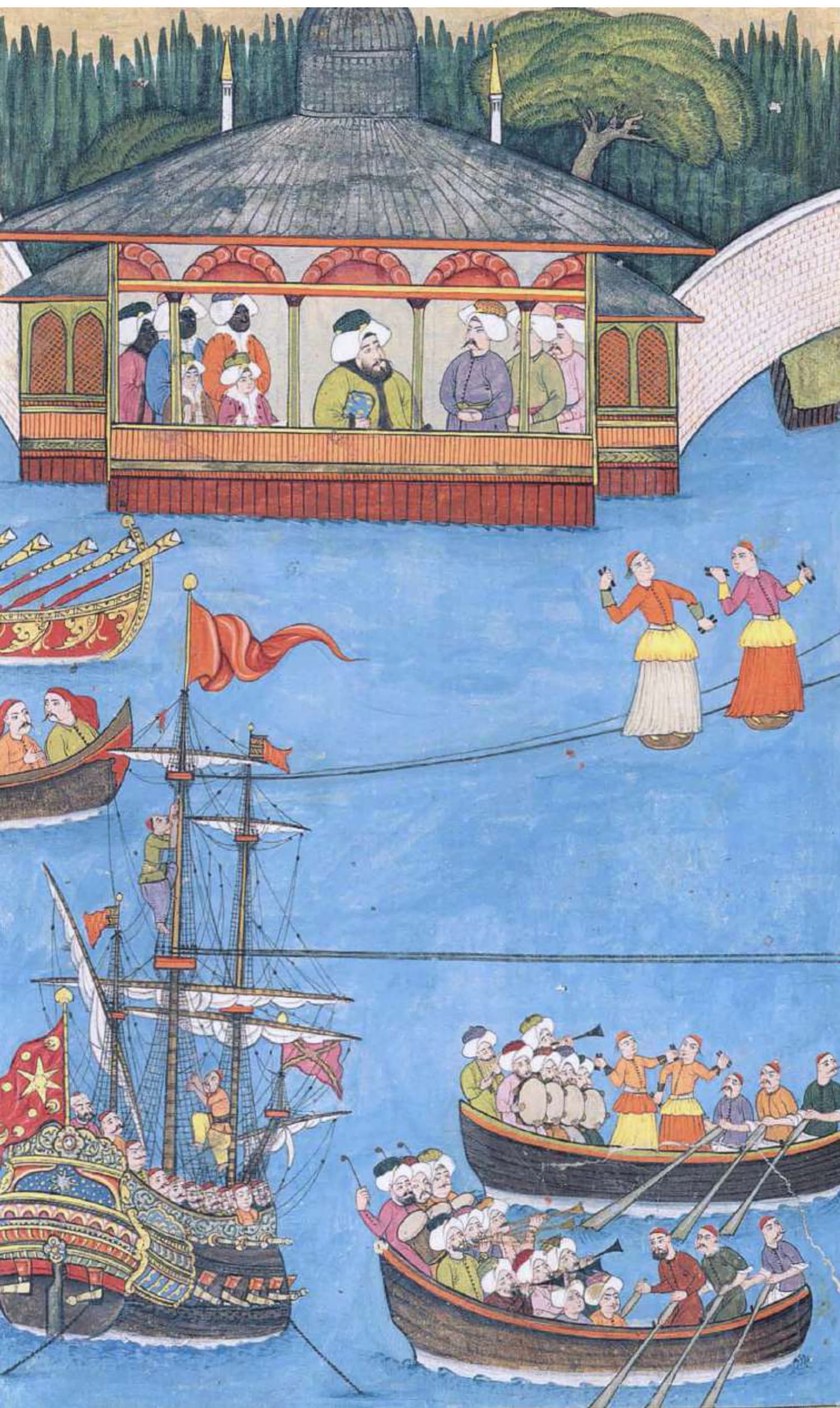
As the Sultan, viziers, and princes watched the
festivities from the coastal palace of Aynalı Kavak on the shores of the Golden Horn, the crocodilelike submarine emerged from the water. Slowly progressing towards the side where the Sultan was located, it stayed on the sea for about half an hour before diving back underwater. According to the accounts, five individuals, carrying trays of pilaf and sweet rice pudding, emerged from the mouth of the crocodile-shaped submarine, leaving the onlookers in awe. The submarine resurfaced an hour later.
Seyyid Vehbî’s work, Surnâmei Hümâyun, written during that period, not only describes the crocodile-like submarine but also provides technical details about its submersion and how the crew could breathe underwater using reed pipes. This work serves to demonstrate that the Turks successfully conducted early experiments with submarines. In the surnâme by Hafiz Mehmed Efendi, recounting the events of the circumcision ceremony of Sultan Ahmed III‘s princes on Tuesday, October 1, 1720, there is a description that reads, “… the invention of a fish of significant size, created by the shipyard, was displayed…”190
The mention of its invention is unprecedented, and the description of its size being comparable to a barge indicates that it was not a small creation by any means. Indeed, Vehbî uses the term ihtira (invention) for the submarine and describes its size as equivalent to “a boat propelled by three pairs of oars.”
While it is mentioned that the first submarine ship was used during the siege of Acre in 1150 against the Crusader knights in the Seljuk period, it is apparent that during the Ottoman era, the submarine built by the architect İbrahim in the reign of Sultan Ahmed III was more advanced, capable of remaining submerged for one hour. Considering that the Englishman Day died in 1774, half a century after the architect İbrahim Efendi, without ever surfacing again with the larger
Figure 1 On October 1, 1720,
during the circumcision ceremony of Sultan Ahmed
III’s princes, performances
were held in front of the shipyard. The Sultan was observing the displays from
within his tent. The submarine, shaped like a fish, as narrated by Vehbî in
the surnâme, was not depicted in the miniature
drawings by Levni in the
book.
submarine he had built after testing the small submarine he had built in 1774, it can be seen that the success of the Ottomans in this field is too great to be underestimated. However, in 1776, American David Bushnell successfully tested the submarine he developed. 191
According to Surnâme author Vehbî, this is what happened on the morning of October 1, 1720:
“An early morning, when His Majesty the Sultan arrived at the seaside pavilions adorned with ornamental decorations in the (initially referred as) Tersane Bahçesi (today’s Aynalıkavak Pavilion) and took his seat, and the Grand Vizier was present in the tents set up in the shipyard, captivating performances with instruments and songs were taking place all around. Skillful individuals were showcasing brand-new plays and amusements here and there, creating a spectacle of wonder and entertainment.
One of the peculiar things witnessed today was the fabricated crocodile, the personal invention of the old architect İbrahim Efendi, entangled in the web of his imagination and thoughts. This artificial crocodile, adorned with a printed Yemeni fabric that closely resembled fish scales, had a width and length equivalent to three pairs of infantry (a type of boat propelled by three pairs of oars). At times, as it moved its upper jaw, even those who knew what it was and how it came to be would be left wondering, ‘Could it be a real crocodile?’
It emerged from the depths of the sea, swimming slowly until it reached the shore where the Sultan and the Grand Vizier were located. After swimming for about half an hour, captivating onlookers and leaving them in sheer amazement, it suddenly submerged into the sea, disappearing in a manner that would make one exclaim, ‘the fish sank.’
The Grand Vizier, not deeming the invention of the mentioned architect worthy of examination,
preferred to divert his appreciative gaze to the dancers. They, in turn, joined hands and synchronized their steps, beginning to dance joyfully. Their performance was such that it seemed as if they were attempting to salvage the awkward situation to some extent.
After this situation persisted for about an hour, the mentioned fish reappeared in front of the Sultan, suddenly moving its upper jaw and displaying a truly astonishing nature. It anchored near the seaside like a boat; from its mouth, five peculiarly dressed, joy-spreading individuals emerged, and from its belly, a furnace appeared, emitting heat and flames. As it turns out, he had tightly fastened his fabric, which he fashioned in the shape of a fish, underneath a makeshift boat using rigging, placing support in the middle of the fabric to create a tent-like structure. He had also prepared pulley devices connected with bellows to immerse it in water when needed and bring it back to the sea surface when necessary. At first sight, he had busied himself with making the necessary preparations, and later, he had observed the time to showcase his skills underwater.
They had skillfully attached five or ten reed pieces inside the covers, which covered it, with the inner side caulked to allow air entry through holes. It was as if they had turned them into eyelashes and eyelids, slightly above the water.
They worked inside, as if they had boiled pots in the sea and cooked rice and sweet rice pudding. Taking table by table onto their heads and shoulders, they emerged one by one from the mouth of the fish, captivating the minds of the spectators who delved into the sea of thoughts to grasp the essence of this spectacle.When they displayed their skills and showed that they were divers in the sea of imagination, the open-handed Grand Vizier extended his hand, waving it with waves of generosity, and overwhelmed each of them with unrestrained kindness, folding it in
waves of benevolence.
While this peculiar affair bewildered the public and left the minds of onlookers in awe from the moon to the fish, Sultan turned towards the Tersane Sarayı (today’s Aynalıkavak Pavilion), departing from their places. They left their highly esteemed Grand Vizier as a representative to
oversee the affairs in the wedding venue.”192
Source: Innovation, Inventions and Quests Among the Turks