

Culture & communication
1808
Charter of Alliance The first attempt in the Ottomans to limit the powers of the sultan
In the Ottoman Empire, the local authorities, who had been the liaison between the state and the people since the second half of the 16th century and who were known by names such as the âyan205 and the eşraf, took advantage of the state's troubles and expanded their power and influence in their regions to the detriment of the central authority, and powerful families and dynasties emerged in Anatolia and Rumelia in the 18th century. Unable to establish its authority in the provinces, the state was forced to accept the existence of these powers, and the struggles of the ayan among themselves and with the state disrupted the social structure and balance.
The Grand Vizier Alemdar Mustafa Pasha, who had come to the conclusion that the government and the ayan should meet in order to establish order in the country, invited them to İstanbul. As a result of the negotiations, an unprecedented text called Senedi İttifak (Charter of Alliance) was drafted between some of the ayan and the central bureaucrats (October 7, 1808). The Charter of Alliance, signed by prominent figures of the
bureaucracy including Capanoglu Süleyman Bey, İsmâil Bey of Siroz, Karaosmanoǧlu Ömer Aǧa, and Mustafa Bey, the governor of Çirmen, was submitted to the Sultan for approval. Finding the terms of the treaty burdensome, Sultan Mahmud II deliberated on the matter. Following the advice of the Chief Steward Eǧriburun Ömer Aǧa, who suggested approving the treaty first and then later abolishing it, Sultan Mahmud II confirmed it with an imperial decree. After the signing of the charter, the ayan left the city.
The Charter of Alliance, written through the words of those who attended the meeting, consists of an introduction, seven articles (conditions), and a conclusion. In the introduction, it is emphasized that during periods when the state was strong, unity and solidarity prevailed. However, it is noted that in recent times, the order has been disrupted, and there has been ongoing conflict between the central bureaucracy and the ayan. It is highlighted that this internal and external struggle has undermined the influence of the state. In response to these challenges, the parties have come together
to make efforts for the revival of religion and the state. The first article states that the person and the reign of the Sultan are the essence of the state and are under the commitment and guarantee of those who sign the treaty.206
The Charter of Alliance became worthless only five weeks after its signing due to the assassination of Alemdar Mustafa Pasha. The ayan, lacking solidarity among themselves, quickly disintegrated after Alemdar's death, allowing the central government to easily dissolve their influence by taking action against the ayan. In addition, the absence of a mechanism to oversee the implementation of the provisions in the Charter of Alliance and whether the promises made were kept was not naturally foreseen. This lack of oversight mechanism rendered the treaty a “stillborn document” from the very beginning.
Apart from the methods used to limit the powers of the sultan-presidents in Turkish legal history, which were often ineffective, the Charter of Alliance is the first legal document to guarantee this limitation in a text and with mutual commitments. Mahmud II found himself compelled to negotiate with the ayan due to extraordinary political developments and upheavals that led to his ascent to the throne. Consequently, the Charter of Alliance, which remained in effect for a very short time and never gained vital importance, was abolished by the Sultan and took its place in our legal history. However, the Charter of Alliance is seen as an important step toward the “Rule of Law,” as it involved efforts to limit the Sultan's absolute powers.207
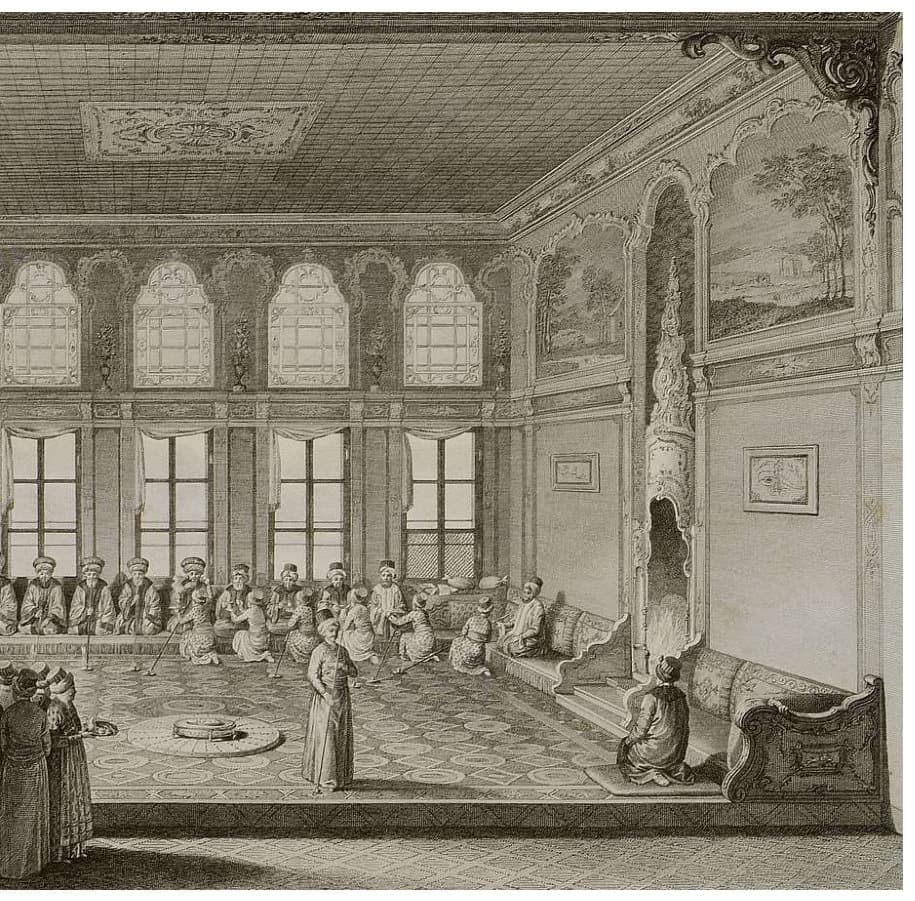
Charter of Alliance, the alliance treaty concluded between the rulers and local dynasties of the provinces in order to save the Ottoman State from the danger of collapse.
Figure 1 Ignatius
Mouradgea d’Ohsson, estate of
a pasha.
An alliance treaty of seven articles was established between the rulers of the state and the dynasties of the provinces due to various disagreements leading to the breakdown of the Ottoman State order and the imminent threat of collapse. The purpose of this treaty was to address the following issues: Protection of the person of the Sultan and
the state against betrayal by state administrators and military institutions, especially by the dynasties of the provinces that signed this treaty.
Implementation of military regulations to preserve the existence and strengthen the power of the Ottoman State, with joint action against those who oppose these regulations. Protection of the State Treasury and revenues for the state's strength, ensuring the collection of revenues. Issuance of all orders and decrees exclusively from the Sadrazam's office, preventing interference in each other's affairs, and preventing actions harmful to the state and corruption by the Sadrazam's office. Establishment of mutual trust among state administrators, dynasties, ayan, and leaders in the provinces under the rule of the dynasties, and mutual protection against unwarranted threats and dangers. Immediate arrival in İstanbul of all dynasties to ensure the peace of İstanbul in case of unrest and mischief among military institutions and other parties. Protection and care for the poor and the people, and the establishment of justice in financial obligations. This alliance aimed to counter the threats to the Ottoman State's stability and unity arising from internal conflicts and provide a framework for collaboration and mutual support among the ruling entities.
October 211, 1808
By the Name of Allah, the Most Merciful and Most Compassionate
A Copy of the Decree (Imperial Edict) Personally Written by the Sultan
(While beginning to recite this Quranic verse, I seek refuge with Allah from Satan): “Even if you were to spend all that is on the earth, you could not have brought their hearts
together; but Allah has conciliated them.”208
As expressed in this verse from the Quran, the preservation of the religion, the Ottoman State, and the Islamic land is dependent on the unity and harmony of the state’s leaders and administrators and their agreement and understanding. With the help of Almighty Allah, the realization of this purpose is contingent upon the perpetual fulfillment and implementation of these blessed and sacred treaties and agreements. For this reason, since I, as the Sultan, personally undertake that the mutual promises and conditions written in this Charter of Alliance will be implemented and fulfilled to the letter by the grace of Allah, and by following this command of Allah Almighty (I seek refuge in Allah from Satan as I begin to recite this Qur’anic verse): “When they make a covenant, they fulfill their covenants and agreements.”209 My Grand Vizier, Sheikh-ulIslâm, the viziers, ulama, and administrators of my state, and the dynasty of the Ottoman country follow the commandments of these treaties and agreements and make them lawful outside and inside the country, and may they exert all their strength and efforts to fulfill them to the letter for the sake of Allah. Anyone who acts contrary to this, even in the slightest, and God forbid, dares to break this treaty shall be deemed deserving of the curse of Allah. May they face difficulties, dangers, punishment, and torment in both worlds.
All praise and thanks are due to Allah, who strengthens Islam with men who form a single body in unity and solidarity. Blessings and peace be upon our lord Muhammad, who removes division and discord from his ummah, and upon his family (âl) and companions (ashâb), who, in humble unity, work and strive on the path of Allah. After this introduction, the reason for the
writing of this blessed and sacred document is as follows:
There is no need to explain that the glorious Ottoman State, which is the benefactor of all, is the Sultanate of the Prophet Muhammad, and that the conquest, victory, glory, and splendor it has enjoyed from its first emergence with the help of Allah (swt210) to the present day have been realized by being united in work and thought and by eliminating hatred, selfishness, and disagreement. However, due to the inevitability of the world’s turning wheel, the chain holding the robe of the order [of the book] has been unraveling for some time. The strength of the Ottoman State began to fracture due to animosity, selfishness, and disagreements among state administrators and the dynasties of the provinces. As a result, the state’s power has been divided, and its influence, both internally and externally, has been shaken, leading to adverse consequences gradually. This situation has caused harm and weakness to all, including the rich, the poor, the upper class, the lower class, and essentially the entire Islamic nation. Unjustly occurring known atrocities have brought the foundation of the state to the point of collapse. This matter is acknowledged by everyone, whether small or great. In accordance with the verse of the Quran: (I begin reading this verse in the name of Allah:) “So take heed, O people of insight.”211 It is understood that learning from past experiences, reviving the pillars upon which religion and the state are founded, and elevating the word of Allah (i’lâi kelimetullahi’lulya) with the noble intention of transforming this disarray into unity and thus consolidating the power of the Ottoman State is a duty of piety and loyalty. Recognizing this responsibility, many meetings have been held, and collectively, in unity and solidarity, we have
discussed and determined through consultation the ways to exert every effort to preserve the religion and the state and to elevate the existing strength of the state to its highest level. Therefore, documenting the terms of this alliance, we bind ourselves to the conditions of this treaty as outlined below:
First Clause: Since our Sultan, the owner of kindness, mercy, majesty, and might, and the benefactor of the world, is the center of this eternal state, we have all made a pledge to glorify and consolidate His Majesty and the glory of His sublime reign, relying on the grace and bestowal of Allah, the Lord of the Worlds, and with the help of the spirituality of His Messenger. If at any time there emerges, from among the viziers, scholars, statesmen, dynasties, and the existing military institutions, any verbal or actual betrayal, in secret or openly, contrary to the orders and approval of the [Sultan], after the truth is investigated, those who dare will be punished and set as an example; on this matter, we will all work together both domestically and internationally. Efforts will be made to punish those who show laxity in this regard. If anyone refuses to enter the circle of this alliance, we will all prosecute against them. Through both words and actions, everyone will be compelled to adhere to the condition of unity and to enter into this circle. As a result, we all collectively pledged and pledged with our property and our bodies to the protection of our glorious Sultan and his property, his supreme sultanate, his orders, and his consent, and to the protection of his property from treachery and mischief. As long as we ourselves are alive, we ourselves, and if we are not alive, our children and dynasties will continue this surety. In this way, since it is evident that His Majesty the Sultan will show kindness and attention to everyone, efforts will be
consistently made to be worthy of this by fulfilling the requirements of goodwill and servitude.
Second Clause: Since the continuation of the existence of the Ottoman Empire and the increase of its power and majesty is the means for the continuation of the existence of all of us as individuals and dynasties, therefore, as it was decided as a result of the negotiations held among us, we will work and strive to ensure that the soldiers who are planned to be enlisted from the Ottoman country in order to increase the strength of the sultanate are enlisted and completed as state soldiers in accordance with the order given in the negotiation assemblies and that they will continue their existence in perpetuity; all state dignitaries, employees and dynasties, both inside and outside the country, will be diligent in their organization and arrangement. Since a unanimous decision has been made regarding this arrangement for the survival of religion and the state through military service, if anyone, along with those inclined towards corruption and envy, shows consent to change it at some point, and if objections and opposition arise from the existing military institutions, we will all collectively prosecute and condemn such attempts. Not only will we refrain from daring to eliminate or alter this order, but we will also consider anyone speaking on this matter as a traitor. Together, we will make efforts to punish and remove them, and none among us will engage in opposition in this regard. Whenever an enemy of the Ottoman Empire, from whatever side, appears, it is the essence of the order to make every effort to go quickly to counter and to eliminate it, so that no action contrary to this procedure will occur at any time.
Third Clause: The steadfast and strong existence of the Sultanate is our foremost desire, and since
we have pledged to make collective efforts in this regard, we are committed to increasing the strength of the state by expanding the military. Additionally, we have pledged to safeguard both the State Treasury and the revenues of the Ottoman Empire. We commit to the collection and payment of these revenues, protecting them from embezzlement and loss, and ensuring the implementation of the orders and decrees of the Sultan. Anyone who opposes and disobeys these orders will be collectively punished, as we have committed and guaranteed adherence to this procedure.
Fourth Clause: As it has been the established order and law of the Ottoman State since ancient times, all the commands and prohibitions of the Sultan are conveyed domestically and internationally to all leading figures and administrators through the office of the Grand Vizier (the seat of absolute representation). Henceforth, everyone shall be mindful of their boundaries and refrain from trespassing into matters beyond their duties. All commands and prohibitions will emanate from the office of the Grand Vizier, and these directives will be recognized as the Sultan’s commands and laws. No one shall muster the courage to defy or oppose them. We all pledged that whoever encroaches on someone else’s duties other than his or her own, we would all prosecute him or her, and that he or she would be dismissed from his or her position on the grounds that “so-and-so interfered in such and such a way when such and such work was soand-so person’s duty,” and that all such encroachments would be completely eliminated, and that all work would be submitted to the Grand Vizier’s office for approval and be in line with the Grand Vizier’s orders and opinions. In addition to this, if the office of the Grand Vizier starts to
engage in bribery, corruption, and other kinds of evil deeds, both in the provincial and internal affairs which are contrary to the law and that will damage the Ottoman Empire at the time and in the future, we will all prosecute, and we will all try to prevent it together. If the Grand Vizier (absolute deputy), out of personal interest and animosity, throws false accusations on someone for what he or she has said, it has been pledged by all of us to prevent this and safeguard that individual. Therefore, these commitments will always be respected by us.
Fifth Clause: As we are all committed to the preservation of the sultan himself, the power of the sultanate, and the order of the state, it is the greatest condition that the households and dignitaries of the countries have confidence in the Ottoman State and that the statesmen and dignitaries within the country have confidence in each other, and since this confidence and trust depends on the unity and solidarity of everyone and their confidence in each other, both the dynasties and the ayan, as well as the state administrators, men, and dignitaries, who are within the circle of this alliance, will also respect each other’s person and dynasty. That is to say, without any act contrary to the terms of this union, if any aggression, treachery, or assassination occurs against one of the dynasties by the Ottoman State or by the viziers in the provinces or by one of these dynasties, neither far nor near will be considered, but we will all prosecute, and we will all endeavor together to punish and eliminate the one who dared to do so. While they are alive, all state administrators pledge and guarantee the security and preservation of themselves and their dynasties, both during their lifetimes and after their deaths. These dynasties, in turn, pledge and take
responsibility for the ayan and notables under their rule, ensuring their safety. They commit not to assassinate or harm these ayan and notables for reasons such as greed or personal animosity. If any of these ayan or notables commit a crime or betrayal that goes against the pledge and the consent of the sovereign (the Sultan), the dynasty will investigate the truth of the matter. After obtaining approval from the office of the Grand Vizier, the guilty party will be expelled and removed. The dynasty will replace them with another individual. No one will trespass beyond the boundaries of the places assigned to them; they will not encroach upon an inch of land beyond their designated limits. If anyone violates this rule, everyone, without exception, will prosecute and prevent the encroachment. If the
offender does not come to their senses, collective efforts will be made to rectify the situation and impose punishment on the one causing the separation. All ayan, dynasties, and notables of the regions will unite as one body and collectively strive to prevent rebellion and separation. If anyone oppresses and acts unjustly towards the poor and opposes the implementation of the Sharia, collective efforts will be made to punish and reform them. Just as all dynasties and notables pledge in this manner, state administrators, their officials, employees, and even the scholars (ulema) are guaranteed in the same way. No one will be punished out of personal animosity or vengeance without proper evidence of a crime that incites disturbance, conspiracy,
betrayal, or assassination. All dynasties and leaders, on behalf of themselves and their
dynasties, pledge and guarantee that no action contrary to this commitment will ever be taken. The prevention of any crime requiring punishment and the enforcement of justice will be a shared responsibility among all parties. If there is an offense committed by any of them, it will be punished according to the severity of the crime by the office of the Grand Vizier after the guilt has been proven by everyone.
Sixth Clause: If any strife or discord arises from military barracks or other places in İstanbul without obtaining approval, all dynasties will rush to İstanbul. Those who dare to cause such strife and turmoil, and the party or individual responsible for the strife and turmoil, will be identified. If it is a party, similar to the dissolution of the soldiers of the Bosphorus Castle who caused the strife, they will be punished, and their livelihoods and salaries will be revoked. If it is an individual, regardless of their social status, they will be investigated, and if found guilty, they will be executed. All the dynasties and leaders of the regions pledge to ensure the security and order of all of İstanbul, and they commit to making continuous collective efforts to maintain this strong connection, regardless of the circumstances.
Seventh Clause: The protection and care of the poor and the public are essential. Based on this principle, it is crucial for dynasties and leaders to pay attention to the orderliness of the districts under their administration and ensure that the financial obligations of the poor and the public are within normal limits. Therefore, in the discussions between state administrators and the dynasties of the nations regarding the elimination of injustices and the fair adjustment of financial obligations, a decision should be made on how to implement this decision continuously and consistently. Care should be taken to prevent oppression and injustice from occurring contrary to this decision, and each dynasty should oversee the situation of the other. If anyone acts in violation of the orders and consent of the sovereign and against the
Sharia, it will be reported—without malicious intent—to the Ottoman State, and collective efforts should be made to prevent it.
The decisions regarding these seven clauses were reached through negotiation, and an oath was sworn to Allah and His Messenger not to act contrary to them. “Henceforth, whoever hears it (the testament) and then alters it, surely the sin is upon them. Indeed, Allah is All-Hearing, AllKnowing.”212
This document was written between the eleventh and the twentieth of the month of Sha’ban of the year one thousand two hundred and twenty-three, according to the date of the Hijrah of the one to whom honor and glory belong (Hadrat Muhammad).
The conditions contained in this esteemed document form the foundation for the most important task, the strengthening and sustenance of the sublime religion and the Ottoman State with the help of Almighty Allah. Due to the necessity of maintaining these principles as fundamental and referring to them continuously, it is imperative that they be kept in force as legal provisions. To ensure that these conditions remain unaltered and immutable over time and with changes in individuals, upon assuming the positions of Grand Vizier and Sheikh-ul-Islâm, those who will succeed to these positions in the future should seal and sign this document when they are first appointed and assume their offices. In the event of a change in duties, to prevent any delay in sealing this document due to the engagements of these offices, as soon as there is any change in either of these positions, Dîvân-ı Hümâyun Beylikçisi (Chief Principal of the Imperial Council) at that time should take the original of this document from the archives and remind the current Secretary to the Grand Vizier and the Head Clerk (Reis ülKüttab) to have it sealed and signed by the person transitioning to the position of Grand Vizier or Sheikh-ul-Islâm.
For this purpose, this regulation shall also be
recorded in the Dîvân-ı Hümâyun (Imperial Council Office) and maintained as a legal provision. A copy of this document should be kept in the Imperial Council’s archives, and a duplicate shall be preserved in the presence of His Majesty the Sultan, and its implementation shall be personally overseen by our gracious Sultan at all times.
Undertakes the matters contained in this deed
Mustafa
Grand Vizier (Seal)
Undertakes what is written in this deed
Abdurrahman
Vizier, Governor of Anatolia
(Seal)
Undertakes to perform what is written in this deed
Mehmed Salihzade Ahmed Esad “May Allah forgive them both.”
(Seal)
Undertakes what is written in this deed
Mehmed Derviş
Military Judge (Qadi Asker) of Rumelia
(Seal)
Undertakes to perform what is written in this deed
esSeyyid Abdullah Ramiz
Chief Admiral
(Seal)
Undertakes to perform what is written
in this deed
Dürrizade esSeyyid Abdullah
Chief of the prophet‘s descendants
(Seal)
I have seen, examined, approved and committed to the contents of this document.
Written by a prayer of the Ottoman Empire and was honored with the rank of the Rumelian Military Judge.
Emin Paşazade Mehmed Emin
(Seal)
Undertakes what is written in this document
Hafiz Ahmed Kâmilî
Military Judge (Qadi Asker) of Anatolia
(Seal)
Undertakes what is written in this document
Mehmed Tahir
Judge (Qadi) of İstanbul
(Seal)
I am one of those who made a commitment
Mustafa Refik
Chamberlain of Grand Vizierate
(Seal)
I am one of those who made a commitment
Mustafa
Chief of the Janissaries of the Dergâhı Âlî
(Seal)
I am one of those who made a commitment
Mehmed Emin Behic
Treasurer
(Seal)
I am one of those who made a commitment
esSeyyid Ali
Minister of Navy
(Seal)
I am one of those who made a commitment
Süleyman Cebbarzâde
(Seal)
I am one of those who made a commitment
Ahmed
The person who holds the title of Chief Accountant
(Seal)
I am one of those who made a commitment
Hüseyin Hüsnü
Chief Clerk of Imperial Council
(Seal)
I am one of those who made a
commitment
esSeyyid Mehmed Said Galib
Head Clerk
(Seal)
I am one of those who made a commitment
esSeyyid Mehmed Tahsin
Dergâhı Alî Sergeants Chief
(Seal)
I am one of those who made a commitment
İsmail Sirozî
(Seal)
I am one of those who made a commitment
Mehmed
Chief of the Sipâhis of Dergâhı Âlî
(Seal)
I am one of those who made a commitment
Mustafa
Governor of Çirmen
(Seal)
I am one of those who made a commitment
Mustafa Reşid
Former Rikâbı Humayun Chamberlain
(Seal)
I am one of those who made a commitment
Mehmed Emin
Chief Bookkeeper
(Seal)
I am one of those who made a commitment
elHâc Ömer Kara Osmanzâde
(Seal)
I am one of those who made a commitment
Mehmed İzzet
Head Clerk of the Imperial Council
(Râqimulhuruf) who wrote this deed213
(Seal)
A copy of the Charter of Alliance, which is a verbatim copy of the sealed and signed original.
Mehmed İzzet
Head Clerk of the Imperial Council
(Seal)
“Indeed, might and glory belong to Allah.”214
HAT, 74G/35242
Source: Innovation, Inventions and Quests Among the Turks