

Transport & engineering
1830
Transition from sailing to steamships
Our first mechanized ship: Buğ
The arrival of the first steamship to our country occurred approximately 21 years after its voyage in America and only nine years after successful trials in Europe. Steam engines, which emerged in the second half of the 18th century, were initially used in coal mines, followed by applications in mills and factories. The use of steam engines on ships, however, dates back to the early 19th century.
The first successful steamship trial took place in America. Following this initiative, the main development in steam navigation occurred with the invention of the screw propeller in 1837 and its immediate adoption for use in ships. Until that time, steamships were mostly equipped with side paddles. The screw propeller technique, implemented by the Swedish engineer Ericsson in 1837, was located at the stern of ships, within the water; it significantly increased the speed of vessels compared to side paddle steamers. The Ottomans started to acquire steamships from the second quarter of the 19th century onwards and used them, along with sailing ships, effectively in their navy and trade. The first steamship acquired
by the Ottomans was the Swift, owned by the British merchant Black, purchased in İzmir and brought to İstanbul in 1828. A year later, another vessel named Hylton Joliffe was also purchased from England and added to the Ottoman fleet. Of the two steamships, the Swift had lower engine power and was referred to as Sagir, while the Hylton Joliffe was called Kebir. In addition to these names, the Ottomans also referred to both steamships as buǧ from the beginning, due to the steam/smoke emitted from their boilers. The Ottomans continued to use these two steamships until 1837.
From the purchase of the vessel Swift in 1828 until 1837, there were no initiatives to build any steamships observed during this period in the Ottomans. In 1837, the decision was made to construct steamboats at the Imperial Shipyard (Tersâne-i Âmire), while the engines and boilers would be sourced from England. In the subsequent period until 1853, a total of 13 steamboats were built, with 11 at the Tersâne-i Âmire, 1 at the Small Iron Factory (Küçük Demir
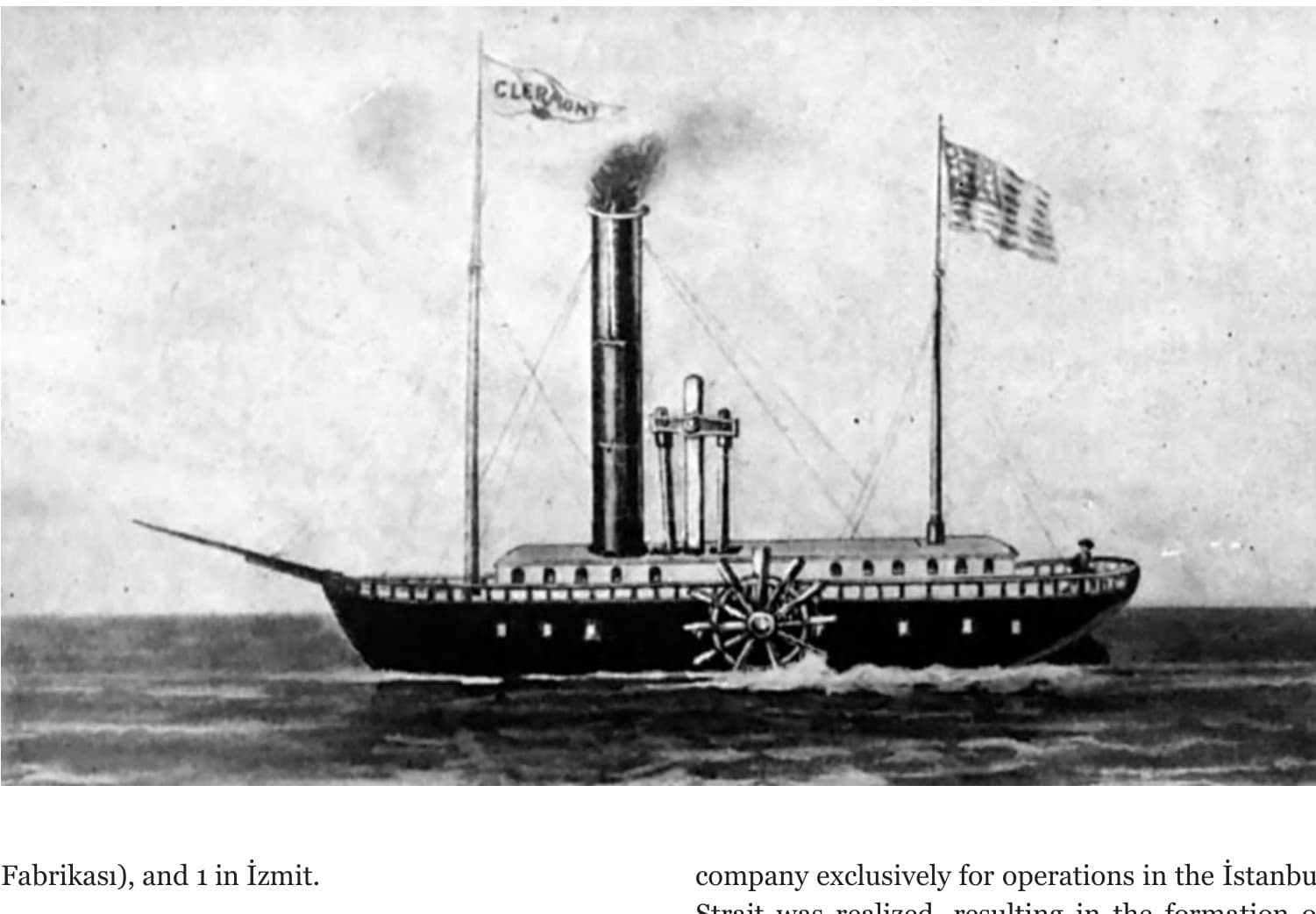
Figure 1 The Clermont is the
first steam-powered passenger ship, designed by
American engineer Robert Fulton and constructed by
Charles Brown. Launched into service in 1807, the ship
made its inaugural journey
between New York and
Albany.
Fabrikası), and 1 in İzmit.
Between 1845 and 1847, the construction of warships continued at the Imperial Shipyard. These were steamships with wooden hulls designed specifically for military purposes. The following year, in 1848, a milestone was achieved in Ottoman maritime and technological history with the construction of a steamship entirely made of iron—a first in the Ottoman Empire. However, it‘s noteworthy that this iron-hulled vessel was built not at the Imperial Shipyard but at the Küçük Demir Fabrikası. Due to its construction material, the ship was aptly named Eseri Hadid (Iron Artifact).
In 1850, four warships were ordered from England, and these steamships, later named Cidde, Basra, Şat, and Tuna, were delivered in 1852. Additionally, orders for commercial ships continued to be placed with England on behalf of the Imperial Treasury Steamship Company (Hazîne-i Hâssa Vapur Kumpanyası).
Furthermore, the idea of establishing a steamship
company exclusively for operations in the İstanbul Strait was realized, resulting in the formation of Şirket-i Hayriye. Founded in 1851 with entirely local capital, the company placed orders for steamships from England starting in 1851 and acquired nine vessels by 1854.217
The thoughts and evaluations of the American warshipbuilding expert Henry Eckford on building warships for the Ottoman Empire
American naval architect Henry Eckford, an expert in the construction of warships; During his meetings with the harbor master and Serasker Pasha, he was asked to stay in İstanbul and build ships, and he stayed here; there were many
developments in the field of warship construction; and in order to realize the Ottoman Empire‘s wish in this regard, architects should be trained from the young people of this city, whom he observed to be very talented. First of all, the shipbuilding architect should know the science of weight lifting;
he could build ships of various sizes, such as the ship he brought with him to İstanbul as a sample, and if requested by the Ottoman Empire, he could return to America immediately and build a ship within six months. It was enough for him to select some of the talented young architects from the Tersâne-i Âmire and take them to America to be employed in the construction of this ship, which would enable them to learn shipbuilding methods and the American language, and which he would bring back with him on his return, that he would start a new era in shipbuilding here with eighty people and the Muslim architects he took with him, that this work could only be accomplished with young people, that it was useless to try to change the methods of old people, and that in terms of the consequences, he risked breaking his promise to the Ottoman Empire and losing his reputation in the field of architecture, The ships he will build are suitable for both the Mediterranean and the Black Sea and will be very useful as they will serve as mobile bastions in the straits, a large area completely separate from the Shipyard should be allocated for this work, he is building ships for the governments of Brazil and Colombia in America, Chargé d‘Affaires David Porter can testify to him on this matter, the reason for coming to İstanbul is not to sell the ship he brought with him, because Rayndo, who had already been commissioned to make a treaty between the Ottoman Empire and America, had shown him an article in the said treaty and was told by the Chief Clerkship that the Ottoman Empire was ready to have a ship built, Therefore, his request was limited to the compensation of this ship, and upon the submission of this request to the Sultan, the Sultan‘s imperial decree, stating that “without delay, the Captain Pasha, who was out of İstanbul with the navy, should write a letter for him to come to İstanbul by land to negotiate
with the person in question on this matter.”
June 1830
The translation of the petition submitted by the American naval architect Henry Eckford to His Excellency the Chief Clerk in İstanbul.
It has been seen and examined
The issues mentioned in the petition by the aforementioned architect are considered plausible, feasible, and likely to yield favorable results concerning our Imperial Arsenal. Therefore, without any delay, as described in the letter marked in red, in order to make a decision, you are instructed to write and send a letter to the Captain Pasha on your behalf, instructing him to “hand over our Navy to our Fleet Admiral” and to come immediately by land.
This is the translation of the petition submitted by the architect who arrived from America, this time regarding ship construction. In summary, it is understood that if employed by the Ottoman State, he will demonstrate his skill and art, and the things he has written appear feasible and plausible. However, the implementation of this depends on your servant, the Captain Pasha, being in İstanbul and thoroughly discussing and conversing with the aforementioned. Your servant, the Captain Pasha, has come with your permission along with your Navy to the Bosphorus and is waiting for favorable weather conditions. However, it has been revealed that there will be a slight delay due to the prolongation of the northerly wind. Therefore, if deemed appropriate and ordered by our esteemed Sultan, I, your servant, will write a letter to him, instructing him to “discuss the matter of ship construction with the aforementioned and to come immediately by land to be present at your Arsenal and attend to the other affairs of the Imperial Arsenal, handing
over your Navy to the Captain of your Fleet.” When the situation is known to your lordship, the command and decree belong to you.
When I met with the port captain five weeks ago, he asked, “Would you stay in İstanbul and build a warship of every kind for the Ottoman State?” When summoned to the presence of the esteemed Serasker Pasha, he also asked me, “Would you stay in İstanbul for about three months?” Despite my reluctance to stay here for an extended period away from my homeland, I had accepted. A few days ago, when I arrived in his presence, he expressed that “Captain Pasha would come to İstanbul in a short time” and requested I provide a written explanation of my opinions and assessments regarding ship construction. Therefore, I deemed it appropriate to present the essence of my detailed statements, opinions, and evaluations to Your Sublime Highness. As follows:
There is no doubt that the foremost desire of the Ottoman State is to establish a shipbuilding method comparable to the practices of states renowned for their naval power. To fulfill this desire, it is necessary to train skillful architects among the youth of this region. These young architects should have opportunities to learn about the new developments and methods in shipbuilding science (engineering) that have emerged in the past twenty-five years. Additionally, they should acquire the knowledge of cutting timber from mountains and forests.
The most significant development in the science of warship construction is the mastery of an architect in the science of lifting weights (ilmi cerri eskal). Although it is possible to draw beautiful shapes and designs on paper with the knowledge of architecture alone, without the assistance of the science of weight lifting, a ship, while appearing to be well constructed, would continuously incur expenses for the state, and genuine benefits would
not be expected from it.
The construction of warships is a significant undertaking, and it is especially challenging because of the difficulty in expressing my statements. Nevertheless, I am confident that by undertaking this endeavor in accordance with the general principles and style in this field, positive results can be achieved. Therefore, in this manner, I am prepared to build ships capable of carrying at least one hundred guns for ships of the line, sixtyfour guns for frigates, and large-caliber cannon for steamships. All the nails for these ships will be made of copper, just like the ship I brought to İstanbul. If the Ottoman Empire approves of this style, I can return to America immediately and build a ship that can draw sixty-four pieces of guns while I get my affairs in order there. As I have the timber ready, I can complete this ship within six months.
I also think that selecting fifteen or twenty of the young architects currently employed at the Imperial Arsenal and taking them to America with me, preferably those who are eighteen or twenty years old and have some degree of familiarity with the construction of various ships, would be a good opportunity for them to learn many of our methods during the construction of the sixty-four pieces of gunboats I will build there as described above. Since they will also learn our language in the meantime, they will be very useful to me when they return to this side.
Another matter is that I would like to bring with me, from that side, seventy to eighty individuals knowledgeable in the science of construction. In this way, I believe that, with the help of both these individuals and the young Muslim architects mentioned above, we could make a significant breakthrough in the construction of a warship within three years. By transporting the timber of a piece of cover ship using the aforementioned sixty-
four-gun ship, I can start the construction of the said cover ship as soon as I return. Otherwise, [its construction] would take time.
Based on my observations since I came to this land, I have full confidence that the young people in this country possess great talent (merit). Therefore, in a short time, I believe I can train them to be able to build various types of ships equivalent to, and perhaps in some respects better than, the ships of any other state. Trying to change the old methods that the elderly have become accustomed to would be futile. If I cannot achieve results, I will fail to fulfill the desires of the Ottoman State and lose my reputation in the field of architecture. Only through the means of young individuals can success be achieved in this matter. Because I employ them in my own way.
As for the elderly, perhaps after some time and upon seeing the benefits of my method, they may conform to my approach.
It is necessary to allocate a large area for shipbuilding, completely separate from the Arsenal, and to give me permission to use the timber that is not urgently needed in the Arsenal here until the timber is cut from the groves.
These are my general thoughts and evaluations about this important work. I cannot serve the Ottoman Empire well in any other way.
For the last twenty-five years I have been building steamships, which are used for transporting troops and bringing water to warships. These steamships are very suitable for the Mediterranean and the Black Sea, and it is obvious that they will be of great benefit as they will serve as mobile bastions in the straits.
In this way, I built various warships in the war that later took place between America and England. In Africa, I built two sixty-four-piece, gun-drawn warships for the Emperor of Brazil and two for the country of Colombia. David Porter, the Chargé d’Affaires in İstanbul, can testify to this, as
he was in charge of the American shipyard for a short time.
In short, since the warships I have built for America and other countries have been very well received, I hope that you will be satisfied if I start building warships in the same way here.
Moreover, the reason I came to İstanbul was that when Rayndo (?), who had been assigned to conclude a treaty between the Ottoman Empire and the American State, showed me the secret article on his return to America, I observed that the Ottoman Empire intended to regulate its naval power in this article. He was also told by the Chief Clerkship that it would be appropriate to send a piece of warship to İstanbul and that the Ottoman Empire was ready to manufacture and build other warships from the timber that was peculiar to America.
Upon these considerations, I started the construction of the ship we came here together with the Rayndo (?) mentioned above, and I took great care to set it as a prototype.
My arrival in İstanbul with this ship is not for the purpose of selling it. Before setting out, I already considered it as if it were sold. Indeed, what Rayndo (?) mentioned has been confirmed since I arrived here. Although the extension of my stay, which had the purpose of making necessary arrangements for the other ships, has saddened me, as I expressed to Serasker Pasha, I am willing to stay and wait for three months. However, I
would like to send the man I brought with me to America with the necessary instructions for the procurement of a kind of oak tree called liveudak (?) in America. The weather in the places where
this timber is found is quite severe, and its cutting and supply are limited to certain seasons only. My ship here is made entirely of this wood, and the nails are copper and copper plated. Your Excellency is aware that this kind of timber is better than other kinds of timber in terms of durability and strength.
Since my arrival in İstanbul was based on the arrangements made between the Chief Clerkship and the American official, I am confident that I will be approved. My request is limited to compensation for the above-mentioned travel, which was built and brought for the Ottoman Empire. If the Ottoman State wishes to have other ships built, a contract can be made with Rayndo (?). My presence here greatly facilitates this process. In this way, ships built in America can be obtained. If construction is desired here, it will be done according to the mentioned procedure. This way, the naval power of the Ottoman Empire will become equivalent to other renowned naval powers within three to four years. In conclusion, my request is limited to compensation for the mentioned ship, and I have no doubt about the well-known glory and fairness of the Sultan in this matter.
HAT, 1212/47497
Procurement of steamships to be put into operation against foreign steamships coming to the Ottoman coasts and the İstanbul Golden Horn through assembly and construction, not through ready purchase
In order to prevent the drawbacks of steamships owned by foreigners with residence permits in the Ottoman Empire, two ferries have been put into operation. However, it has been deemed insufficient, and two more ferries need to be added. Therefore, Captain Pasha's manager and customs administrator, Tahir Bey, have been assigned the task of constructing them and obtaining the necessary equipment. It was evident that obtaining the tools from England and
constructing them here would be cheaper than purchasing them ready-made from England, France, or other places.
April 1837
My sovereign, benevolent, compassionate, merciful, sublime, gracious, and bountiful lord, His Excellency
As my esteemed lord is aware, due to various inconveniences arising from the frequent comings and goings of foreigners with residence permits in the Ottoman territory (müste’men) on steamships to the shores of the Ottoman State and the Golden Horn, although it is a necessity to prohibit their movements, it is deemed inappropriate to openly ban them due to the current circumstances. Therefore, a decision was made by the Ottoman State to provide two commercial steamships to prevent them from deriving further trade and benefit. However, since the desired result could not be achieved with these two ships, the necessity arose to procure two more steamships from scratch. Yet, if these ships were to be acquired from France, England, or other places, they would be quite expensive. It was evident that if their equipment was brought from England and they were constructed here, it would be more costeffective. Therefore, it was decided that the
construction of these ships, along with the assignment of the honorable Müşir Pasha— without any connection to his primary duties or the duties of the Captain Pasha’s managementship or his presence in the provinces—and the Customs Administrator Tahir Bey. They were also entrusted with the procurement and contracting of the mentioned tools from England. The imperial order (irâdei seniyye) of the Sultan has been issued in this regard. Hence, the decree is conveyed to your esteemed person through the writing of your honored self, and it is at your discretion to ensure that the necessary actions are taken.
HAT, 1267/49040-B
Grand Vizier expressing his satisfaction to the Sultan after seeing the steamship being built in Aynalıkavak
A response was issued from the Sultan's Office regarding the petition submitted by the Grand Vizier. The response acknowledged that, with the high permission granted by His Majesty the Sultan, the Grand Vizier, accompanied by Serasker Pasha, Nafi Pasha, Mehmed Hasib Pasha, Muavin Bey, and the undersecretaries, visited the Imperial Arsenal. They observed the construction of the steamship in Aynalıkavak and found it exceptionally excellent and unique in terms of strength, design, and external appearance. They expressed their belief that, after the completion of other equipment, it would be extremely well organized. The Grand Vizier, in the petition presented to the Sultan's Office, conveyed their admiration for the ship and mentioned that they had already offered abundant prayers to the Sultan for this achievement. The response also noted that the Sultan had seen the thank-you letter from the Grand Vizier.
March 1838
As Your Excellency is aware, by the abundant grace of our benevolent and generous Sultan, a new steamship has been graciously ordered to be constructed in the Aynalıkavak area. With the high permissions and approvals granted by His Majesty the Sultan, the honorable Serasker Pasha, Nafi Pasha, and Hasib Pasha, along with the esteemed Muavin Bey and Undersecretaries, were accompanied by this humble servant to visit the Imperial Arsenal yesterday to witness the newly constructed steamship.The ship is truly exquisite and unique in terms of its strength, design, and external appearance. Especially with the divine favor of Almighty Allah and through the benevolence of His Majesty the Sultan, it is already evident that the ship will be extremely well organized after the completion of every tool and piece of equipment. Therefore, prayers for the prolongation of His Majesty’s life, grace, and prosperity, as well as an increase in his glory, splendor, sovereignty, and elevation, have been added to our supplications and remembrances.In this manner, expressing the infinite joy and pride that has emerged in the hearts of us humble individuals, we have begun the duty of gratitude, remembering and repeating prayers that are owed to His Majesty. This letter has been written by me, expressing our thanks and pride, with the hope that Your Excellency will be pleased to convey our gratitude and expressions to their blessed threshold at an appropriate time.
Your permanent slave’s exposure is that:
This letter of thanks from Your Excellency has been presented to the sublime threshold of His
Your kind and compassionate majesty, the owner of high patronage and generosity
Holiness the Caliph and has been graciously seen by our generous Sultan. The permission granted by His Majesty, allowing for the observation and examination of such valuable works, is considered a favor and grace, a source of honor and pride for His servants who express gratitude. In this way, fulfilling the duty of thanks and praise is also a requirement of servitude. We, the humble ones, are obligated to pray for the continued life, glory, and prosperity of His Majesty, recognizing that it is our duty to express thanks and pray at all times for the beautiful successes of His Majesty. Whenever you see fit, Your Excellency, both orders and support are under your esteemed guidance.
HAT, 577/28287
Peyki Şevket Commercial Steamship‘s Operation on the İstanbulİzmir Route and the Principles it will be Subject to
The decree sent for the notification of the relevant authorities, prepared by Grand Admiral Vizier Fevzi Ahmed Pasha and approved by the Sultan, outlines the principles governing the freight and passenger transportation of the steamship named Peyki Şevket, which is under construction at the Imperial Shipyard and deemed suitable for operation between İstanbul and İzmir ports. The regulations include the allocation of the revenue to the Shipyard Treasury, determination of voyage days and hours, and exemption from customs duties and voyage permits for the goods it carries.
May 1524, 1839
Said.
Recorded.
Order to Hüseyin Bey, who holds the position of İstabl-ı Âmire Müdürlüğü (Head of Department of İstabl-ı Âmire), serving as the Governor and Minister of Social Affairs in İzmir, and to the Judge of İzmir and Customs Officers.
The steamship currently under construction at the Imperial Arsenal, named Peyki Şevket, has been deemed suitable for commercial purposes, and in
a letter submitted by my vizier, Fevzi Ahmed Pasha, who currently holds the position of Captain Pasha, the following regulations have been proposed for the said steamship to travel to and from İzmir Port:
“In the arrivals and departures of this ship, passengers will be taken in accordance with the Port Regulations established by unanimous decision and the procedures of the steamships operated by foreign (non-Ottoman) traders residing in the Ottoman territories. If, among them, a passenger is found without proper documentation (without a permit) in violation of these regulations, they will be immediately expelled. Since being expelled is considered an act of evasion, the fare paid by such a passenger will not be refunded to them and will be completely withheld to prevent any deduction from the total fare (navlun) of the mentioned ship.
In both its departure from İstanbul and its arrival and return to the ports on the shores of the Ottoman State, the passengers and cargo will be primarily loaded onto this Ottoman steamship. No passengers or cargo will be placed on other steamships and vessels until its cargo is complete. In every aspect, it will be superior (exceptional) to other ships.
The profit obtained from this trade will belong to the Imperial Arsenal Treasury. It is proposed that no labor or goods be loaded into it from any source by coercion or force, stating that it is a beylik (imperial) steamship.
The days and hours of departure from İstanbul and İzmir will be determined and announced to everyone. There will not be any circumstances or reasons that may later require a change in the appointed times.
In the regulation of state-owned trade ships, for the transportation of all kinds of goods and commercial commodities from one place to another, the customs duty will be as follows: Three percent of the capital for goods is owned by the state, and for goods loaded by Muslim merchants
or the public by paying a fee, the customs duty will be reduced by one-fourth of their tariffs. However, this duty will only be paid once at the place of sale or purchase, and documents (tezkire) proving that the owners have paid will be valid at each transit point. Whether passing through the Bosphorus or traveling to and from the ports of the Mediterranean from the İstanbul harbor, in short, at the places it passes through and stops, excess or repeated customs fees, customs permits, customs duties, masdariye, reftiye, vürudiye, and other fees under various names will not be demanded by customs officers and workers. If it is reported that any excess payment has been made, it will be refunded.
While a royal decree (izni sefâne fermanı) is issued for each journey of state-owned trade ships, it will not be necessary to issue such a decree for this Ottoman steamship.
All these matters will be recorded in the Imperial Council’s Office, and notifications will be sent to the Harbor Chamber, Revenue, Customs, and Imperial Arsenal authorities. Additionally, decrees detailing all these conditions will be separately written and sent to the aforementioned governor, judge, and customs officers, as well as to the relevant authorities in the Mediterranean and the Bosphorus.”
All these matters have been arranged and put into effect by my order (irâdei seniyye). A separate decree has been issued for the mentioned strait as a result of my imperial command on this matter, and notifications have been written and sent to the specified places. Therefore, as explained, an order from my Imperial Council has been written and sent to you for your compliance with these instructions. Consequently, you should explain this situation to those concerned and necessary, emphasizing that the full implementation of the provisions in this decree is in accordance with my order, and any actions or situations contrary to it are not acceptable. Be aware that we all must strive to act as specified above and avoid deviating
from it.
1-10 Rebiülevvel 1255
Said.
Recorded.
A copy of this decree has been sent exactly to the Commander of the Imperial Forces (ferîk), the Governor of the Province of Biga, and the Guardian of the Mediterranean Strait, el-Hâc Ali Pasha. It has also been sent to the deputies of the Bosphorus fortresses, administrators, and the customs administrator.
C.BH, 122/5922
Source: Innovation, Inventions and Quests Among the Turks