
Culture & communication
1840
First theater in İstanbul The evolution of theater in the Ottoman Empire
One of the most significant changes in the literary field in the Ottoman geography during the 19th century was the emergence of a Western genre, namely theater, in Ottoman literature. However, the history of this genre in Ottoman territories did not begin with the publication of the first Turkish play, Şair Evlenmesi, in 1860. In fact, the “Turkish plays” that began with Şair Evlenmesi were likely the third and final stage of this process.
Theater was not a phenomenon present in the culture of the Ottoman State. Although performances such as orta oyunu (street theater), gölge oyunu (shadow play), and meddah (storytelling) were occasionally associated with theater, they fundamentally differed from Western-style theaters. While all of these could be considered under a general category such as “performing arts” along with theaters, they were not written forms but rather oral literary products, representing the traditional dimensions of Ottoman culture. Theater, a written literary genre, began to be incorporated into Ottoman culture with the Westernization movements of the 19th century. The primary target audience for theater works produced in Europe and introduced to the Ottoman Empire were Europeans themselves.
Foreigners in Ottoman territories, for various reasons, were the first individuals to bring theater, a part of their culture, to the Ottoman State. Therefore, the first theaters were often established either in the embassies of foreign countries or in regions with a high concentration of foreigners. They were performed for foreigners living in the Ottoman State and Ottoman citizens who were proficient in foreign languages. Similarly, minorities living in large cities, especially those close to Western culture, also constituted an important target audience for the theater.
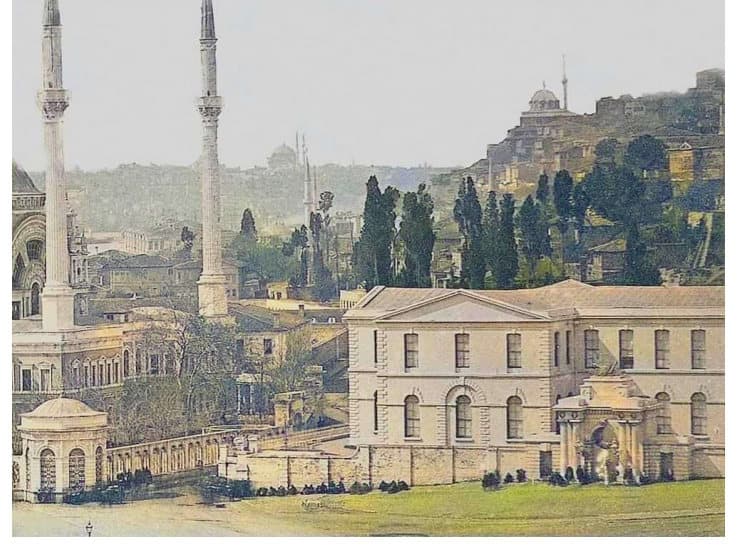
Apart from theaters established for foreigners and embassies, one of the places where theaters were first presented in the Ottoman State was the palaces. Ottoman sultans, like in Europe, had theaters constructed within their palaces where theater performances could be staged for state officials and their guests. A beautiful example of this is the Dolmabahçe Palace, completed in 1856. At the request of Sultan Abdülmecid in 1859— when no Turkish theater work had yet been written or performed —a theater building was constructed here. Similarly, in the Yıldız Palace used by Sultan Abdulhamid II, there was a separate section for the staging of theater and
Figure 1 Dolmabahçe Theater
opera works.
The process that began with the staging of theaters in foreign languages continued with works translated into Turkish. From the second half of the 19th century onwards, theater gradually ceased to be an area exclusively catering to foreigners and those proficient in foreign languages. With the translation of foreign works into Turkish, theater started to reach other segments of the population.
One of the significant theaters from this period was founded by Hagop Vartovyan known as “Güllü Agop” in 1870, and it is still widely recognized today. Güllü Agop’s theater was of great importance in terms of providing a stage for many Turkish artists and presenting numerous significant works through translation into Turkish.
Although İbrahim Şinâsî made a significant literary achievement with Şair Evlenmesi as an important first in Turkish literature, a considerable amount of time passed before
Turkish theater works were staged. Vatan yahut Silistre, written by Namık Kemal and staged in 1873, was the first work written and performed in Turkish.
After the 1870s, many Turkish theater works began to be staged in various locations, and theater coming from Europe started to become an important part of Turkish literature and culture.228
The French performing art at the Odeon Theater
Letter sent by the Grand Vizier to the Minister of Commerce about the Sultan’s permission for the French to perform at the Odeon Theater in Beyoǧlu.
September 9, 1840
“Esteemed Pasha, Minister of Commerce
As Your Excellency is aware, a request has been
made for the performance of the arts by known French artists at the theater named Odeon in229
Beyoğlu. Upon this request, the execution of these arts at the mentioned place was submitted to the approval of His Majesty the Sultan, and thus, high orders have been issued regarding their execution. Therefore, it is kindly requested from your esteemed side to take the necessary measures in this matter.” as it was ordered.
12 Receb 1256.
Picture 2 The situation has been registered in the Department of Trade [Ministry], Accounting [Office], and the aforementioned person has been issued a license document.
C.BLD, 20/963
Request for permission to build a theater in the center of İstanbul
As a result of the permission granted by the Sultan for the construction of a theater in Beyoǧlu,
eliminating the emulation of other provinces, a petition has been submitted by a person named Henry Höge (?) for permission to build a theater in the center of İstanbul. The proposed theater is intended to feature mixed performances of dance and music, wordless plays, and short segments taken from Ottoman history that would enhance the affection of the public towards virtue.
February 1, 1850
This is the translation of the petition submitted by a person named Henry Höge (?) at the beginning of February of the year 1850 to the esteemed Office of the Grand Vizier.
Due to the previous approval granted by His Majesty the Sultan, the theater constructed and opened in Beyoğlu, leaving nothing to be envied by other provinces in this regard, has emboldened me to express the courage to request and implore the esteemed Office of the Grand Vizier for the opening of a theater in the center of İstanbul. The plays performed in this theater will be a combination of music and dance (raks), along with some wordless plays. Among them will be notable short pieces (fıkra) and stories taken from the history of the Ottoman State that can inspire the efforts and heroism of Ottoman soldiers. It is
evident that these pieces will not only increase the public’s affection for virtue but also convey the necessary respect to the artists (ashabı hüner ve maarif230.) In short, the acceptance of this humble request for the construction of a theater (lu’bhane) in İstanbul would be a significant step towards the
progress of the civilized manner.
On this occasion, I express my profound respect and reverence for Your Excellency, the Grand Vizier.
A.DVN, 57/82
Permission granted to French actors in İstanbul to perform various plays at the Odeon Theater in Beyoǧlu
The Imperial Decree allowing the performance of plays, including comedy, drama, farce, and small opera, by French actors in the Odeon theater in Beyoǧlu, İstanbul, was issued in response to a petition submitted by the directors through Filol to the Ministry of Foreign Affairs. The petition emphasized the benefits of education and civilization that French actors could bring. The Minister of Commerce, Fethi Pasha, expressed the opinion that there was no objection due to the performances being in another language. This perspective was then presented to the Grand
Vizier with the additional view that refusing permission might lead to gossip among the French community. Subsequently, upon the approval of the Grand Vizier, an imperial decree was issued permitting the performances as stated.
August 31, 1840
A translation of the petition submitted to the high office of the Ministry of Foreign Affairs by the French theater companies in İstanbul through their director, Monsieur Filol.
The undersigned playwrights, by applying to your esteemed office, express their desire to be granted permission to stage plays such as comedies, dramas, vaudevilles, and small operas taken from reputable French works at the theater named Odeon in Beyoğlu. These individuals hope that the permission they seek will lead to benefits in education and civilization. Considering Your Excellency’s knowledge and appreciation of culture and the arts, they anticipate that the establishment of a French theater would be worthy of your high patronage.
Your Highness, the owner of high patronage, generous, benevolent, beneficent, compassionate, and exalted sir;
The matter of obtaining permission from our Sultan to perform certain arts referred to as comedy and opera at the theater named Odeon in Beyoğlu has been requested by the French actor Mr. Filol, who is currently in İstanbul. He submitted a petition to the high office of the Ministry of Foreign Affairs, and the translation of the said petition was sent to the Honorable Minister of Commerce, Fethi Pasha, to provide the necessary explanation on the matter. In the response provided by His Excellency Pasha, it was stated that the performance of these arts at the mentioned theater would not pose any harm, as these arts are in a different language and are things that only those belonging to the same
nation would understand. Therefore, there was an indication that there would be no objection to their performance at the specified location as requested. The letter containing the correspondence on this matter and the translation of the mentioned petition have been sent to you as an attachment for our Sultan’s consideration. In truth, there is no objection to this matter; on the contrary, if it were to be prohibited, there is a possibility that the French may spread certain rumors. Therefore, if His Majesty the Sultan grants permission for its execution as mentioned, the matter will be referred to the aforementioned Pasha for implementation, sir.
M.
Your humble servant submits the following:
Your Excellency’s esteemed letter, along with this correspondence and the translation of the mentioned petition, has been presented to the high office of our Sultan and has been seen and examined by His Majesty. According to your esteemed letter, there is no objection to the performance of these arts at the mentioned place, as determined by His Majesty. Permission has been granted, and the attached documents are returned to you. Therefore, the order and decree for referring the matter to the aforementioned Pasha are at your disposal.
İ.HR, 6/292.
Source: Innovation, Inventions and Quests Among the Turks