

Culture & communication
1846
Hazîne-i Evrâk (Treasury of Documents)
The first step towards a modern archive
As a result of the developments arising from the reign of Sultan Mahmud II and the Tanzimat era onwards, coupled with changing global conditions, the growth and development of bureaucracy led to an increase in the circulation of documents among institutions. In parallel with this increase, the issue of systematically storing and easily finding the documents filed in the bureaucracy became prominent.
These developments established the theoretical foundation necessary for a modern archive and brought up the idea of preserving and classifying documents through a new system. After the conquest of İstanbul, the cellar where documents were accumulated and stored was located around Yedikule. During the reign of Sultan Ahmed III, the registers of the divans and army divans in Edirne were moved to the Topkapı Palace. In the room adjacent to the Kubbealtı, where the meetings of the Dîvân-ı Hümâyun (Imperial Council) were held, the necessary registers for the council were kept in chests. On council days, the door of this room would be sealed with the seal of the Grand Vizier by the Chief Sergeant, and it
would be opened again in the presence of the Grand Vizier. Documents were systematically stored in archival vaults in a chronological order. Depending on their importance, they were placed in covers and pouches made of silk or ordinary fabric, known as kese. During times of war, the necessary registers were taken with the army. Once a document's processing was complete, it would be stored in the Imperial Treasury, known as Hazîne-i Âmire.231
The meticulous care and precision in preserving the registers find vivid expression in a decree from the era of Sultan Mustafa III (1757-1774). The registers belonging to Dîvân-ı Hümâyun (Imperial Council), which resembled the present-day Cabinet, held records of vital importance. As stated in this decree, these registers were considered at the level of the state treasury, and it was emphasized that no one could be held accountable even for the slightest harm to them.232
An initiative to facilitate the preservation and use of Ottoman archival materials was undertaken during the reign of Sultan Abdulhamid I (1774-1789). It was indicated that the protection of
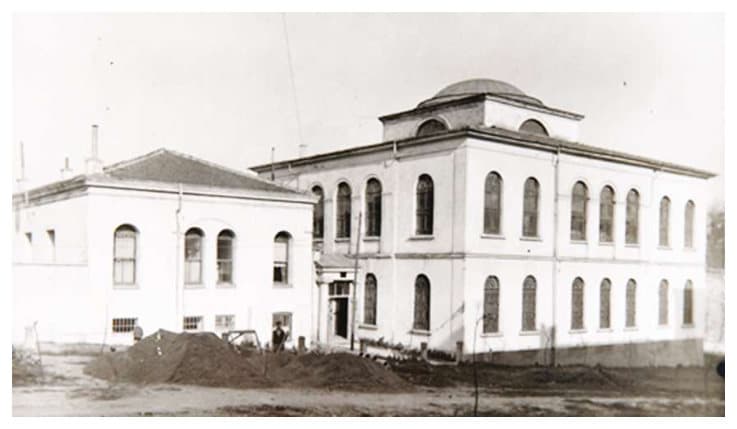
Figure 1 Hazîne-i Evrâk
building
important documents required the construction of a solid building, and for this purpose, a cellar repaired in the garden of the Grand Vizier‘s palace was deemed suitable. The arrangement emphasized the cellar's construction as a solid building, particularly taking care in this regard. The reason for this was the consideration of protecting documents from the occasional fires that erupted in İstanbul and devastated the city. The fires in Bâb-ı Âli and some negligence had led to the destruction of a significant amount of important documents.
Before the establishment of Hazîne-i Evrâk (Treasury of Documents), various archival materials (registers and documents) accumulated in various state offices were stored in different locations. Some of these materials were kept in the cellar of At Meydanı, some in Topkapı Palace, and some in the tomruk (headquarters) near Bâb-ı Âli. As Bâb-ı Âli gained increasing importance and the
transfer of affairs to this location continued, the recent documents that were being processed accumulated in the tomruk section. Financial documents, on the other hand, were stored in the barracks of Çadır Mehterleri in Sultanahmet. The scattered and distant storage of documents in various depots made finding a specific record time-consuming. This, in turn, caused delays in processing the documents handled by the offices and disruptions in administrative procedures.
Due to the neglect and deterioration of documents from past years stored in the Treasury of Enderûn within the palace, during the tenure of Mehmed Emin Rauf Pasha, under the leadership of Finance Minister Musa Safveti Pasha in 1845, officials from the finance ministry were assigned to inspect and categorize documents and registers individually to prevent further decay and loss. Among those deemed worthy of preservation, the documents were placed in new pouches and
transferred to other storage areas. The unnecessary ones were sorted out and burned in the palace furnaces. The rationale for burning was the difficulty and time-consuming process of accessing the necessary documents due to the clutter created by the deemed insignificant documents. While steps were taken to preserve some documents, the destruction of others based on the argument that they had lost their relevance is perhaps a poignant indicator that the statesmen of the time had not yet fully developed a historical consciousness.
Undoubtedly, a significant milestone in the history of our archival practices was marked with the establishment of Hazîne-i Evrâk (Treasury of Documents) in 1846. Mustafa Reşid Pasha, inspired by the institutions he observed during his time in Europe and eager to implement similar practices in his own country, played a pivotal role in the establishment of the Treasury of Documents, as he did in many reforms of that period. When the idea of creating the Treasury of Documents surfaced, there was a consideration to renovate some rooms in the defterhane (record office) in Sultanahmet and relocate the documents there as a precaution. However, this plan was abandoned due to the distance from Bâb-ı Âli, the logistical challenges of transporting documents, and the potential disruption it might cause, all of which were taken into account.
To rectify all these inappropriate conditions and to ensure that transactions could be conducted swiftly, it was necessary, as in other states, to store documents collectively and in an organized manner in the same location.
Based on this statement, a decision was made to construct a durable, fire-resistant building within Bâb-ı Âli to house and preserve important documents. The project for the building was prepared by the Italian architect Fossati, who was brought to İstanbul to construct Darülfünun. The
structure, named Hazîne-i Evrâk, according to the project, was to be built with multiple rooms to accommodate documents in an organized manner. By the end of 1847, the construction of the Hazînei Evrâk building was completed, and its architect, Fossati, was honored with an engagement. After the completion of the construction, it is evident that there was no rush to place the documents, considering the likelihood of the new building being damp and the potential harm it could cause to the documents. There was a period of waiting for the humidity to subside, the building to dry, and meticulous efforts were made to address any deficiencies before the documents were carefully placed. Although the construction of the Hazîne-i Evrâk building was completed in 1847, and the sorting and categorization of documents began in 1846, we observe that its official inauguration could not take place until 1853. The primary reason for the delay was the inability to find the necessary funds to address the deficiencies in the building's fire-resistant features.233
Construction of an archive building for the preservation of Ottoman state documents
The decree drafted by the Meclis-i Ahkâm-ı Adliye (Parliament of Administrative Justice), which emphasized the need for a special department within Bab-ı Âli in the form of a large and
organized library to protect Ottoman State documents from dispersion and decay due to the unsuitability of the cellar and Defterhâne for their
preservation and easy retrieval, was found appropriate and accurate in the Meclis-i Umûmî. The decree was then presented to the Sultan for approval by the Grand Vizier. Upon the Sultan's approval, an imperial decree was issued in the prescribed manner, endorsing the construction of such a department.
November 8, 1846
Your Highness, the owner of high patronage, generous, benevolent, beneficent, compassionate, and exalted sir;
In a decree drafted by the Meclis-i Vâlâ-yı Ahkâmı Adliye, it was stated that important documents related to significant matters and the affairs of the Ottoman State were stored in the vicinity of Bab-ı Âlî in the cellar and Defterhâne. However, due to the dampness of the cellar, many documents had deteriorated, and the limited space had caused them to become mixed and torn. Additionally, the documents in the Defterhâne were disorganized,
making it impossible to find old records when needed. Given that these documents were vital records of the Ottoman State, including original copies of treaties and agreements made with other states, the disorganized and potentially lost state of these documents was deemed unacceptable. In light of these considerations, it was understood that to preserve, transport, store, and facilitate the retrieval of the necessary documents in the desired manner, it would be appropriate to construct a spacious and well-organized library-like department made of stone within Bab-ı Âlî solely for this purpose. Consequently, a plan for this department, named Hazîne-i Evrâk, was drawn by the architect Fossati, who was responsible for constructing university (Dârülfünûn) buildings. It was reported that if this place were to be built using new-style bricks, it would also be safe from humidity. Therefore, based on the mentioned plan, it was proposed to construct a suitable department within Bab-ı Âlî under the name Hazîne-i Evrâk. The department would be constructed according to the plan, with separate rooms allocated for internal, divan, and foreign affairs documents. A suitable clerk would be appointed as Muhâfız-ı Evrâk234 (Guardian of Documents). Additionally, a special place similar to a library would be created inside, and it would house documents related to international treaties, official documents, and necessary history and geography books along with maps for reference. The estimated construction cost was understood to be around three hundred fifty to four hundred kese. Despite the considerable expense, it was acknowledged that such a sum could not be spared for such beneficial endeavors. Therefore, it was proposed to start the construction of this department under the supervision of the mentioned architect and the Meclis, and the construction costs would be covered by the
Treasury of the Finance Ministry. This proposal was submitted to the Sultan for consideration and approval.
Therefore, the mentioned decree and plan have been sent to you to be seen and examined by His Majesty the Sultan. If His Majesty deems it appropriate, the necessary steps will be initiated accordingly, sir.
Your faithful servant submits that;
The letter of you, His Highness the Grand Vizier, has been seen and examined by His Majesty the Sultan, together with the aforementioned memorandum and plan. Indeed, the necessity for the construction of a place to preserve such official and reputable documents, as you mentioned in your letter, is quite clear, and the expenses are not exorbitant. Therefore, due to the grace of His Majesty the Sultan, the matter has been discussed and approved as stated in the aforementioned decree. Accordingly, His Majesty has issued orders and directives for the necessary actions to be taken in line with the discussions and approvals. The decree and plan have been returned to you, Your
Excellency, as you are now well aware. In this matter, the commands and edicts are in your hands.
19 Zilkade 1262
İ.MSM, 25/G58
Source: Innovation, Inventions and Quests Among the Turks