
Transport & engineering
1848
The Kızılırmak River transportation project that Ahmed Agha “Hezâr-Malumat” failed to
realize
From the second half of the 19th century onward, until the widespread use of railways, the most cost-effective and convenient means of transportation was undoubtedly seen as watermaritime routes. Therefore, the Ottomans made various initiatives throughout the 16th century to more effectively benefit from waterways. The idea of connecting the Don-Volga rivers with a canal and uniting the Mediterranean and Red Seas through a shortcut, the Suez Canal, emerged as a result of these pursuits. As mentioned earlier, in the same century, there was also a proposal to open a canal using the Sakarya River and Sapanca Lake, providing maritime transportation from the Black Sea to the Sea of Marmara.
In 1847, a similar project emerged for the Kızılırmak River. Ahmed Agha, the former director of the Gümüşkân Mine (Keskin region), presented a project to the Ottoman authorities.
In this project, he suggested that establishing boat
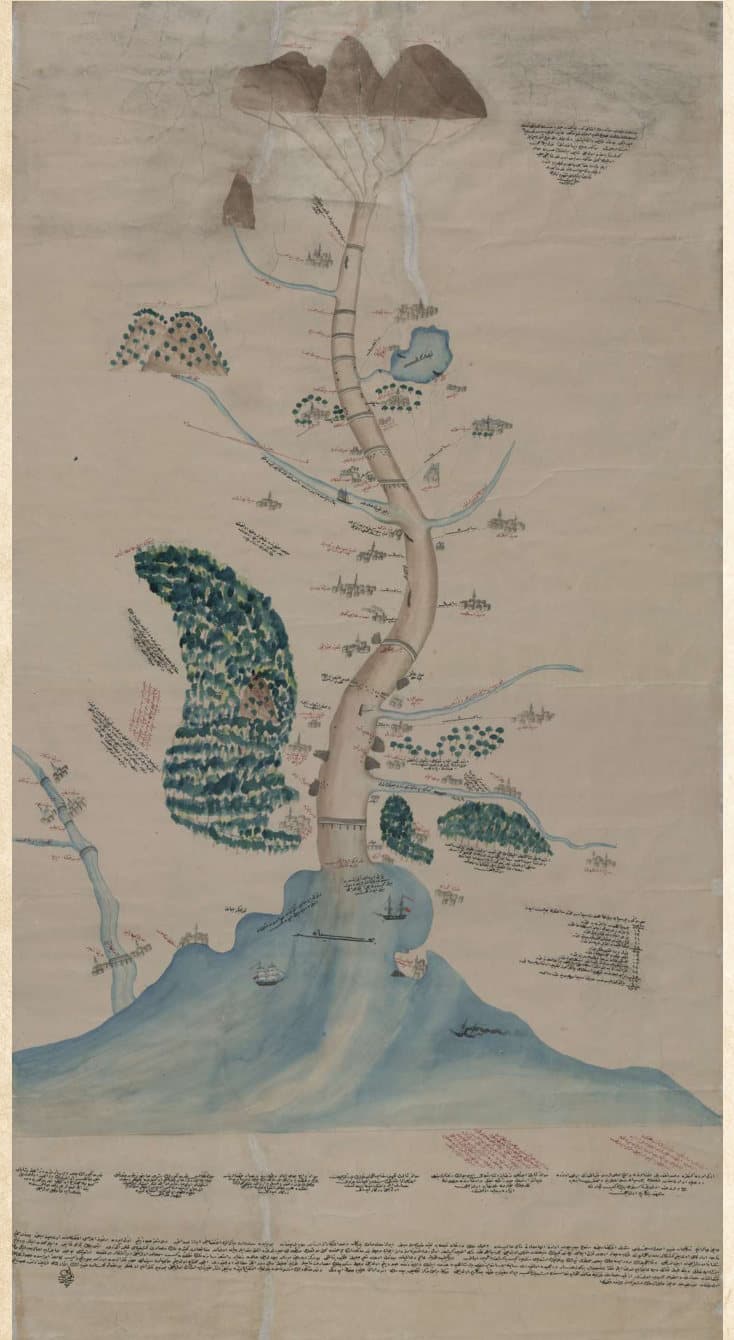
operations for transportation on the Kızılırmak River would facilitate the transportation of agricultural products, timber, and various commercial goods from the surrounding areas, leading to significant economic benefits. Ahmed Agha submitted a detailed map along with the project, outlining the advantages and potential gains in writing, as part of his application to the Sadaret (Government). He identified himself as an individual who had served for an extended period in the military with the rank of arms expert. While traveling on diplomatic missions in countries such as Russia, Prussia, Germany, Venice, and Iran, he acquired a wealth of knowledge, earning him the title hezârmalumat, which signifies someone highly knowledgeable or skilled.239 The expression, akin to the nickname “Hezarfen,” conveys the meaning of being “highly knowledgeable.” He had previously conducted inspections from the source of the Kızılırmak River, which is adjacent to the Gümüşkân Mine,
where he was in charge, to the point where it flows into the Black Sea. Additionally, he had drawn a detailed map of the route. Initially, constructing twenty boats, three warehouses at different locations, and creating alternative routes at some points for boatmen, along with a few buildings for the accommodation of personnel, would be sufficient. The cost for these initial tasks was estimated to be around eight hundred kese. If the project were approved and put into operation, the generated income would cover the expenses. It was also pledged that after the expenses were deducted, an annual income of five thousand kese would be provided to the treasury.
If the project were to be realized, many benefits would be observed. One of these was that if the rock salt from the salt flats in Çankırı and Sungurlu towns, which exceeded the needs of İstanbul, were sold to the Black Sea coasts and other places, an annual income of a thousand kese could be obtained.
On the other hand, if ten loads of grain were transported and stored in Sinop Port each year, a lucrative trade could be established. Grain from the Bozok (Yozgat) region is currently transported to Samsun Port at a rate of eight kuruş per kilogram. If the same grain is transported to Sinop Port via the mentioned river at a freight cost of two kuruş per kilogram, a profit of six kuruş per kilogram could be achieved.
Similarly, the transportation of the timber needed for Ottoman State ships to Sinop Port would be accomplished with both less expense and greater ease through this route.
The transportation of rice produced in Boyabat, Tosya, and the surrounding towns, as well as oil, honey, and various grains produced on the right and left banks of the mentioned river up to Kayseri, would bring many benefits in terms of logistics. Ahmed Agha's project was referred to the
Agricultural Council for examination. The council summoned Ahmed Agha to question the things he promised to do. He explained that lightweight boats would be constructed since it was not possible to use large boats in the river. Some stones in the river would be removed, and it would be necessary to widen and deepen narrow and shallow areas. In some places, it would also be necessary to create paths for pulling boats from the land. However, as a preliminary step, constructing three to five boats as examples and transporting some grains and items like salt and lead from the districts around the river to the Black Sea coast would demonstrate the feasibility of the project to everyone. This initial demonstration could cost around eighty thousand kuruş.
However, according to the information gathered by the Council, the task of opening and organizing the river was quite challenging and expensive. It became apparent from Ahmed Agha's statements that the project, for the time being, involved constructing three to five boats as examples and transporting them to the extent allowed by the river. This was limited to the back-and-forth movement of these boats and the transportation of some goods to the Black Sea coast along that route. The real intention behind Ahmed Agha's proposal was to convince the Sultan to clean and open the river, thereby achieving the benefits mentioned above. If certain parts of the river were fixed and large stones removed, it would allow for the transportation of timber and grains. In this way, many timber and mineral resources from the surrounding mountains, as well as passengers, could be easily transported to the coast.
The former governor of Kastamonu, Mustafa Pasha, expressed that the location where the Kızılırmak River flows into the Black Sea is suitable for the construction of a pier. Due to the significant cost involved in constructing it all at
once, it was deemed more practical to do it in stages. For this purpose, it was necessary to first send an engineer knowledgeable in this field to identify the areas that needed to be opened and fixed. This would reveal the appropriate approach and associated costs. Since the season coincided with a time when the water levels were low, and Kastamonu governor Bekir Pasha was planning to go to that region soon, it was decided to promptly assign an engineer to accompany Pasha. The engineer would investigate how to easily organize the project, what would be required, and report back to the Council.
It seems that in line with the decision of the Agricultural Council, Ahmed Agha was not assigned an engineer for exploration, as he submitted another petition, this time attaching the map he drew. The petition was then referred to the Meclis-i Vâlâ. Meclis-i Vâlâ summoned him and obtained information about his proposal but could not reach a conclusion. Since the matter had been previously discussed in the Agricultural Council, the Council of Ministers referred the issue back to the Prime Ministry to decide according to the direction of the Agricultural Council.
The matter was sent back to the Agricultural Council again. Ahmed Agha was once again summoned to the council and questioned. His statement was more or less the same as before. However, this time, he brought the goldsmith Goncagüloǧlu Karabet as a guarantor for the requested eighty thousand kuruş to the Council. If Ahmed Agha‘s request is accepted, it was deemed appropriate to take a promissory note from the treasury and proceed accordingly. However, a note dated December 28, 1847, was appended to the documents, stating, “Deferred for execution in the early spring for now,” and indicating that the paperwork was archived for the time being.240
In June 1848, Ahmed Agha submitted another petition. Despite assurances that the necessary
action would be taken in the spring and the arrival of spring, he noted that nothing had been done yet. Once again, he listed the benefits that the treasury would gain if his project were realized. If not accepted, he expressed the intention to attempt to carry out the project as a small company. However, he requested that certificates be issued to them, granting one-fifth of the income from the project to the treasury and the remaining four-fifths to the company partners and, later, their children. It can be inferred that this application, too, was consigned to the dusty shelves of the archive without any activity being initiated.241 Even if the Kızılırmak River project did not come to fruition, today we can appreciate the beauty and details of the image created by Ahmed Agha, allowing us to remember the past and honor him.242
Project for operating boats on Kızılırmak by Ahmed, former manager of the Gümüşkân Mine
Ahmed, the former director of the Gümüşkân Mine, proposed a project in which he highlighted the potential benefits of operating boats for transportation on the Kızılırmak River. According to his plan, this initiative would facilitate the transportation of agricultural products, timber, and other commercial goods grown in the regions around the river. He prepared a detailed map indicating the specifics of the project, showcasing
Figure 1 The Kızılırmak Transportation Project that
“Hezâr-Malumat” Ahmed
Agha failed to realize
the advantages it would bring to the areas along the Kızılırmak and its surroundings.
September 30, 1848
Intending the development of the country and the welfare of the people, the Tanzimat decree has permitted the presentation of loyal servants’ ideas. Therefore, your servant’s proposal is put forth as a sample of my sincerity and servitude, utilizing the knowledge I possess on this matter.
I personally explored the Kızılırmak, a large river adjacent to the Gümüşkân Mine, where I previously served as the administrator, from its source to where it flows into the Black Sea. A formal drawing indicating the locations and positions of the river has been prepared for leveling as needed. As you will see when you view and examine it, the benefits and exploration expenses are outlined in six points. Accordingly, the estimated expenses for the exploration and leveling are currently set at eight hundred kese, involving the construction of twenty boats, three warehouses at different locations for storage, a few buildings for the accommodation of personnel, and the leveling of alternative routes at some points for boatmen.
If His Majesty the Sultan deems it fitting, as He generously bestows blessings upon the whole world, it is evident that there will be great ease in the transportation of grains and other commercial goods. If the leveling is assigned to this humble
servant, I sincerely pledge that all my efforts will be devoted to it, and no harm or discomfort will be caused to the poor and weak. As it is my duty to serve through the grace of His Majesty, no funds will be requested from the treasury for the expenses at this time. All I need is to be deemed worthy of the gracious favor of His Majesty the Sultan. If this is granted, the profits from the implementation of this project will be used to cover the expenses incurred. After deducting the expenses, an annual fixed income of five thousand kese will be pledged by your servant to be paid to Hazine-î Hâssa-i Hümayun (Imperial Treasury of the Sultan.) However, it is subject to your command to allocate a place for use as a center.
I am confident that there are endless great benefits in leveling this river, and it will serve as a precedent for many beneficial projects. Speaking about such benevolent deeds is my duty as a servant, and with all humility, this proposal for leveling has been put forth.
Your servant
Ahmed Former Mine Director
[The 6 articles in mention]
1. I undertake that if the rock salts in the salt flats in Çankırı and Sungurlu towns are sold to the Black Sea coast and other places in excess of İstanbul’s needs, an annual income of one thousand kese will be obtained. (Each kilo of this salt, which is of better quality than the salt coming from Eflak, will be delivered to İstanbul at a price of fifteen bucks each with its profit).
2. Transporting various types of grains, ten loads annually, to Sinop Port would result in limitless profit (trade) when easily delivered and stored. (From the Bozok (Yozgat) region to Samsun Port, each kıyye (an unit of weight) of grain is transported at a rate of eight kuruş. When transported to Sinop Port with a freight cost of two kuruş per kıyye from the mentioned river, a profit of six kuruş per kıyye will be achieved. Many more
benefits will become apparent during the flow of the mentioned river.
3. The transportation of the timber needed by the ships of the Ottoman Empire to the Sinop Port would be both less costly and easier.
4. It is clear that there will be many benefits in the transportation of rice produced in the Boyabat, Tosya, and Cidar districts, as well as oil, honey, and various grains produced on the right and left banks of the mentioned river, up to Kayseri.
5. In the Zeytin district on the east side of the mentioned river and the Durağan district on the west side, there are abundant olive trees that have long been neglected. When various trees in the forested area are cut and cleared, many benefits will emerge.
6. There is a need for water to cultivate the vast amount of arable land on the right and left sides of the mentioned river. If water is brought from the mentioned river with a dam, an incomparable income (yield) will be obtained.
[Some information given on the map and indicated project locations]
Such a matter will seem challenging to everyone due to its unprecedented nature. However, despite the danger and swift flow of the Çoruh River on the Georgian side, a certain number of boats are in operation, and these boats are constructed differently. Compared to the Çoruh River, the Kızılırmak River resembles a lake, making boat operation relatively straightforward. By bringing five to ten boatmen from the mentioned location, I pledge, with Allah’s permission, to operate boats on this river from the Black Sea to Kayseri and from Kayseri to Sivas.
The dots on the map in some places show the stones in the river.
Sivas Bridge: I undertake to run boats up to this Sivas Bridge.
Delice River: In the spring, it can be boated for up
to fourteen hours.
Kızık Village: This village is the place of the ports of Çankırı and Bozok.
Gökırmak, also known as Çeltik River: This river allows boat navigation up to Taşköprü during the spring season. [Extending towards Gerze along the banks of this river] and the mountain called Elik is a source of timber needed for the ships of the Ottoman Empire. Therefore, these timbers can be easily transported to Sinop Port through this river with minimal expenses.
There are many olive trees in the town of Durağan.
There are olive trees in the town of Zeytin in Amasya.
Kapıkaya, Kunduz Mountain, and Dağdaşan Mountain: The high mountainous regions of Vezirköprü and Zeytin districts, opposite to Kunduz Mountain, are timber sources. The area known as Kapıkaya between Vezirköprü and Bafra is a source of timber. Additionally, due to the abundant copper deposits in the vicinity of Kapıkaya in this mountain, it was concealed and closed off from the Ottoman state at one time.
The route of this river from the Black Sea to Sivas is as follows:
From the mouth of the Kızılırmak River at sea, the port of Sinop is forty-four miles by land and twenty-two by sea; the town of Samsun is fiftyfour miles.
HRT.h, 144
Source: Innovation, Inventions and Quests Among the Turks