
Science & discovery
1858
Coal Gas and Lighting
İstanbul meets light
The illumination of streets and avenues of the cities emerged at the beginning of the 19th century with the realization of the effective use of coal gas. Jan Pieter Minckelers, a Dutch citizen, was the first to produce coal gas for illumination purposes. He initiated his experiments by lighting his room at the University of Louvain in 1753. Jan Pieter had discovered the combustible nature of the gas emitted from coal.
William Murdoch (1754-1839) also achieved positive results from his experiments in this regard and succeeded in producing gas. Murdoch, who had been involved with coal since his childhood, purified the smoke obtained from coal and, when ignited, observed that the flame emitted a white and bright light after passing through water. Thus, he demonstrated that gas could be used for purposes beyond its combustible properties. Using this method, he illuminated his home in 1792, the entrance of the Manchester police station in 1797, and other places. The first set of thirteen gas lamps connected to each other with pipes was tested in London in 1807.
The unpleasant odor of the coal gas constituted a
negative aspect of these efforts. Murdoch also undertook experiments to purify the gas for this purpose. Although he established a purification plant to vent the foul-smelling gas during the days he illuminated his house and achieved positive results from these experiments, he eventually suspended his research. Research on coal gas had spread across all of Europe. The efforts of the Frenchman Philippe LeBon, who also attempted to illuminate Paris using coal gas, served as an encouraging reason for Murdoch to resume his experiments in this field where he had previously suspended. Meanwhile, in England and the United States, efforts to illuminate streets with coal gas were ongoing. Friedrich Albrecht Winzer, of German origin, established a gas company and took on the task of illuminating the streets of London. Winzer carried out his first experiment by illuminating Westminster Bridge with coal gas produced at the first gas factory he built on Petter Street in London. This invention in Europe quickly spread everywhere. The main streets, or important thoroughfares, of major cities in Europe and the United States became illuminated with gas lamps.
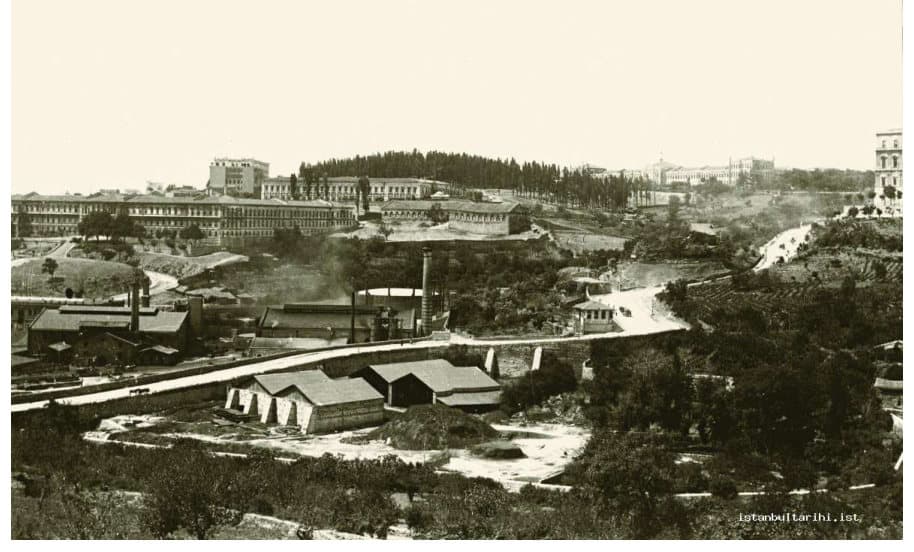
Figure 2 Dolmabahçe
Gasworks
The 1810s marked a turning point for gas lighting, and, for example, a street in Baltimore, United States, was illuminated with gas in the year 1817. Paris, one of Europe’s most prestigious cities, joined this trend with a delay and saw its first street illuminated using gas in 1829. The Germans were also late to adopt this technology; the attempt to light Berlin with gas did not begin until after 1826.
After 44 years since the establishment of modern city lighting with gas worldwide, it is observed that in the year 1856, İstanbul initiated its first modern urban lighting efforts. The first example of avenue, street, and interior lighting in İstanbul was the Dolmabahçe Gasworks, established and put into operation in 1856 for Dolmabahçe Palace. To solve the problem of lighting and heating the palace, along with the construction of the palace, a highly strategic gas factory, like the Gasworks, was built by the Imperial Treasury in the valley extending
towards Nişantaşı, right behind the palace and adjacent to the imperial stable buildings.
The construction of the Dolmabahçe Gasworks was completed in 1853 along with the palace, and the necessary gas for lighting the palace was produced here for the first time within the borders of the Ottoman Empire. Dolmabahçe Gasworks was administered under the Imperial Treasury. The initial production attempts yielded positive results, and even a surplus was produced within three years.
The surplus production of the Dolmabahçe Gasworks resulted in the supply of gas to the Beyoǧlu district starting in 1856. With gas lighting, the first street illumination in İstanbul was realized on Grand Avenue of Pera (Cadde-i Kebir or İstiklal Avenue). Initially, from Taksim to Galatasaray, and in the second stage, from Galatasaray to Tünel Square, and then along the High Sidewalk (Yüksek Kaldırım Avenue) route to
Figure 3 Opening of the Yedikule Gasworks in 1881
Karaköy, lamps were arranged on one side of the street at intervals of 80 steps. Streets were illuminated by supplying gas to lamps with cast iron poles and cast iron network pipelines drawn from Dolmabahçe Gasworks.
In 1859, the Galata and Tophane areas were illuminated. In 1861, gas was delivered from Tophâne-i Âmire to Talimhane and Saraçhane. By 1864, a pipeline drawn from the gas plant reached from Maçka Arsenal to Teşvikiye and Nişantaşı. In the same years, Beşiktaş Avenue also joined the illuminated spaces with gas lighting.
The first facility built in İstanbul for social purposes and for the public was the Yedikule Gazhanesi (Yedikule Gasworks), completed in 1880. The gas produced from this facility was initially used to meet the lighting needs of the people in İstanbul. The construction work began in 1873, and although it took a long time to complete, it regained prominence in the early
years of Sultan Abdulhamid II’s reign. Only Dolmabahçe and its surroundings, İstiklal Avenue, Galata, and the nearby areas had embraced this innovation in İstanbul; the rest of the city had not yet transitioned. Yedikule was chosen as the most suitable location within the city walls to produce gas. The gas produced here would be distributed through underground pipes: one route to Langa, another route of the same size through Bahçekapısı to Beyazıt via tramway, and a third route extending through Aksaray and Beyazıt to Şehzadebaşı.
The Yedikule Gasworks was constructed through a tender process in 1880. Initially designed to supply four hundred street lamps, it was later expanded to provide gas to Eyüp, Bakırköy, and Yeşilköy. The Yedikule Gasworks commenced operations in 1880 and was managed by the City Council.
Kadıköy Gasworks, officially inaugurated in 1892,
operated under the name Üsküdar-Kadıköy Gaz Şirket-i Tenviriyesi (Üsküdar-Kadıköy Gas Lighting Company), established on January 6, 1892. Üsküdar-Kadıköy Gas Lighting Company remained in continuous operation until World War I, occasionally suspending activities during the war and its aftermath. Instead of relying solely on coal, the primary material for gas production, olive pits were sometimes used to produce gas in an attempt to prevent interruptions in the facility's production. The task of illuminating İzmir with gas, known as the Ottoman City Gas, was awarded to a company owned by the British journalist Edwards in 1876, and the city began to be illuminated with coal gas produced at this gas plant.254
Draft articles of agreement of the company to be established for the gas lighting of İstanbul
A Parisian, who had proposed the illumination of İstanbul with gas to the Grand Vizierate, expressed his desire to contribute to the reform activities in İstanbul led by the Grand Vizier. Based on his observations, he concluded that this endeavor would bring numerous benefits. He submitted a draft agreement proposing the establishment of a company, outlining its privileges, duration, operation, raw material supply, and other related matters. This draft agreement contained certain conditions similar to those found in the contract of the Samsun-Sivas Railway Company.
March 17, 1858
The dedication and efforts that you, his Excellency, have displayed for the improvement of the Ottoman Empire have strengthened my desire
to contribute to this noble cause. During my residence in İstanbul, I witnessed the reforms implemented in one of the suburbs and, based on
the information gathered, concluded that the benefits and beauties of illuminating İstanbul with gas are evident. Therefore, without delving into further details, I present a draft agreement that aligns with the conditions accepted by the Ottoman State regarding the construction of the Samsun-Sivas railway in August of 1857. I hope that this draft, which I submit for your esteemed consideration, will be accepted by the Ottoman Empire due to its compatibility with the aforementioned conditions. Expressing my desire to return to Paris after obtaining a response that facilitates the implementation of the requirements of this draft, I kindly request the prompt examination and resolution of this matter under your esteemed orders. I convey my deepest respects.
Draft of an agreement on the illumination of İstanbul with gas.
The undersigned undertakes to establish a company for the lighting of İstanbul with gas under the following conditions.
First Clause: The Ottoman Empire grants the undersigned, for a period of ninety-nine years, the exclusive permission to illuminate İstanbul with gas under privileged conditions.
Second Clause: This company, under these privileged conditions, shall be placed under the high supervision of the Ottoman Empire for the protection and enforcement of the general laws and provisions of the Ottoman Empire.
Third Clause: The location of the gas plant where gas will be produced will be determined after special research and examinations are conducted.
Fourth Clause: The land required for the establishment and construction of complementary elements (accessories), such as storage and office rooms, along with this gas plant, will be gratuitously and on lease provided to the company by the Ottoman State if it belongs to state
property; if owned by individuals, it will be easily acquired by the said company following the procedures for real estate acquisition in force in specific locations, in order to ensure the general benefit.
Fifth Clause: The aforementioned company, within ten months from the signing of this agreement, will present to the approval of the Ottoman State a detailed report (lâyiha) and an estimate book regarding the establishment and construction of the gas plant.
Sixth Clause: The Ottoman State, within five months from the date of the submission and presentation of the detailed report and estimate book mentioned above, will hand over the land specified in the Fourth Clause to the company if it complies with the conditions stated therein.
Seventh Clause: At the time of the submission of the aforementioned detailed report and estimation book, the aforementioned company shall deliver to the Treasury of Finance paper money (kaime) or gold and silver coins in circulation.
Eighth Clause: Once the amount spent by the company for the gas plant and roads [as specified above] is expended, the said amount will be refunded and delivered to the aforementioned company.
Ninth Clause: The mentioned company undertakes to operate the gas plant three years after the signing date of this agreement.
Tenth Clause: The said company shall have the authority and permission to cut and extract the wood and stone necessary for its manufacturing from state-owned forests and quarries that have not been previously assigned to another company.
Eleventh Clause: The said company shall retain the right to use the ( ) amount obtained from the issuance of authorized shares.
Twelfth Clause: The mentioned company shall be
authorized to import all the necessary tools and equipment for the construction of the gas plant exempt from any kind of customs duties; however, it will give preference to goods produced within the Ottoman territory over others.
Thirteenth Clause: Within the ninety-nine years of the concession period, the Ottoman State undertakes to guarantee and commit to paying seven percent interest on the amount expended and utilized by the company until ( ), and if the actual expenses are less, the Ottoman State will only ensure and commit to the interest on that amount.
Fourteenth Clause: The surplus revenue exceeding seven percent shall be paid to the Ottoman State until the advance provided by the Ottoman State for securing the excess interest is fully repaid.
Fifteenth Clause: The [company] is obligated to submit the operational expenses of the gas factory to the examination of the Ottoman State, firstly for the payment of its principal, secondly to determine when it will be relieved from the obligation of paying this interest, and thirdly to specify the time for the return of its advance, allowing the Ottoman State to be informed about these matters.
Sixteenth Clause: Before the operation of the gas plant, the regulations and tariffs must be presented and submitted for approval of the Ottoman State by the company.
Seventeenth Clause: The Ottoman State shall grant the company the right to extract the coal required for the production of gas for a period of ninety-nine years from mines to be determined later.
Eighteenth Clause: After calculating the extraction expenses for the coal mined for the need of the gas factory, the company will pay twenty percent on the remaining value; however, if it extracts more coal than necessary and sells the surplus, it will pay an additional twelve percent beyond the
specified twenty percent, and these percentages, after deducting the expenses, will be imposed on and distributed over the value of the coal in the mine. These fees will be paid, at the discretion of the state, either in cash or in kind.
Nineteenth Clause: The company will supply gas to state buildings such as the ministry headquarters (Meclis-i Vükelâ), barracks, and guardhouses at a price twenty percent lower than the general tariff price.
Twentieth Clause: At the expiration of the concession period, the Ottoman State shall acquire, free of charge, all buildings, equipment, goods, and machinery at a valuation determined by experts appointed in equal numbers by both parties. In the event of a disagreement between the experts of both parties regarding the valuation, a new member shall be chosen by a majority vote to resolve the dispute.
Twenty-First Clause: Likewise, at the end of the specified period, the gas concession, including all buildings, equipment, and machinery integral to the operation of the gas plant, will revert to the Ottoman State, which will purchase them as outlined above.
Twenty-Second Clause: If, for some reason, the construction of the gas factory is not commenced by the company within eighteen months from the date of signing this agreement, the privileges stipulated in this agreement will be deemed null and void, and the security deposit will be confiscated (seized and detained).
Twenty-Third Clause: In the event of wars or other political events that hinder the establishment of the company or the commencement or completion of the gas factory construction during the specified period, the Ottoman State will [extend] the said period adequately. Furthermore, if the obstacles arising from the reasons mentioned above persist for more than two years, the right to choose whether to return the concession decree will
belong to the company. In the case of such a return, the Ottoman State will refund the security deposit provided by the company.
Twenty-Fourth Clause: Any dispute between the Ottoman State and the mentioned company will be discussed and resolved by a commission formed by appointing an equal number of members from both sides. In the event of a disagreement among the commission members, a third member will be appointed by a majority vote.
A.DVN, 131/27
The lamp works on the principle of converting water gas into air gas
Lieutenant İbrahim Hakkı of Üsküdar, who was a guest at Tripoli Castle, named his invention
Hayatü’l-İnsan (Life of the Human). This invention is a lamp that could be burned without the need of a wick and oil, and tests showed that it
did not contaminate the air in the environment where it was burned. Its light stayed unaltered even in open spaces and among turbulent conditions. It provided a higher and brighter light compared to the management lamp, and the machines made according to their own system could operate. When used in these machines, it eliminated the need for coal and water storage in ships and trains. It operated on the principle of converting water gas into air gas with chemical substances, and due to these features, it was deemed worthy to be exhibited at the Chicago Exhibition in America. He provided a depiction of his lamp along with the production and operation guide (manual).
March 17, 1858
Hayatü’l-İnsan Production and Operation Guide
(Manual).
I believe the lamp, which I boldly named “Hayatü’l-İnsan” has been definitively proven, through careful inspection, not to have any drawbacks such as causing a bad odor like a wick and oil. It does not compromise the air quality when burned inside a room. Therefore, I find it fitting to be named “Hayatü’l-İnsan”.
One of the many beauties of this lamp is, as mentioned above, that it never compromises the air quality when burned in a very narrow room. Another is that it can burn without any decrease in its light, even in an open area and in very stormy weather. The third is that it illuminates with a very bright light up to twenty-five to thirty centimeters in height from the degree of light of a management wick.
The fourth is its ability to operate a machine, regardless of its horsepower, if made compatible with its own system. The fifth is that the machine propelled by this lamp does not require coal and water storage and boilers in ships and trains.
About the description of how it is made and operates: As shown in the illustration, it consists of two containers. One container is enclosed within a sphere for protection, while the other is connected to the base of the sphere with a cylinder in a foot position. The pipe with a nozzle can be extended as desired. Chemical substances that convert water gas into air gas are placed in the container inside the sphere and in the container below. The valve between the two containers is
used to decrease or increase the flame of the gas.
The lamp that is burned inside a hanging basin is precisely the one equipped with this machinery.
This lamp, which converts water gas into air gas, is suitable and deserving to be exhibited at the Chicago Exhibition in America, considering all the mentioned beauties:
I apologize for not mentioning another extraordinarily useful application of this lamp.
(Date, name, seal on stamp)
19 Teşrinievvel year 1308
The Guest at Tripoli Castle Lieutenant
İbrahim Edhem of Üsküdar
A.DVN.MKL, 34/6
Source: Innovation, Inventions and Quests Among the Turks