

Culture & communication
1876
Kânûn-ı Esâsî Our First Constitution
Kânûn-ı Esâsî, meaning Basic Law or Constitution, refers to the fundamental law of the Ottoman Empire. The first and final constitution of the Ottoman State was proclaimed on December 23, 1876. However, it was suspended by Abdulhamid II in 1878 and was reinstated following the revolution on July 24, 1908. It remained partially in effect between the adoption of the Teşkilât-ı Esasîye Kanunu (Law on Fundamental Organization) on January 20, 1921, and the enforcement of the Constitution of the Republic of Turkey on May 24, 1924.270
Under the leadership of Mütercim Rushdi Pasha, Ahmed Shefik Midhat Pasha, and Hüseyin Avni Pasha, a group of high-ranking civilian and military officials staged a coup on May 30th, overthrowing Sultan Abdülaziz and placing V. Murad on the throne. The situation became even more complicated five days later with the suspicious death of Sultan Abdülaziz. Meanwhile, in İstanbul, the failure of the new sultan to mention the Kânûn-ı Esâsî in his accession decree disappointed Midhat Pasha and his associates. Additionally, the swift occurrence of violent events adversely affected the mental health of V. Murad. As the treatments administered to Murad V proved ineffective, and in the absence of his declaration of the Kânûn-ı Esâsî, on August 31st,
Abdülhamid II was installed on the throne.
Under the presidency of Midhat Pasha, which included intellectuals such as Ziya Pasha and Namık Kemal, a commission began working on the preparation of the Kânûn-ı Esâsî on October 7th. As the work progressed, on December 19, 1876, Midhat Pasha was appointed as the Grand Vizier. On the same day that the Tersane Konferansı (Constantinople Conference) began, December 23rd, constitutional rule was announced, and the Kânûn-ı Esâsî was enacted. Consisting of 119 articles under twelve headings, the Kânûn-ı Esâsî envisioned a bicameral parliament, comprising the Meclis-i Mebûsan (Chamber of Deputies), composed of representatives elected by the people, and the Meclis-i Ayân, composed of members appointed by the Sultan. Before the opening of the parliament on February 5, 1877, Abdülhamid II sent Midhat Pasha into exile. Meclis-i Umûmî, (Ottoman Parliament) was inaugurated in a ceremony held at Dolmabahçe Palace on March 19, 1877. The first session of the Meclis-i Mebûsan concluded on June 28, 1877, and its second term began on December 13, 1877. During the period of the 1877-1878 Ottoman-Russian War, overshadowed by both internal and external issues, the parliament, in its second term, adopted
a more confrontational tone towards the Sultan and the government, whom it held responsible for the defeat in the war. Consequently, relying on the authority granted by the Kânûn-ı Esâsî, II. Abdülhamid indefinitely suspended the parliament on February 13, 1878. Members of the Meclis-i Ayân retained their titles even after the dissolution of the parliament since they were appointed conditionally.271
Kânûn-ı Esâsî’s proclamation actually bears some resemblance to the Gülhâne Hatt-ı Hümâyûnu (Imperial Edict of Gülhane) and the Islahat Fermanı (Imperial Reform Edict). The Hatt-ı Hümâyûn read in Gülhane largely aimed at addressing the Egyptian issue, while the Reform Edict sought to secure the support of Western powers during the Paris Conference convened after the Crimean War. However, attributing the proclamation of the Kânûn-ı Esâsî entirely to external factors is not entirely accurate; internal factors also played a role. In a sense, the Kânûn-ı Esâsî can be seen as a natural continuation of the modernization process that began with the Tanzimat. During this period, the idea of public participation in governance gained prominence, particularly within the Young Ottomans, a significant opposition movement of the time. There is a notable parallel between the Young Ottomans and Midhat Pasha in their emphasis on this concept.
During the reign of Sultan Murad V, Midhat Pasha had prepared a draft constitution consisting of fifty-seven articles. II. Abdülhamid assigned Said Pasha the task of translating accepted French constitutions into Turkish. A second draft emerged based on this translation. Finally, to prepare the ultimate text, a commission called Meclis-i Mahsûs was established under the presidency of Midhat Pasha, consisting of scholars, military personnel, and bureaucrats. This commission, with a membership ranging between
twenty-four and thirty-seven, worked in subcommittees to prepare a draft. They drew inspiration from Western constitutions during this process. The drafted proposal was eventually discussed and accepted in the Heyet-i Vükelâ (Council of Ministers) and then presented for the Sultan's approval.
The preparation of the law did not involve a constituent assembly or a legislative assembly consisting of representatives of the people. Therefore, although some legal experts argue that Kânûn-ı Esâsî cannot be considered a constitution in a formal sense, there is no reason for it not to be recognized as a constitution in substantive legal terms. In the drafting of the constitution, there was a struggle between conservative figures such as Cevdet Pasha and Mütercim Rushdi Pasha, who aimed to protect the Sultan's rights, and a liberalreformist group led by Midhat Pasha, Süleyman Pasha, Ziya Pasha, and Namık Kemal.
Shortly after the enforcement of the 1876 constitution, Midhat Pasha was forced to resign and subsequently sent into exile. The Meclis-i Umûmî (General Assembly) worked for two terms (March 19, 1877-June 28, 1877, and December 13, 1877-February 14, 1878) before being suspended until the Second Constitutional Era. During this hiatus, the cosmopolitan nature of the assembly had an impact. Although Article 65 declared that one deputy would be elected for every fifty thousand men, this was not realized in practice. For the first term of the assembly, representation was unequal, with one deputy for every 18,750 Jewish men, every 107,550 Christian men, and every 133,367 Muslim men. Regional disparities were also evident, with one deputy for every 88,882 men in the European region and one for every 162,148 men in the Asian region.
After the suspension of the Meclis-i Mebûsan, the Kânûn-ı Esâsî was, in a sense, put on hold. However, it came back into effect with the
declaration of the Second Constitutional Era. In the years following its proclamation, Kânûn-ı Esâsî underwent seven amendments. Among these, the most significant occurred on August 21, 1909. The key innovations introduced included the oath of allegiance by the Sultan to the Meclis-i Umûmî, the government’s obligation to be accountable to the Meclis-i Mebûsan and the requirement to obtain a vote of confidence, the direct election of the first and second presidents of the Meclis-i Mebûsan by the Assembly itself, and the imposition of the necessity for the Sultan to exercise his powers through the Meclis-i Vükelâ.
With the new regulations, some of the powers granted to the Sultan in the 1876 text were removed, thus giving the Ottoman State a more constitutional structure and essentially adopting a parliamentary government model. On the other hand, Article 113 of the 1876 constitution, which granted the Sultan the power of exile and was widely debated, was also abolished. This radical change was followed by amendments in 1914, 1915, 1916 (three times), and 1918, each of secondary importance. Kânûn-ı Esâsî, adopted in 1876, remained in effect until the end of the Ottoman State. In fact, considering Article 104 of the 1924 Law on Teşkîlât-ı Esâsiyye Kanunu (Turkish Constitution of 1924), its effect persisted until 1924. In this case, the said constitution remained in force for forty-eight years.272
The term “Meşrutiyet” has been used in Ottoman political literature since the second half of the 19th century to refer to the “constitutional and parliamentary system of government under the rule of the Sultanate and Caliphate.” In Turkish literature, the period from the proclamation of the Kânûn-ı Esâsî on December 23, 1876, to the temporary suspension of the Meclis-i Mebûsan on February 13, 1878, is referred to as I. Meşrutiyet (the First Constitutional Era). The period from the reconvening of the parliament on July 23-24,
1908, until the Armistice of Mudros on October 30, 1918, or the publication of the Teşkîlât-ı Esâsiyye Kanunu on January 20, 1921, or the abolition of the Sultanate on November 1-2, 1922, is called II. Meşrutiyet (the Second Constitutional Era).273
While it is widely accepted that the period known as the First Constitutional Era concluded with the suspension of Meclis-i Mebûsan on February 13, 1878, the regular publication of the Kânûn-ı Esâsî in official state announcements has led to legal debates regarding the regime of the state during this period. The inclusion of provisions in the Sultan's decrees that contradicted the Kânûn-ı Esâsî, along with the failure to convene the parliament, makes it impossible to speak of a constitutional rule during this era. Meşrutiyet proponents joined the opposition to the regime after 1878. The Young Turk movement, gaining momentum from 1895 onwards, primarily demanded the reimplementation of the Kânûn-ı Esâsî. The scholars who supported the Young Turk movement also defended the compatibility of constitutional rule with Islamic law. During the propaganda of the Committee of İttihat ve Terakkî (Committee of Union and Progress) targeting Muslims during the 1908 Revolution, constitutional rule was presented within an Islamic framework. The amendment to the Kânûn-ı Esâsî in 1909 brought significant changes in favor of the legislative-executive balance, facilitating a transition to a constitutional regime similar to European monarchies.
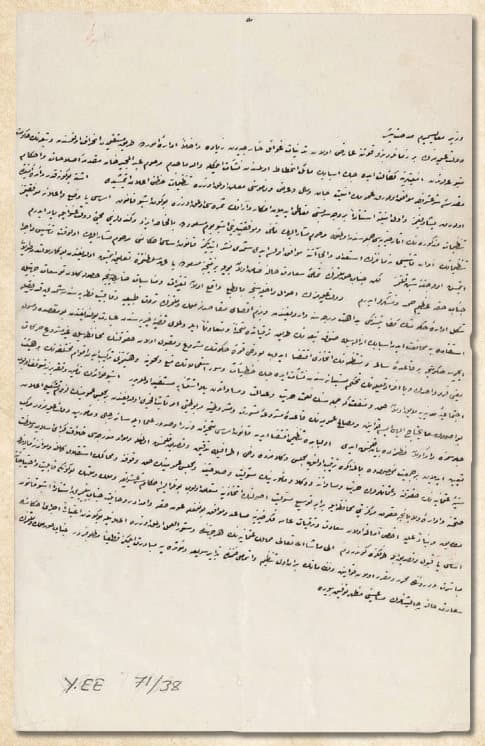
The approval and ratification of the Constitution by Sultan Abdülhamid II
Decree on the approval and ratification of Kânûn-ı Esâsî (First Constitution) by Sultan Abdülhamid II, which was prepared by a commission and approved by the Meclis-i Vükelâ (Council of Ministers).
December 24, 1876
My Vizier Midhat Pasha,
The decline of our esteemed state from its former strength for some time is not primarily due to external issues but rather stems from a departure from the right path in the administration of internal affairs and the weakening of the bonds that would ensure the trust of the subjects in the governments to which they are attached.
My dearly late father, Abdülmecid Khan, announced the “Tanzimat Edict” as the beginning of reforms, declaring that the life, property, honor, and dignity of everyone were under the protection of the state for the sake of ensuring its security.
Thus, our ability to live securely until today and, based on this confidence, to put the fruits of thoughts and opinions freely forward, including putting the Kânûn-ı Esâsî into effect and declaring it today, is a result of the auspicious achievements of the Tanzimat era. On this joyful day, I especially mention the name and accomplishments of my dearly late father, referring to him with the title muhyii devlet (reviver of the state).
If the days when Tanzimat was declared were in
accordance with the conditions of our time, there is no doubt that my dearly passed father would have put Kânûn-ı Esâsî into effect we are publishing now. However, because the gracious God has aligned such a happy ending that brings satisfaction to our people with the time of my reign, I express immense gratitude and thanks to the Almighty for this infinite gain.
It is quite clear that due to the natural changes occurring in the internal affairs of our esteemed state and the expansions in external relations, the administrative structure of the government has proven inadequate. Our main goal is simply the realization of the ideal that the obstacles preventing the proper utilization of the natural wealth and talents of our country and people are eliminated. This ideal revolves around the unity and cooperation of every class of the population, working together for progress and development.
To achieve this goal, the government must be established on a strong and orderly foundation. This involves safeguarding the legitimate and acceptable rights of the government’s power from illegitimate actions—in other words, eliminating errors and abuses arising from arbitrary and oppressive rule by a single individual or a small group. The ability of the nations forming our society to benefit uniformly from rights and interests worthy of a modern social structure, such as liberty, justice, and equality, depends on the fulfillment and implementation of these principles. Since what these principles require is the establishment of laws and the adherence to the principles of consultation and constitutionalism in public affairs, the creation of a general assembly was declared in our imperial edict announcing our accession to the throne.
In this regard, the necessary Kânûn-ı Esâsî has been prepared through deliberations in a special commission appointed from viziers, scholars, and other statesmen and officials. It has been
thoroughly examined and approved by our Meclisi Vükelâ.
The articles it contains are related to the rights of the Ottoman Sultanate and Caliphate, the freedom and equality of the Ottomans, the responsibilities and authorities of deputies and officials, the rights and powers of the general assembly, the complete independence of the courts, the establishment of financial balance, and the implementation of the method of expanding responsibilities along with the preservation of central law in provincial administrations.
These provisions are in accordance with the principles of Sharia, meeting the current needs of the country and the people and aligning with the general goal of development and prosperity, which is one of our foremost aspirations. Relying on divine assistance and the spirit of the Prophet, I have sent this Kânûn-ı Esâsî to you for ratification and approval.
As long as God wills, we desire that, starting from today, the proclamation be effective throughout every part of the Ottoman lands, and we urge swift
and effective measures to commence the implementation of the provisions. We also emphasize the prompt completion of the laws and regulations outlined in its content. May the Almighty not render in vain the efforts of those striving for the happiness of our country and people.
BOA.Y.EE, 71/38
Source: Innovation, Inventions and Quests Among the Turks