
Transport & engineering
Automobile First automobile brought to Ottoman territory is returned from
customs
The automobile refers to a vehicle that moves on its own. Initially, automobiles had steam engines, but later they transitioned to using gasoline engines. It was realized that the steam engine, which was useful for locomotives, was not suitable for vehicles that needed to maneuver easily and be lightweight. This realization led to new explorations. In the 1890s, companies such as Daimler Motors Corporation and Benz & Cie. in Germany, Peugeot, and Panhard et Levassor in France, Società Italiana Bernardi and Lanza in Italy, Duryea Motor Wagon Company and Ford Motor Company in the United States produced the first examples of automobiles. They resembled horseless carriages in appearance. In 1903, France had a 48.77% share of world automobile production with 30,204 units. During the same year, the United States produced 11,235 units, the United Kingdom 9,437, Germany 6,904, Belgium 2,839, and Italy 1,308 automobiles.286
The automobile, which started to be seen in major cities in Europe, came to İstanbul after a while. The first automobile to arrive in İstanbul was
ordered by Memalik-i Şahane Duhanları Müşterekül Menfaa Reji Şirketi (shortly Reji, Ottoman Tobacco Company) and brought to İstanbul Harbor in July 1904. The vehicle was transported in three crates and in unassembled form. Customs officers, who had never seen such a thing before and were quite surprised, learned from the person bringing the vehicle that it was a gas-powered automobile. Consequently, the customs officers referred to the vehicle as zâtü'l hareke, meaning self-moving. However, since there was no procedure in the customs tariff for automobiles, the officials hesitated on whether to allow the entry of the vehicle or not. The Council of Ministers, evaluating the matter in its meeting on September 18, 1904, decided to return the vehicle to its place of origin, citing that the streets of İstanbul were not suitable for the operation of automobiles.287
Around the same time, Teftiş-i Askerî Umûmî Komisyonu (Military Inspection Commission) conveyed in its letter dated August 16, 1904, that some countries had started using automobiles to
1904
Figure 1 Periods when
automobiles came to İstanbul land transportation.
expedite communication in their armies. It was reported that the benefits of using automobiles during military operations had been observed in practical exercises. It was deemed appropriate for our army to acquire one automobile from Europe for experimentation.288
While the ban on automobiles persisted, some affluent families did not refrain from secretly bringing automobiles to İstanbul due to their enthusiasm for this means of transportation. In May 1908, Sultan Abdulhamid II addressed this issue, warning and urging the government. Abdulhamid II pointed out that recently some individuals had brought automobiles to İstanbul, causing accidents in Şişli, Kâğıthane, and Üsküdar. In response to the Sultan's warning, the government assessed the situation and decided to maintain the ban on automobiles in İstanbul. Automobiles could be used outside the city.
The permanent arrival of automobiles in İstanbul took place after the declaration of the Second Constitutional Era on July 23, 1908. According to some sources, the first automobile brought to İstanbul for personal use was by Ahmed Pasha,
the deputy from Basra. Ahmed Pasha had obtained special permission for this from Sultan Abdulhamid II.
After the constitutional monarchy, some entrepreneurs took action to obtain the privilege of transporting goods by automobile in İstanbul, taking advantage of the flexibility shown towards automobiles. However, regulations for automobile traffic had not yet been established. No privilege was granted to any company before issues such as taxes on automobiles and public safety were clarified. The number of automobiles in İstanbul started to increase, being used both as official vehicles and private cars by wealthy individuals. Between 1908 and 1914, there were an estimated 100-150 automobiles in Istanbul, most of which were official vehicles. These automobiles were imported from Germany, France, England, and Italy. The concept of a chauffeur (driver) did not exist yet, and those who operated the automobiles were referred to as otomobil çarkçısı (automobile wheelman).
With the increase in the number of automobiles, certain measures were taken, and on December
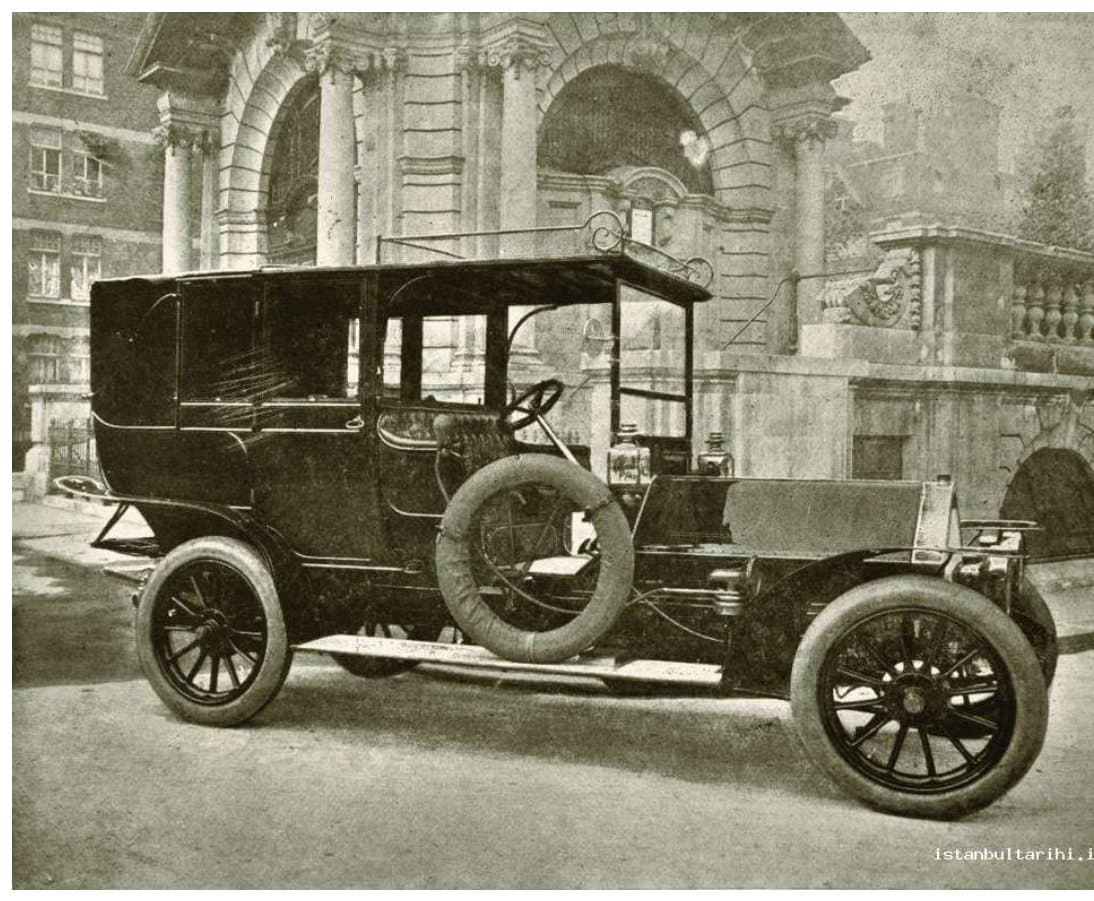
Figure 2 1910 Ford-T automobile
24, 1913, regulations related to automobiles were included in the municipal police duties regulation. According to these regulations, automobile engines should operate quietly, without the risk of explosion or combustion, and should not emit excessive smoke or foul odors that would disturb pedestrians. The brakes must be sound and capable of preventing the vehicle from rolling backward on steep inclines; otherwise, the automobile could be prohibited from operating. Each automobile must have two plates, one in the front and one in the back, with black backgrounds and thick, legible white lettering; these plates should be illuminated at night. Two lanterns, one green on the right and one white on the left, should be present at the front of the car; large lanterns should not be used within city limits to avoid dazzling and causing accidents. Each automobile must be equipped with a whistle audible from at least 50 meters away. Drivers without a license for automobiles, buses, and trucks would be dismissed from their positions.
Automobile drivers, when coming to a stop, were required to either extend their hands out of the window or sound the whistle three times to warn those behind them. If someone wanted to overtake the vehicle in front, they would sound the whistle three times, pass the leading vehicle from the left, and then continue using the right side of the road. The speed limit for automobiles was ten km/h within the city and thirty km/h outside the city. In narrow and crowded places, this speed would be equal to that of horse-drawn carts. Those exceeding the set speed in the city would be penalized.
The operation of new transportation vehicles, including automobiles, in İstanbul was organized with this regulation, establishing the first traffic rules in the country. Another regulation regarding automobiles was related to taxes. Commercial automobiles with engine power up to twelve
horsepower would be subject to an annual six lira tax; those with 12-20 horsepower would pay ten lira, and those exceeding twenty horsepower, as well as buses and trucks, would pay fifteen lira in municipal taxes. Private and foreign-owned automobiles would be charged fifty percent more than these amounts. Official vehicles were exempt from taxes. When passing through the Galata Bridge, automobiles were required to pay a fee. Passenger cars would pay two kuruş, empty commercial cars five kuruş, and loaded ones would pay twenty kuruş. Additionally, for automobiles that had to cross the bridge regularly, there was a monthly payment of one and a half lira for a pass.289
Refusal of customs entry of the automobile to be imported
A decision by the Council of Ministers regarding the return of a single automobile that came to customs on behalf of the Reji administration. This decision was made due to the unsuitability of streets of İstanbul for the passage of such gasoperated vehicles.
September 18, 1904
Minutes of the deliberations of the Council of Ministers Date: September 18, 1904
Summary:
A report was presented regarding the examination of the contents of three crates that arrived for the Reji administration on behalf of Forniyal via the vessel named Menkareli of the Messageries Maritimes from Marseille. It was determined during the inspection that the crates contained an unassembled automobile. It was declared that it operated on gas. Due to the absence of a decision either permitting or prohibiting the import of such vehicles, there was hesitation about allowing its passage. The report also mentioned that similar applications were being made for other cars arriving on behalf of different entities. This information was conveyed through the accompanying documents of the Customs Office, and the report from the Ministry of Internal Affairs dated July 21, 1904, was read.
Decision:
The fact that the streets of İstanbul are not suitable for the passage of such gas-powered vehicles has led to the decision to return the vehicle in question to the place where it was found, and it has been decided to make the necessary notification to the Customs
Administration in this regard and to forward it to the Ministry of Interior in response.
Signatures of the members
MV, 110/10
Purchase of an automobile from Europe to be tested during military operations
The automobile, which is used in the armies of some states to speed up communication, is expected to be useful during military operations, so one is brought to be tested.
September 18, 1904
Military Inspection Commission
The durability and resilience of the automobiles produced for the transportation of the second and third armies, serving as indicators of the level of advancement the repair workshop has reached, are evident in each detail. Similar to European armies, the ability of these automobiles to be towed by locomobiles290 when needed aligns with the thoughts of our Sultan regarding the necessity for our army to follow all military developments available in other state armies and in line with the advancements of the era.
However, it is understood that in some state armies such as Germany and France, automobiles are used by commanders to expedite communication and deliver orders. The benefits of
this practice have been observed during major maneuvers and military operations executed by the mentioned states. While it is considered appropriate for our army to experiment with the usage of one locomobile and one automobile by ordering them from Europe for the purpose of testing, the decision on this matter is left to your discretion.
August 16, 1904
(signatures)
Y.PRK.KOM, 13/30
Source: Innovation, Inventions and Quests Among the Turks