
Transport & engineering
1907
Varda Viaduct The latest engineering masterpiece of the Ottoman period with its
elegance and magnificence
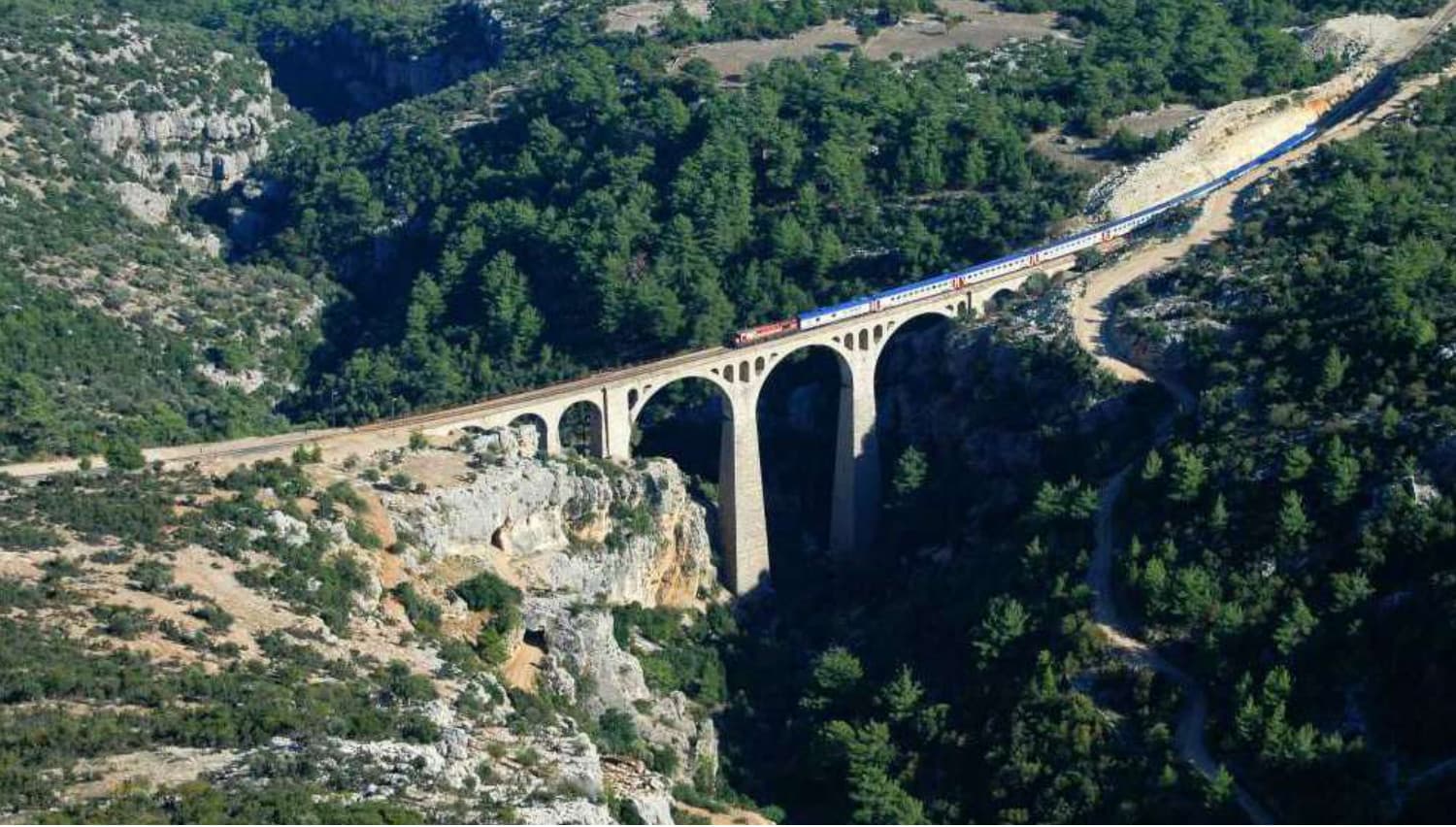
The Varda Viaduct, also known as the Giaour Dere Viaduct, is a railway bridge located in the Adana province. Popularly referred to as the German Viaduct or Koca Bridge, it is part of the Konya-Adana railway line, which is a segment of the Baghdad Railway. Situated in the Karaisalı district, just southwest of the Hacıkırı train station, it is at the 307th kilometer. Adana Central Station is 63 km to the south. The bridge, with a length of 172 meters, boasts an exceptional height of 98291 meters, making it the highest railway bridge in Turkey.
The masonry viaduct is constructed in the form of a stone bridge with 3 main spans supported by 4 main piers. The bridge piers are of the steel abutment type, and the external cladding is built using stone masonry technique. Near the Varda Viaduct, there are two tunnels used for vehicular transportation during construction, as well as unused bridge piers today. Before the construction of the Varda Bridge, an old road
with a “U” shape, which posed a high risk during the passage of a train due to its form, was abandoned after the completion of the construction of the bridge, which directly crosses the valley.292 The structure is constructed as an eleven-arch stone bridge. Each of the three main spans has a width of 30 meters. The viaduct extends along a north-south direction on a curve with a radius of 1,200 meters.
The passage through the Taurus Mountains constituted the most challenging section of the Baghdad Railway from a technical standpoint. A total of 37 tunnels, with a combined length of 20 kilometers, had to be constructed in this region. Numerous bridges were built, among which the Varda Viaduct stands out as the most famous in terms of architecture and engineering. The viaduct was designed by the German engineer Winkler, an employee of the German construction company Philipp Holzmann. Construction began in 1905 and was completed
Figure 1 Varda Viaduct by Nicholas Mavrogordato after Winkler's death. Basic construction work was completed in 1907.293
The bridge is commonly depicted with its sturdiness and elegance. Typically, an image of the Varda Viaduct accompanies descriptions of the Baghdad Railway. The climax of a dramatic chase scene in the opening sequence of the James Bond film Skyfall was filmed at the Varda Viaduct. The James Bond film made the railroad bridge known worldwide.294
The project involved the construction of 37 tunnels between Konya and Kelebek. The most
challenging section of this phase was the construction of 12 tunnels, 7 bridges, and the famous Varda Viaduct between Belemedik and Hacıkırı. The demanding nature of this stage necessitated the establishment of a logistical base in Belemedik, allowing personnel to stay and work in the region for an extended period. In this context, the first structures in Belemedik began construction in 1905.
Although tunnel construction started from Hacıkırı in 1905, Tunnel No. 20, which reached Belemedik, could only be fully opened in December 1914. Meanwhile, in 1911, the ItalyOttoman War broke out in Libya, leading Italians
Figure 2 Tunnel 5 drilling
works in the Taurus Mountains. (holzmann-
bildarchiv.de/ bauhistorische-forschung/
holzmann-in-nahost)
working on bridges and viaducts to abandon their jobs and leave. Subsequently, due to the Balkan Wars of 1911-1912, mobilization was declared, and anyone capable of bearing arms was conscripted into the military, resulting in the depletion of the Belemedik and Hacıkırı construction sites. To address this, a decision was made to bring technical personnel and soldiers who were taken as prisoners of war on the fronts to Belemedik. Initially, with the arrival of those captured in the Gallipoli Campaign and later those captured in the Caucasus, Belemedik became an international settlement. As of 1916, out of the 3,354 prisoners of war in Belemedik, it is reported that 1,537 were Russian, 728 were Indian British, 78 were French, and 1,011 were British.295
During World War I, the construction of the 12 tunnels between Belemedik and Hacıkırı had not yet been completed. On February 16, 1916, the Minister of War, Enver Pasha, who was passing through Hacıkırı, realized the lack of qualified workers, personnel, and budget, so 8 million Marks were provided from the Düyûn-ı Umûmiyye (Ottoman Public Debt Administration), and a military unit of 450 people from Germany, including expert railway technical personnel, was sent as reinforcement.
Philipp Holzmann AG, which undertook the construction of the Baghdad Railway, was founded in 1849 and gradually transformed from a national company into an internationally successful construction company. One of Philipp Holzmann AG's largest and best-known foreign projects is the construction of the Baghdad railroad. This railway is an engineering masterpiece and one of the most complex infrastructure projects of its time. In this context, the company executed the construction of various bridges, tunnels, train stations, and other
buildings. After securing the financing for the railway construction, upon the request of Georg von Siemens, the construction company Philipp Holzmann took on the construction works of the project. This marked Philipp Holzmann‘s entry into the international construction sector and symbolized the beginning of a new dimension for the company. Construction of the Baghdad Railway began in the year 1903. Initially, the route extended from Konya through Ereǧli to Burgulu at the foothills of the Taurus Mountains. The first phase of the construction was completed in 1904. Due to the route passing through the plain, there were very few technical difficulties. Beyond Burgulu, the railway line reached its highest point in Ulukışla. Construction work was halted for six years due to the challenging nature of building the railway on
Figure 3 Bridge construction
on the line (holzmann-
bildarchiv.de/ bauhistorische-forschung/
holzmann-in-nahost)
the rugged mountain range and the excessive costs involved. Construction experts equipped with precision instruments struggled for days to map out a route around the Taurus Mountains in impassable terrain.
The passage through the Taurus Mountains became possible with the construction of a large viaduct across the Gavurdere Valley. The construction of the viaduct, which would be known as the Varda Viaduct, began in 1905 and was completed two years later. At the beginning, to enable transportation, a mountain road was constructed with a width of 4 meters and a length of approximately 37 kilometers. Due to political turmoil and the Balkan Wars, construction activities on the construction sites had to be completely halted three times and restarted four times within six years. Additionally, Turkey‘s entry into World War I on November 1, 1914, further worsened the situation both financially and engineering-wise. The mobilization of many engineers, technicians, officials, and workers
from various countries to join the war effort led to disorder on the construction sites as they were sent back to their homelands to take up arms.
Ultimately, it can be said that the engineers tasked with planning and constructing the Baghdad Railway had to overcome a series of challenges. The difficulties that began with the financing of the project were followed by geographical, political, and social obstacles. Additionally, the challenging working conditions and the shortage of qualified labor caused by World War I can also be noted. Despite all these challenges, engineers and planners managed to skillfully overcome the formidable natural barriers, successfully navigating through the Taurus Mountains.
This unique railway line held great significance both economically and culturally. Not only the railway line itself but also a series of stations and administrative buildings were constructed based on it. With this legendary project, Philipp Holzmann made an international breakthrough
Figure 4 Construction
activities in 1912: The actively used line up to Ulukışla, the completed and
ready-to-use line between Ulukışla and Belemedik, and
the under-construction line
between Belemedik and Durak are indicated (Sevda
Yosul-Kübra Sahar, Die
Bagdadbahn)
in the construction sector and successfully established his company as a global entity. The Baghdad Railway is still considered one of the most impressive construction projects of that era.296
On the Ulukışla-Pozantı-Belemedik-Hacıkırı route, a total of 37 tunnels, more than 15 smallsized bridges, a viaduct, and 7 additional bridges between the tunnels had to be constructed. The most challenging section of the project was the 14 km stretch between Belemedik and Hacıkırı, and in order to build the planned 12 tunnels in this area, a 20 km service road needed to be opened. Additionally, there was another structure here that was as important as the tunnels, which later came to be known as the Varda Viaduct—the viaduct over Gavruderesi.
Among the 12 tunnels between Belemedik and Hacıkırı, the longest tunnel is 3,795 meters, while the second longest tunnel reaches 2,200 meters. The total length of the tunnels in this part of the Çakıt Valley is 11,805 meters. Considering that the railway length here is 14 km, it can be observed that only 2,195 meters are left unoccupied.297
Varda Viaduct is part of the 37 km Belemedik (Karapınar)-Durak line, constituting the most challenging section of the Baghdad Railways. Due to its great military importance during the war, efforts were repeatedly made to complete it quickly. Friedrich Bronsart von Schellendorf, chief staff of the Ottoman Army, in a letter dated September 11, 1915, addressed to Dahiliye Nezâreti (Ministry of Interior), requested the examination of the completion of the construction solely from a military perspective. He stated that it was considered the safest way to deliver an effective blow to the British in Egypt.298 As the war was ending in 1918, construction activities were still ongoing. Temporary passages were provided in some
ROUTE SECTION LENGTH
(KM)
OPENING DATE
Konya-Burgulu 25.10.1904
Burgulu-Ulukışla 01.07.1911
Ulukışla-Karapınar (Belemedik) 21.12.1912
Karapınar-Durak 09.10.1918
Durak-Yenice 27.04.1912
Total
Figure 5 Construction of the
Varda Viaduct
unfinished sections. In a document dated November 13, 1918, signed by the Minister of Public Works, it was stated that although temporary passage was provided in the Taurus and Amanos sections of the Baghdad Railway, construction work had not yet been completed, and efforts were underway to complete it. As construction costs up to five thousand liras per day to complete, and the company lacked the necessary funds, it would not be possible to continue construction.
Therefore, there was a possibility that the temporary sections would be demolished or ruined, and therefore transportation would be interrupted. However, suspending construction work on the Taurus tunnels, which were obliged to be secured and kept in a condition suitable for passage in accordance with the special article of the treaty, would lead to misunderstanding, and the destruction of some parts would also cause
suspicion.299
Here are some details about the general construction process of the Baghdad Railways that will help better understand the strategic importance of this line: The significance of railways in military and economic terms led the Ottoman Empire, with its vast territories, to take new measures. In 1865, İbrâhim Edhem Pasha was appointed to head these efforts, leading to the establishment of Nâfia Nezâreti (Ministry of Public Works). From 1870 onwards, comprehensive railway construction projects were carried out, and their implementation possibilities were investigated. With this goal in mind, the construction of a large railway line connecting İstanbul to Baghdad was decided. The first part of this project, the Haydarpaşa-İzmit line, which started in 1872, was completed quickly. However, due to financial difficulties faced by the state, the extension of this line was
Picture 6 Belemedik during
the construction of the line
(holzmann-bildarchiv.de/ bauhistorische-forschung/
holzmann-in-nahost)
halted until 1888, and foreign capital was needed to complete the line.
The financial situation of the Ottoman Empire, especially regaining credibility in European financial circles after the establishment of Düyûn-ı Umûmiyye (1882), and the interest of Ottoman governments in railways paved the way for the emergence of new railway projects.
While the activities of British and French investors increased the competition and conflicts among each other from 1888 onwards, Germany emerged as a new power in the construction of railroads. By a decree of the Sultan dated September 24, 1888, the construction and operation of a railway between Haydarpaşa and Ankara were entrusted to Alfred von Kaulla, the director of Württembergische Vereinsbank, who had close relations with the Ottomans due to arms sales.
On March 4, 1889, the Chemins de Fer Ottomans d'Anatolie (Anatolian Railway) was officially established. Thus, the construction of the railway line to Baghdad, which had been initiated in 1872, albeit with delays, resumed. The Anatolian Railway consistently carried out its construction activities and fulfilled its commitments for further lines in a timely and efficient manner, thanks to the new privileges it obtained. In 1890, the İzmit-Adapazarı line was completed, followed by the completion of the Haydarpaşa-EskişehirAnkara line in 1892 and the Eskişehir-Konya lines in 1896, resulting in a railway network exceeding 1,000 kilometers. During the inauguration ceremony of the İzmit-Adapazarı line, the Ottoman government announced its intention to extend the railway to the Persian Gulf and intensified its contacts with the Germans.
During the second visit of Kaiser Wilhelm II to
Figure 7 Construction of
Varda Viaduct Istanbul in the early months of 1899, it is understood that discussions between Sultan Abdulhamid and Emperor Wilhelm included the extension of the railway line to Baghdad and Basra beyond Konya. On November 25, 1899, when the Council of Ministers decided to extend the line to these areas, Wilhelm sent a thank-you telegraph to Sultan Abdulhamid for the fulfillment of his requests during his visit. In the early months of the same year, a German commission came to İstanbul to examine the economic and strategic aspects of the section that would connect the Konya line to Baghdad via Aleppo.300
Russia, England, and France were opposing the extension of the railway to Baghdad. Allowing England to increase its military presence in Egypt
and granting France the privilege of extending the İzmir Town line from Alaşehir to Afyon prevented opposition from these states.
The Baghdad railway agreements went through very complicated stages before taking their final form. The preliminary privilege agreement was signed on December 23, 1899, and the main privilege agreement was signed on January 21, 1902. Finally, on March 21, 1903, a contract was signed for the financing of the first line, the 250kilometer Konya-Ereǧli line. On April 13, 1903, the Baghdad Railway Company was officially established. To expedite the construction, the Ottoman Empire immediately fulfilled its financial obligations and used the taxes of Konya, Aleppo, and Urfa as a kilometer guarantee.
The official language of the company was French. Its officials were required to wear a special uniform and fez. The company, dominated by German capital with 30% French capital, was also open to other investors. The concession agreement, which had a duration of 99 years, granted the state the right to purchase the company when the first thirty years elapsed. The construction of this railway, which continued during World War I and finally connected Baghdad to İstanbul without interruption in October 1918, was purchased and nationalized by the new Republic of Turkey on January 10, 1928.301
A different topic that needs to be highlighted here is the introduction. In Switzerland, the Rhaetian Railway connects two train routes that pass through the Albula and Bernina regions, crossing the Alps. The Albula line, opened in 1904, is 67 km long and consists of 42 tunnels and 144 viaducts. On July 7, 2008, the Albula and Bernina railways, part of the Rhaetian Railways, were listed as UNESCO World Heritage Sites under the name Rhaetian Railway
Figure 8 Varda
Viaduct
in the Albula/Bernina Landscapes. Landwasser Viaduct is considered one of the most distinguished parts of the Albula Railway. It is a single-piece structure with six curved limestone arches. Completed in 1902, it stands 65 meters high and spans 136 meters, with one of its ramps directly leading to the Landwasser Tunnel. When compared to the tunnels and bridges constructed along the Çakıt Valley, including the Varda Viaduct, it is evident that this contemporary structure is not inferior in terms of natural beauty. In fact, the Varda Viaduct, situated in the Çakıt Valley, is not only on par with its counterparts listed on the UNESCO World Heritage site for their natural beauty but is also higher and longer than the Landwasser Viaduct. The absence of even a highway reaching Varda Viaduct until recent years is an indication that we are not aware of the cultural value of the historical monument.
The edict for approval of the Baghdad railways tender
The concession decree of Abdülhamid II approving the construction and operation of the Baghdad Railways to the Anatolian Ottoman Railway Company for a period of ninety-nine years in accordance with the terms of the prepared contract.
March 18, 1902
The idea of constructing a railway between İstanbul and the province of Baghdad was envisioned as a means to improve the prosperity and economic and commercial development of Anatolia and Iraq. As a preliminary step, the existing railway from Haydarpaşa to İzmir was extended through Eskişehir to reach Ankara and Konya. Although the expected benefits were observed in the places where it was implemented,
the main intention is to extend this line to Baghdad, aiming to expand and spread the
advantages for the development of Anatolia and Iraq.
The Chairman of the Board of Directors of the Anatolian Railway Company, the late Dr. Georg von Siemens, has initiated efforts on behalf of the company to seek permission for the extension of the Anatolian Railway line to Baghdad.
The extension of railways in this manner is not only conducive to the development of the country’s infrastructure but also aligns with the notion of increasing the wealth of our citizens. As the content of the contracts and specifications appears to be in accordance with expediency and procedure, I gave my consent granting a ninetynine-year concession to the Anatolian Railway.
This decree was issued from the Dîvân-ı Hümâyun to fulfill the provisions of the contract and the terms and conditions and other provisions, and copies of the contract and specifications are provided herewith.
BOA.A.DVN.MKL, 43/7
Source: Innovation, Inventions and Quests Among the Turks