
Health
1400
Dârüşşifâ (Dâr al-Shifâ) The Healthcare System Introduced to the World by the Turks
In the social state understanding of Anatolian Turkish states, medical education, which holds a significant place, was conducted in parallel with the concept of serving the patient. The institutional units where these medical activities were carried out were darüşşifas (hospitals) and medical madrasahs.
In the simplest sense, darüşşifas can be described as places where health services are provided to the public. In addition to the name dârüşşifâ, these health institutions are also referred to as şifahane, mâristan, bimâristan, dârüssıhha, dârülâfîye, and darüttıbb in Anatolia. In these healthcare institutions, health services were provided to the public without discrimination based on religion, language, or race.
The health institutions built in Anatolia during the Seljuk and Ottoman periods continued their functions in a manner that resembled the scientific hierarchy of Nizamiye madrasahs. Under the context of an individual endowment system as a social assistance idea from beginning to end, the Ottoman period is known
to have inherited the functions of health institution structures and continued to offer medical education and health services.
With the beginning of the Turkish era in 1453, starting with the conquest of İstanbul by Fatih Sultan Mehmed, health services and health education gained special importance along with the emphasis on general education. Health institutions and medical madrasahs founded in Anatolia during the Anatolian Seljuk and Beylik periods were the first places in the Ottoman State where health care and health-related education were provided. In addition to these, the construction of the Yıldırım Bayezid Complex, the first university-level complex of the Ottoman Principality, was completed in 1395 in Bursa. Besides a madrasah for religious education, a medical madrasah and a dârüşşifâ structure were also built in this complex.
The functional structures in the Yıldırım Complex are important in terms of their numerical multiplicity and diversity. The health institutions and madrasahs in this complex are particularly significant in the history of
education. While the dârüşşifâ in the complex serves as a medical practice area and a unit providing services to patients, the two madrasah structures serve as educational units, one providing religious education and the other medical education. The construction of such a dârüşşifâ structure in the second capital, Edirne, would take place in the complex named after Sultan Bayezid II.
In the mid-15th century, there were only two health institutions in İstanbul during the Byzantine era. These were the monastery complexes around the Hagia Sophia Church and Monastery of the Pantokrator (Zeyrek Mosque), including a guesthouse, a poorhouse, and a complex with a hospital. This complex was repaired by Mehmed the Conqueror after the conquest and, under the name “Old Soup Kitchen” (Eski Imaret Mosque), continued to provide health services for some time.
Seventeen years after the conquest, the construction of the Fatih Complex (1456-1470), including the dârüşşifâ structure, is documented in archive records. After the dârüşşifâ structure, which held a privileged place among the structures of the Fatih era architect Atik Sinan, Sultan Bayezid II also included a dârüşşifâ structure in the complex he had built in Edirne on the banks of the Tunca River after Tokat and Amasya. The dârüşşifâ, later known as the “New Soup Kitchen” (Yeni Imaret Mosque), was built between 1484-1488, adjacent to the madrasah structure. The last section of the dârüşşifâ included a sequence of six chambers behind the galleries for mentally ill patients. Evliya Çelebi mentioned that medicinal plants used in pharmacy were cultivated in the gardens near the dârüşşifâ and that “music therapy” was applied in the
treatment of mental patients. He also described the distribution of prepared medicines to patients free of charge twice a week.
In the Ottoman period, isolation structures for epidemic diseases, especially for the contagion and prevalence of leprosy, were built, known as isolation wards or leprosariums. The first of such structures is known to be in Edirne, called the “Miskinler Tekkesi,” built by Sultan Murad II (1421-1451), which served for two centuries.
In the 14th-15th centuries, it is known that some health institutions were built in places connected to the Ottoman State in Anatolia. In İstanbul, in 1514, Yavuz Sultan Selim had a structure built in Üsküdar known as the Karacaahmet Leprosarium, with a mosque and a series of rooms arranged in an “E” shape under the gallery being of particular importance.
The Hafsa Sultan Darüşşifa in Manisa joined the complex known by the same name in 1539. Before the dârüşşifâ, in 1538, a double bath was added to the complex, consisting of a mosque, madrasah, soup kitchen, hospice, and an elementary school in 1522. The structure was built by Sultan Suleiman the Magnificent in the name of his mother, Ayşe Hafsa Sultan.
The first physician of the dârüşşifâ was the scholar of his time, Müslihiddin Efendi, who contributed to the establishment of the Mesir Bayramı tradition.
In the mid-16th century, a second dârüşşifâ structure was built in the district known as “Haseki,” named Haseki Külliye, commissioned by Hürrem Sultan, the wife of Sultan Suleiman the Magnificent.
Another complex planned and built by the architect Sinan for Sultan Suleiman, the
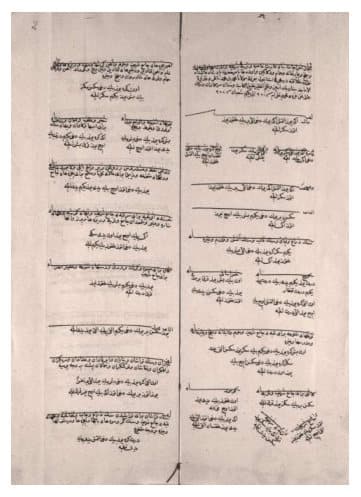
Document 1 The accounting summary
book showing the expenses of the imaret,
tomb, madrasas, soup
kitchen, kitchen, hospital, bath, shops, and rooms built in the
name of Sultan
Suleiman the Magnificent in İstanbul.
Mehmed is the overseer
of the job, Sinan Bey is
the treasurer, Halil is the secretary, and Sinan
is the architect of Dergah-ı Ali. The
period covered is between December 7, 1553, and May 28, 1559.
Süleymaniye Külliye, included a dârüşşifâ, a medical school, a pharmacy, and a dârü’lâkâkîr (pharmacy warehouse), forming a medical complex. The foundation inscription of the mosque, dated 1557, and the mosque’s inscription reveal that the construction of the complex took nine years.
The apprentice-master method of medical education, conducted in health institutions alongside patient care, reached its pinnacle in the Ottoman Empire with the Yıldırım Bayezid Külliyesi in Bursa. This complex featured a medical school where theoretical medical sciences were taught, a dârüşşifâ for practical application and patient care, a pharmacy for producing medications, and a storage facility for their raw materials.
Following this, the Atik Valide Darüşşifa in Üsküdar, on İstanbul's third peninsula, was planned and built by Mimar Sinan. Unlike previous examples, it was constructed as a single building. Commissioned by Nurbanû Sultan, the wife of Sultan Selim II and the mother of Sultan Murad III, the complex was completed in eleven years between 1570 and 1583, complying with the conditions of the land in a three-tiered area.
A new institution that joined these health institutions in the early 17th century is the hospital of the complex built by Sultan Ahmed I (1603-1617), planned and constructed by Chief Architect Mehmed Agha. Starting with the mosque in 1609, the completion of the complex, including the hospital, took place during the reign of his brother, Sultan Mustafa I (1617-18). The construction of the hospital, along with the other structures forming the complex, continued until the 1620s.
Among the hospitals built in the Ottoman capital between the 15th and 17th centuries, it is known that both theoretical and practical medical education took place in the Süleymaniye Hospital and Medical School. In others, it is understood that education was provided through the master-apprentice relationship, which was the contemporary method of education, without including a medical school.
In 1827, the first modern medical school was established in İstanbul. In 1826, while Sultan Mahmud II was abolishing the Janissary organization and attempting to establish a new army, he also initiated the establishment of new health institutions. A military medical school, a hospital, and several military hospitals were established. However, the cholera epidemic in İstanbul in 1826 and the smallpox epidemics in 1843 indicated the need for a new large hospital. Consequently, Bezm-i Âlem Valide Sultan, the mother of Abdülmecid, had the hospital, known by names like “Bezm-i Âlem Gureba-i Müslimin Hospital” and “Bezm-i Âlem Hospital,” built in 1845. With this structure, health facilities known as dârüşşifâ began to be referred to as “hospitals.”34
The expansion of the Seljuk Turks to the Mediterranean in the 11th century, serving as rulers and protectors of the eastern Islamic world, is now recognized as a turning point not only in Turkish and Islamic history but also in European history. However, this realization has only emerged in recent times. As the role played by the Seljuks in the emergence of the Renaissance era in Europe is thoroughly investigated, it becomes more evident how much they influenced European culture, especially European medicine, hospitals, and
university establishments.
The Nizamiye Madrasa in Baghdad, established in 1067 by Seljuk Sultan Alp Arslan, is considered by some scholars as the world's first official university. In addition to providing education in various fields, including medicine, this Nizamiye Madrasa also had a hospital. Prominent Islamic physicians, whose works were later translated into Latin, taught at this madrasa, such as Bağdadî. During the Seljuk era, the Mustansiriya Madrasa in Baghdad was founded, where, in addition to various sciences, medical education was provided. Furthermore, a medical madrasa was established in Basra.
So far, the Seljuk hospitals that have been documented include the Nur al-Din Hospitals in Aleppo and Damascus (1154), the Gevher Nesibe Hospital and Gıyaseddin Keyhüsrev Medical School in Kayseri (1206), the Keykavus Hospital in Sivas (1217), the Hospital of Turan Melik, the daughter of Behramshah, in Divriği (1228), the Pervane Bey Hospital, also known as Gök Madrasa, in Tokat (1275), the Atabey Ferruh Hospital in Çankırı (1235), and the Ali b. Pervane Hospital in Kastamonu (1272). Investigating these medical establishments reveals that the Seljuk Turks brought architectural features like the cruciform plan with four iwans and dome constructions, which later influenced the development of Gothic architecture in Europe. Additionally, they introduced animal figures inspired by their 12animal zodiac and motifs of the moon and sun to the Middle East, along with their ancient homeland.
Picture 3 Sivas Divriği Dârüşşifâ, Crown Gate
From the perspective of the history of science, a
Picture 1 Nur
al-Din Bimaristan in
Damascus
Picture 2 Crown gate
of Kayseri Gevher
Nesibe Medical
Madrasah and
Dârüşşifâ
crucial aspect is the widespread establishment during the Seljuk period of the first officially recognized universities in the form of madrasas sponsored by the state, as well as the first hospitals serving as clinics and medical faculties. Remarkably, some of these institutions, both madrasas and hospitals, have survived to this day as the oldest structures of their kind.
Prior to the Seljuks, during the Umayyad and Abbasid periods, it is known that many hospitals were built from Damascus and Baghdad to other regions where Islam spread. However, none of these have survived to the present day as structures, and there is no clear information in the sources about medical education being conducted in these hospitals during those times. Hospitals such as Nur alDin Hospital in Damascus (1154) and Gevher Nesibe Hospital and Medical School in Kayseri (1206), which have survived to the present day, were established during the Seljuk period. The most comprehensive information about medical education in the Islamic world belongs to the Seljuk period.
During the Seljuk period, there is evidence of a work titled Kütübü Câlînûs fi’tTıb, which was written on Galen's Hygiene (also known as On the Preservation of Health) and accepted as a medical doctoral thesis by the chief physician Haravi at Adudi Hospital. The existence of this work is understood from a manuscript currently present in the Hagia Sophia Library. This thesis is considered the oldest surviving medical doctoral thesis to date, and the method it represents has influenced the way theses are conducted in medical faculties in Europe. This is significant in symbolizing the progress achieved in medical education in Seljuk hospitals during
the Seljuk period.
The Nur al-Din Hospital in Damascus, which still stands today in its original form, is a structure with a central courtyard surrounded by a double-axis cross with four iwans, resembling Central Asian Turkish houses and Seljuk madrasas. Modeled after the Nur al-Din Hospital, the Kalavun Hospital was established in Cairo in 1284 by the Turkish-origin Mamluk Sultan Kalavun. It is known that the Kalavun Hospital provided theoretical and practical medical education, and it housed a large library containing books donated by Ibn al-Nafis.
Another example of the development of theoretical and practical medical education in hospitals during the Seljuk period is the twin complex built in 1206 in Anatolia (Kayseri), consisting of the Gevher Nesibe Hospital and the Gıyaseddin Keyhüsrev Medical Madrasa. The same tradition is observed to continue in 1555 with the Süleymaniye Complex. The renowned physician Bağdadî (1162-1231), who studied at the Nizamiye Madrasa in Baghdad and corrected Galen’s mistakes while practicing in Erzincan, worked alongside Alaeddin Davut b. Behram, a Seljuk bey from the Mengücek dynasty. His contribution to the construction of the hospital in Divriği, named after him and still standing today, at the initiative of Turan Melik, the daughter of this Seljuk bey, indicates the importance given to hospitals during the Seljuk period.
In the late Seljuk period, a noteworthy example of the continuation of medical education in hospitals is the hospital established in Amasya in 1309 in Anatolia. A Turkish physician named Şerefeddin Sabuncuoğlu, who worked as a doctor and instructor at this Amasya Hospital for 14 years, wrote a work titled Cerrahiyyetü’l
Haniyye in Turkish in 1465. This work includes images of patients and physicians as well as depictions of surgeries. Moreover, one of his students, Muhyiddin Efendi, who studied at this hospital, became the chief physician in the Ottoman palace. Another student, Gıyâs İbn Muhammed İsfahânî, upon returning to his homeland Iran, became the court physician of the Safavid Shah and wrote a medical work titled Mir’âtü’ṣṣıḥḥa.
In the Seljuk period, the journey of collecting the works of famous Islamic physicians in Baghdad and translating them into Latin by Constantin Africanus, who then brought these works to Salerno, played a crucial role. These works were subsequently used as textbooks in Salerno and other medical faculties in Europe. This influence signifies the high level of medical education achieved during the Seljuk period, extending its impact to Europe.
Additionally, the existence of a thesis resembling a medical doctorate conducted at the Adudi Hospital in 1178 indicates that, during the Seljuk period, completing a thesis was a requirement for obtaining a doctorate as a qualified physician. It is evident that, besides the final exams for medical education in hospitals, producing a thesis was a means of acquiring authorization as a doctor.
Despite the knowledge that the Hippocratic Oath, translated into Arabic by Abu Suleiman as Kitâbü’lAhd, was examined during the caliphate of al-Muqtadir in 931 CE, where all physicians in Baghdad were tested by the palace physician under the supervision of the controller (muhtesib) Ebu Batiha, and a regulatory organization called Hisba was established for this purpose, we learn how the controllers tested physicians during the Seljuk
period and administered the Hippocratic Oath through the writings of the 12th-century author Shaizar.
In the Anatolian Seljuk period in the 13th century, there is an indication from a letter written by the physician Zekioğlu Ebu Bekir Sadr-ı Konevî, who is presumed to have worked at the Gevher Nesibe Hospital and Medical School in Kayseri, that foreign physicians coming to Anatolian Seljuk territories in the 13th century were probably examined by official court physicians, possibly under the supervision of a Muhtesib. The results of these examinations were then reported to the qadi of the city. This control system for physicians in the Seljuk period appears to have similarities with the examination system established in the cities of Catholic Spain under various names such as hermandades, comunidades, and germanias, as revealed by the research of Professor Heinrich Schipperges.
During the Seljuk period, this system's development, which began in the Seljuk territories, was implemented in Sicily exactly as described in the Health Code introduced in 1140 by Roger II. According to the provisions of this code, those who would practice medicine were required to apply to officials and physicians (judges) involved in this matter. After an examination by these officials and physicians, individuals were expected to comply with their decisions. This system, which initially existed in the palace of the Anatolian Seljuk sultan and was practiced by physicians such as Yakubi, eventually evolved during the reign of Frederick von Hohenstaufen, the Emperor of Sicily and Italy. In 1231 and 1241, under the name “Constitutiones Medicinales,” laws were enacted in Italy and Sicily specifying the examination of
Picture 4 Qalavun Madrasa
and Dârüşşifâ in Cairo,
Egypt.
Picture 5 The surviving entrance door of the Puerta
de la Latina Hospital in
Madrid.
physicians, the practice of medicine, and the prohibition of physicians from engaging in pharmacy.
The fact that the lessons and books taught at the Salerno medical school were almost identical to those taught in Seljuk hospitals for becoming a physician, including the works of Hunayn ibn Ishaq, al-Razi (Rhazes), Ibn Sina (Avicenna), Galen, and Hippocrates, and the existence of a copy of a medical thesis written in 1178 during the Seljuk period in the Adudi Hospital in
Baghdad, which is now housed in the Hagia Sophia Library, demonstrates the influence of Seljuk hospitals and medical schools on the Salerno Medical School long before the enactment of the Constitutiones Medicinales in 1231 by Emperor II. Friedrich.
The Hippocratic Oath reached Christian Europe through Salerno during the Middle Ages, allowing the establishment of the tradition of medical ethics from the ancient era in the 13th century. Another interesting point is that after
the establishment of the Galatasaray School of Medical Education, a major turning point in the Westernization of Turkish medicine, on February 17, 1839, modeled after the Josephinum in Vienna, the tradition was revived in Türkiye with the first graduates reciting a pledge similar to the Hippocratic Oath in the presence of Sultan Abdülmecid during the graduation ceremony on September 18, 1843. The text of this pledge is very similar to the Hippocratic Oath taken during the Seljuk periodin the 12th century. Thus, the tradition of reciting the Hippocratic Oath by those who complete their medical education was established during the Seljuk period, then passed to Salerno and other European medical faculties in the 13th century, and returned to Türkiye in 1843 via Vienna, continuing as a tradition to this day.
Another indication of the significant influence of the Seljuks on the birth and development of universities in Europe is the division of students at the University of Paris according to their nationalities in 1254. This division, made 30 years earlier at the Mustansiriyya Madrasa in Baghdad in 1223 during the Seljuk period, where medical education was also provided, had a notable impact, dividing students based on their sects.
Renowned physicians who were trained at the famous hospital established by Seljuk Atabeg Nur al-Din Mahmud Zengi in Damascus made significant contributions to medical knowledge. Ibn al-Nafis, a famous figure from this hospital, made the discovery of pulmonary circulation before William Harvey. Ibn al-Quff's understanding of the capillary system predates Malpighi. In 1218, during the Crusades, Hugo Borgognoni (d. 1258) learned from the medical
practices of Islamic physicians in this environment, including the use of cannabis, henbane, and mandragora sponge for anesthesia before performing surgery. Upon his return to Bologna after the Crusade, he applied these methods influenced by Islamic medicine. Mondino de Luzzi (1275-1326), who studied anatomy in Bologna, wrote the first anatomy book with many terms in Arabic, based on dissections of human cadavers, influenced by Seljuk medicine and the Nur al-Din Hospital in Damascus.
The medical works of the famous physicians trained and taught at this hospital are not the only contributions; the architecture and organization of the Nur al-Din Hospital have influenced both Islamic and European hospitals. The central dome intersecting the cruciform plan with four iwans in Nur al-Din Hospital, as well as the 1457 construction of the “Ospedale Maggiore” Hospital in Milan by the architect Antonio Filarete, later influencing Renaissance hospitals in Europe, including the central dome in the cross-shaped plan similar to the hospitals in the Seljuk period, such as Nur al-Din Hospital in Damascus and the hospital established by Turkish Mamluk Sultan Kalavun in Cairo in 1284. These examples indicate the impact of Seljuk period hospitals on the crossshaped Renaissance hospitals in Italy, Spain, and consequently other European countries.
The fleurdelis motif, found as the emblem of Nur al-Din Zengi in Nur al-Din Hospital in Damascus and also appearing differently as the emblem of Turkish Mamluk Sultan Kalavun in Kalavun Hospital in Cairo, is interestingly used as the emblem of the hospital constructed by the Crusader Knights in Rhodes between 1440 and 1489. This motif, originally the emblem of the
Picture 6 Fleurdelis;
lily flower motif. Nur al-Din Zengi's coat of
arms was later transported to Europe through the Crusades.
Picture 7 L'Hôpital-
Saint-Blaise and Divriği dârüşşifâ interiors. This hospital in France was modeled after the interior of the
Divriği dârüşşifâ.
founder in Nur al-Din Hospital, later became the emblem of the French king through the Crusades, illustrating the cultural significance of Nur al-Din Hospital and Medical School in Damascus in the history of the region.
Use of fleurdelis in the coat of arms of the Kingdom of France
Bosnia and Herzegovina coat of arms used between 19921998
City coat of arms of Florence, Italy
Considering that Montpellier in 1222, Padua in 1224, Paris in 1254, Oxford, and Vienna in the 13th century are thought to be the oldest medical faculties in Europe, Nur al-Din Zengi Hospital in Damascus, established 848 years before them in 1154, has influenced the development of medicine with physicians like Ibn al-Nafis, who discovered pulmonary circulation before William Harvey, and Ibn Abi Usaybi'a, who wrote the oldest known universal history of medicine. Besides affecting the development of medicine, this Turkish medical center, along with other Seljuk hospitals serving as medical centers, has also influenced the hospitals and medical faculties of the Renaissance period in both Turkish Islam and Europe. The dome construction in L’HôpitalSaint-Blaise is a copy of the dome construction on the mihrab of the mosque built during the Umayyad period in Cordoba and the Seljuk hospital in Divriği.
The Seljuk Hospital established in Tokat, known today as Gök Madrasa, with its courtyard surrounded by arcades and a two-story structure, bears a resemblance to the hospital established by Muslims in Granada in the 14th century and the caravanserai known as Corral
del Carbon established in the 15th century. Furthermore, it shares similarities with the university building Onate-Universitad, established by Catholic Spaniards in the 15th century, and the Hospitali in Medina del Campo from the 16-17th centuries. These resemblances highlight the extent to which Seljuk hospitals influenced European hospital and university architecture.35
Until the 13th century, Europe, unfamiliar with the concept of hospitals, took inspiration from the dârüşşifâs (medical complexes) encountered during the Crusades and established hospitals like Saint Esprit in Italy and Le Quinzième in Paris. Others followed suit. In conclusion, as the French historian Claude Cahen stated, “The intellectual vitality in the Islamic world during the Middle Ages, when compared with Europe and Byzantium, is astonishing and admirable.”36
Recent scholarly research by German and Japanese Sinologists has revealed that Seljuk hospitals and medicine not only influenced Europe but also impacted medical establishments in China during the time of the Mongol Empire established by Genghis Khan. It is known that during Kublai Khan's rule in China, three hospitals were established in the style of Seljuk hospitals in Turkistan and Iran.
Thus, it becomes evident that the Seljuk hospitals and medical practices, functioning as medical centers, had a significant influence extending from China to Italy, France, and Spain. As a result, it would not be incorrect to say that they played a crucial role in the emergence of the medical Renaissance in Europe.37
Picture 8 Tokat Gök
Madrasa hospice. Exterior and interior
view
Source: Innovation, Inventions and Quests Among the Turks