
Science & discovery
1453
The Military Superiority of the Ottoman Empire
Weapon Technology, Logistics, Tactics
The conquest of İstanbul by Mehmed the Conqueror in 1453 marks the end of the Middle Ages and the beginning of the early modern period. Both Ottoman and Byzantine sources point to the use of cannons in the destruction of the walls during the siege of İstanbul as one of the reasons for the city's fall. Undoubtedly, the unprecedented size and power of the cannons used to bombard the walls led to the collapse of the massive fortifications. Additionally, disputes between the Byzantines and the Latins, along with the injury and resignation of the defense Commander Longo during the siege, are recorded as significant events that had an impact on the outcome.38
The development of gunpowder and the use of firearms in warfare are among the most significant events of the late Middle Ages. The first firearms were used by the Chinese from the 1280s onwards. This new weapon reached both the Islamic world and Christian Europe within two or three decades. It was particularly observed in European battlefield and siege situations for the first time, especially in the 1320s and 1330s. The Ottomans played a significant role in the
development and proliferation of cannons and gunpowder weapons in the Islamic world. It is believed that the Ottomans introduced these weapons to states such as Venice, Dubrovnik, Bosnia, Serbia, Genoa, and Byzantium, or their subjects, in the late 14th century.
In the 1440s, during the Ottoman-Hungarian wars, the Ottomans encountered field artillery and battalion tactics. After this period, cannons became even more important in both sieges and field battles. As demonstrated by the conquest of İstanbul in 1453, the Ottomans effectively employed cannons and the new gunpowder technology in both sieges and sinking ships. While in European states the professionalization of artillery took place over a long period from 1500 to 1700, the Ottoman Artillery Corps, probably formed during the reign of Sultan Murad II, was part of the Janissary Corps responsible for the casting and use of cannons. The Artillery Transport Corps, tasked with transporting artillery and manufacturing artillery carriages, likely formed in the second half of the 15th century.39
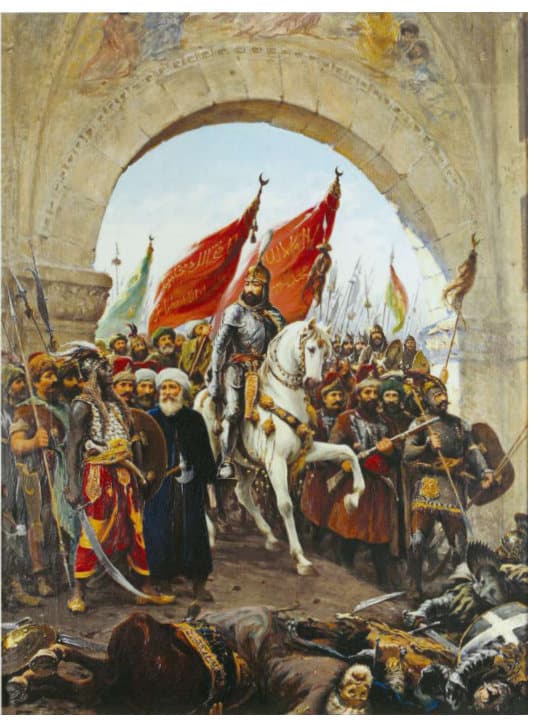
Picture 1 Zonaro’s Fatih
Sultan Mehmed’s painting depicting him entering İstanbul from
Topkapı during the
conquest
In the Battle of Varna in 1444, both the Ottomans and the Crusaders had cannons and rifles. The Crusaders had more cannons, and their cannons were mounted on carriages. After defeating the enemy in the battle, Lala Shahin Pasha proposed taking their cannons, to which Sultan Murad II responded intriguingly: “You have taken a good measure, for a gift is needed for the Sultan [Mehmed II], because we waged this war for the intention of my son, the Sultan. Now, a little gift is needed for him so that his heart may be pleased.” This statement reflects the interest of Mehmed II (Fatih Sultan Mehmed) in cannons even before the conquest of İstanbul.
The era of Fatih Sultan Mehmed witnessed significant developments in the history of artillery. Initially, large-scale cannons for the siege of İstanbul, followed by mortar cannons, and later the development of siege cannons capable of firing projectiles weighing up to 700 kg, are crucial milestones indicating the progress in Turkish artillery during the reign of Mehmed II.40
Mortars, according to the generally accepted account, were first used as an effective weapon during the siege of İstanbul to sink enemy ships in the Golden Horn, and they were developed personally by Fatih Sultan Mehmed. The Sultan summoned the artillerymen to discuss the construction of a new cannon. During the meeting, he explained in detail how the mortar could be designed to ascend high and, upon descending, strike the middle of the ships to sink them. He provided specific measurements for weights, proportions, and instructions on how to aim the mortar at the target ships. The artillerymen then prepared the desired mortar based on these specifications.41
Fatih Sultan Mehmed sought the expertise of both local and foreign specialists in the field of
Picture 2 A 1464 falcon gun cast during the reign of
Mehmed the Conqueror and still in service in the Dardanelles in the 19th century, but gifted to England in 1868. It damaged six British ships during the British
invasion of Constantinople in 1807.
Picture 3 Siege of Constantinople: Jean Le Tavernier's (d. 1462) miniature, dated after 145,
shows Fatih's cannons in front of the city walls
(original in Bibliothèque Nationale de France,
9087/207).
artillery to realize his grand design, and he personally engaged in the planning of cannons with a ballistic approach. Before the siege of İstanbul, he had a large cannon cast. Shortly after being placed in the coastal tower of Rumelihisarı, this cannon, for the first time, fired upon and sank an unauthorized Venetian ship passing through the Bosphorus in November 1452. Similar to this cannon, which was used by the Turks against ships in the Dardanelles until the 19th century, a counterpart was presented to Queen Victoria in 1868 during Sultan Abdulaziz's European tour. The gifted cannon, now turned into a museum, is located at Fort Nelson in Fareham.42 In return, England presented two Armstrong cannons as a gesture of goodwill.43
The first cannons observed in Europe and the Ottoman Empire were made of forged iron, had a detachable gunpowder chamber, and were loaded from the rear. Initially small and crude, these cannons evolved into larger ones by the 15th century. Following the same path, the Ottomans produced twenty-two large forged iron cannons in Tophâne-i Âmire in 1517-1518. With lengths of 714, 558, and 491 cm, and average weights of 6,210 kg, these cannons were the largest known at that time. From the early 16th century, most of the cannons produced by the Ottomans were cast in one piece with a reliable internal gunpowder chamber. These cannons were generally made of copper (89.5% to 91.4) and tin (10.5% to 8.6) and fired stone balls or cast iron round shots. During the reign of Fatih Sultan Mehmed, the Ottomans advanced their artillery technology by casting and using massive cannons, some weighing 15-17 tons and firing projectiles ranging from 200 to 700 kg. However, the casting and transportation of such cannons were extremely challenging, and their usage remained limited to a few significant sieges and fortress defenses.
Figure 4. A six-barrelled mortar mounted on a
carriage at Belgrade Fortress. Bayramoğlu Ali Ağa, Ümmü’l-Gaza, Topkapı Palace, Baghdad:
368.
The cannons most commonly used in Ottoman campaigns were generally of medium size and small caliber. In this category, there were kolunburna, darbzen, and şâhî cannons. Contrary to the general perception, Ottoman kolunburnas were often lighter than their Spanish, Italian, or English culverins. Darbzen, meaning “combatant cannon,” had large and medium types used in sieges, while smaller pieces served as field artillery in battles. Small cannons, known by names like saçma, eynek, prangı, misket, and şakaloz, were typically made of cast iron and, as the name implies, were mostly used to fire clusters of shot. These shot
clusters were employed in fortresses and, particularly, on ships in the Black Sea and the fleets of the Ottoman Navy.
Ágoston argues that Western historians who compared Ottoman and European cannons and claimed that Ottoman artillery mainly consisted of cumbersome and heavy large cannons, thus suggesting that Ottoman artillery technology lagged behind Europe's ability to produce smaller and more mobile cannons, are incorrect. According to him, examining the records of revenue and expenses for Tophâne-i Âmire and the arsenals of the empire's main fortresses reveals that Ottomans cast and used various
cannons, ranging from the smallest ones firing 30 to 500 grams of shot to large cannons firing balls weighing between 31 and 74 kg. This observation applies equally to short-barreled mortars firing curved trajectory shells.44
Against the Western claims stating, “Ottoman cannons are not of high quality; they are heavier and inferior,” Ágoston provides examples from his own comparative studies. He demonstrates that Ottoman and European weapons are more similar in structure than assumed. Due to the Ottoman practice of casting large and mediumsized cannons from bronze in the 16th and 17th centuries, their cannons were not only lighter but also safer than those of Austria, Spain, and England of the same caliber. He attributes Europe's shift to iron cannons in the 16th and 17th centuries to their lower cost. He argues that the Ottoman Empire, being a wealthy country with no shortage of raw materials, continued to use bronze cannons.45
The rifle, a smaller firearm, is a hand-held gun with a wooden stock, consisting of a barrel placed on the stock and a firing mechanism in the barrel for igniting the gunpowder, along with a sight. In Ottoman sources, it is referred to as tüfenk, tüfeng, or tüfek. It consists of a non-stock, forged iron barrel that is muzzle-loaded and fires stone or iron bullets, utilizing a remote trigger-less matchlock firing mechanism, categorizing it as one of the earliest weapons, either a small-caliber cannon or a heavy rifle.
Although some historians dispute the earliest dates related to the use of firearms, it is generally accepted that the Ottomans started using rifles during the Ottoman-Hungarian Wars of 1443-1444 and the Second Battle of Kosovo. These weapons were likely matchlock or wheellock style firearms without a stock, resembling small cannons or heavy handheld firearms. While
similar matchlock arquebuses had been known in Europe since the 1380s, their use as handheld firearms emerged towards the end of the 15th century.
Archival sources indicate that the Ottomans began using cannons and rifles in their frontier forts in the Balkans from the mid-15th century onwards. According to these sources, soldiers using cannons and rifles in forts such as Skopje, Novo Brdo, Güvercinlik, and Resava were mostly Christian artillery and riflemen. Janissaries, during the reign of Sultan Murad II, employed firearms, but the number of janissaries equipped with rifles began to increase only towards the end of the 15th century. A German source from the same year as Sultan Suleiman the Magnificent's 1532 campaign in Vienna and Hungary claimed that out of approximately 10,000 janissaries, about 9,000 were equipped with firearms, while 1,000 carried only spear-type weapons, based on information obtained from Turkish prisoners of war.46
The Ottomans developed matchlock and flintlock mechanism rifles in the late 15th and throughout the 16th century, creating a unique type of rifle. Known in military terminology as the Ottoman rifle, this weapon was easier to carry and use effectively compared to its contemporaries. It is known that this rifle was preferred not only by the Ottoman army but also in the Near and Far East.47
Although janissaries used matchlock rifles until the later years of the 17th century, the production of flintlock rifles increased steadily in the Ottoman Empire from the late 16th century onwards. Advanced versions of flintlock rifles, mainly produced in Spain, emerged by the end of the 16th century. These weapons, with contributions from the Ottomans, quickly gained popularity in the Mediterranean and the Balkans.
Picture 5 In the picture depicting Yavuz
Sultan Selim's siege of Damascus, the Ottoman army is depicted on the left and the
castle and the Mamluk army are depicted on
the right. It will be noted that there are no rifles in the Mamluk army. (Şükrî-yi Bitlisî,
Selimnâme, Topkapı Palace: H. 1597)
However, the early flintlock rifles were not as reliable as matchlock rifles: the flint could wear out, strike the ignition pan at the wrong angle, or fail to produce sparks to ignite the powder in the pan if it fell from the hammer. Therefore, like Europeans, the Ottomans also utilized combined ignition systems. In the 16th century, the number of janissaries armed with rifles became stable and was further increased.
Among the 7,000 janissaries mobilized for war, at least 4,000 of them were equipped with rifles. These specialized rifle-equipped janissaries were so skilled that neighboring countries seeking to acquire this weapon recruited them through various means. A small example is related to the attempt of Shah Ismail to form a rifle unit just after the Battle of Chaldiran. In 1515, Shah Ismail established a military unit of 2,000 riflemen under the command of Mirza Shah Hussein, but these riflemen, consisting of mixed soldiers, faced significant challenges in using rifles effectively. During the interrogation of a captured spy by the Ottomans, the informant revealed that, except for twenty janissaries who had defected from the Ottoman army, none of the members of this unit had any expertise in the art of shooting rifles. In fact, he mentioned that some of them had even burned their eyes and faces while attempting to use the rifles.
They will form a permanent rifleman unit from the Ottoman-like “ghulam” class.
It is emphasized that the development of the trigger mechanism, which perfected the firing process, is attributed to Turkish rifles. In other words, the refinement of the serpent-shaped trigger mechanism is presented as an Ottoman creation and technological contribution. According to Venetian sources, Turkish rifles had a serpent-shaped mechanism, and the ignition of the powder was ensured by placing a match in
this firing system. Therefore, making a generalization that all Ottoman rifles displayed in museums are heavy and cumbersome, based on their ornate appearance and mostly late dates, is not accurate. Ottoman rifles had a wide spread due to their lightweight and effective use. Especially in the early 16th century, they reached the Safavids, Muslim states in India, and even as far as China. There is information about the competition between Ottoman rifles and Portuguese rifles in China. In an interesting account, a Mamluk emir challenged the Ottoman superiority, stating that they were defeated not
Picture 6 Captain-General Halil Pasha's landing at the port of Marfendonia in 1620
and the capture of the castle
(Şehinşehnamei Nadiri,
Topkapı Palace, H 1124).
by the Ottomans' superiority but by the cannons and rifles they acquired from the Franks and used in violation of the Prophet's tradition, inviting the sultan to a mutual horseback combat.48
The sources provide conflicting information regarding the quality of Ottoman rifles. In a work written in 1606, there is a complaint that the rifles produced in state-owned places are of lower quality than those found in private weapon
workshops. On the other hand, there are foreign writers who claim that Turkish rifles have highquality metal, better ranges, and more effective power than Christian rifles. Technology historians confirm this claim, attributing the relatively stronger and more reliable nature of Ottoman rifle barrels to the use of flat steel plates that Ottoman rifle makers spiral-folded in a manner similar to Damascus swords. In the 17th and 18th centuries, rifles became even more
Picture 7 A musket
dating to 1520
diverse. During these centuries, the Ottomans kept a close eye on technological developments. New types of mechanized rifles developed in the West in the 19th century (cap lock and needle) were soon adopted in the Ottoman army as well.49
The central location for rifle manufacturing in the Ottoman Empire was the Tophane-i Amire, located in İstanbul. Initially, Tophane-i Amire consisted of shops belonging to rifle craftsmen in Unkapanı, but it later moved to a large building constructed in masonry on the shore of Cibalikapı. In the last quarter of the 18th century, rifle workshops were established in Hasköy and later in Levend Ciftlik under the supervision of rifle masters brought from Europe to manufacture rifles for use in European armies. However, this initiative came to a halt as a result of two uprisings in the early 19th century. The damaged equipment and skilled craftsmen from Levend Ciftlik were transferred to Tüfekhane-i Âmire in Cibalikapı, and efforts were made to continue modern and high-quality rifle production at the central rifle factory. Until the mid-19th century, the institution continued its service in its original location in Cibalikapı. In the 1830s, English engineers built a large building in Dolmabahçe to produce rifles in the European style using steam power. However, as the annexes of Dolmabahçe Palace, whose construction began in 1843, gradually expanded, the Dolmabahçe Rifle Factory was gradually
evacuated and moved to the modern weapons factory built within the industrial complex in Zeytinburnu. Growing with the establishment of machines and equipment specifically for the production of imported rifles from Europe over time, the Zeytinburnu Arms Factory operated as the Ottoman Empire's most important weapons manufacturing facility until the end of the empire.50
The organization and firepower of the Ottoman armies, although seemingly very effective compared to their rivals in the 15th and 16th centuries, have been somewhat overlooked. Some Ottoman researchers even argue that, in fact, there was no significant difference in Ottoman military methods and fortification styles compared to Westerners during these centuries, and that their military innovations were of European origin.
It is interesting to note the accounts of 10,000 rifles and cannons being fired simultaneously at the Battle of Chaldiran, with descriptions of the terrifying sound. Although dating back to the 18th century, another source, based on contemporary accounts from an earlier period, mentions that during this battle, Janissary riflemen “fired their rifles seven times in succession,” indicating that they collectively discharged their rifles seven times in rows. A selimname writer from the same period explicitly states that the janissaries, while standing and
Picture 8 Aflaki, Tercüme-i
Sevakib-ı Menakib
moving forward from their positions, “fired their rifles without stopping,” emphasizing that this was not an indiscriminate volley but a deliberate and accurate shooting, highlighting their excellent marksmanship skills.
Undoubtedly, their ability to make such effective shots indicates that they underwent special training. Additionally, it is evident from a directive dated 1552, addressed to the Janissary Agha, that the janissaries regularly practiced and learned rifle shooting techniques. In the late 17th century, Marsigli couldn't help but note that Ottoman riflemen took aim very accurately at their targets. In contrast to their Western counterparts' irregular and disconnected shots, the janissary rifle unit possessed the experience to deliver cohesive firepower through collective firing. Here, a comparison made with this information clearly indicates the precedence of the Ottoman practice. An undeniable example, such as the volley fire tactic employed in the Battle of Nagashino in Japan in 1575, could certainly not influence the West.
However, the constant confrontation with the Ottoman army was a different matter. In discussions of military revolutions, it seems certain that the Ottoman side provided a new and original basis for this practice.
In short, it can be concluded that Ottoman traditional order and warfare tactics, to some extent, evolved by internal modernization over time. The system was effectively maintained throughout the 17th century. The defeats during the Holy League Wars starting in 1683 may be related to the vast and well-organized coalition armies that emerged in Europe, presenting a massive and organized front against the Ottomans. By the European military era, armies similar to Ottoman strength were established by the late 17th century. Their supply system was
functioning well, a competent command structure was formed, and, most importantly, professional military institutions had emerged. Until the year 1700, the Ottomans generally kept pace with military technology and were able to set their own standards in some areas. They seemed to maintain their enviable position both in terms of the weapons they used and their methods of warfare.51
Recently, the assertion that the Ottomans started to decline technologically, especially in maritime technology after the defeat at İnebahtı and in land warfare technology during the 1593-1606 Ottoman-Habsburg Wars, has come under scrutiny. Gábor Ágoston argues that the employment of foreign experts, as well as the import of firearms, gunpowder, and lead—which were not exclusive to the Ottomans—cannot be considered signs of decline. He also challenges the notion that the Ottomans preferred large siege guns over small, highly mobile field guns, citing inventories of major fortifications such as Tophâne-i Âmire, Budapest, Belgrade, and Baghdad.
Ágoston even argues, based on foreign observations, that towards the end of the 17th century, the Ottomans were advanced in areas such as siege tactics and mining. Rhoads Murphey also notes that Ottoman rifles used at the end of the 17th century had a superior range compared to those used by Habsburg soldiers. In conclusion, due to the slow pace of technological development and the simplicity of existing technology, what made a difference during this period was more the quantity than the quality of produced weapons. Ágoston suggests that rather than technological backwardness, it is more appropriate to speak of a kind of structural backwardness. In other words, the difference between the Ottomans and their European rivals
Picture 9 Seyyid Lokmân, Şehinşehnamei Murad III,
Volume II, Vizier Ferhat
Pasha in the Revan
campaign.
should be explained not so much by the superiority of Western weapons but by the innovations made by European states in finance, bureaucracy, military intelligence, engineering, and architecture, coupled with state patronage in science.52
Feridun Emecen emphasizes that the function of firearms in the transformation of Ottoman military power became more apparent a bit earlier than Western examples. This situation highlights a different aspect that can be added to the privileges of the Ottoman military, such as an extremely disciplined military organization, the ability to easily mobilize army units, and impressive logistical support units. It will take until the 17th century for a Western-style organization and military structure to truly emerge in Western armies. The aspect where the Ottomans did not fully catch up, especially from the late 18th century onwards, would be the new technological developments gaining momentum in the West due to various commercial and economic factors.
The 17th century witnessed one of the most notable developments in European history, marked by a new shift in Western military systems and tactics, characterized by the incorporation of firearms and the deployment of different strategies based on them. This development is considered as crucial as Europe's social, economic, and technological progress. In European historiography, this phenomenon is often explained by the concept of a “military revolution,” interpreted as a manifestation of their military superiority over their adversaries. The argument asserting that the new military transformation began in the 16th century and was fully implemented throughout the 17th century, emphasizing the prominence of infantry and cavalry units armed with rifles during this
period, particularly gaining an advantage over the Ottoman Empire, finds considerable support. However, these views, largely advocated by Western historians, often rely on Western models and either briefly mention or entirely disregard the Ottoman military system without making a serious comparison, suggesting that the Ottomans failed to evolve beyond a cavalrycentric classical tactic.53
Ágoston argues that when the Ottoman Empire's readiness to accept technology, mass production capabilities, and the highly advanced Ottoman supply system integrated, Ottoman armies gained a clear superiority in firepower against their European adversaries in the mid-15th century. Comparative data indicates that until the late 17th century, the Ottomans maintained a superiority in firepower and logistics against the Austrian Habsburgs and the Venetians. In the late 18th century, Ottoman commanders on the Hungarian front realized that Europeans were better in the use of firearms than the soldiers of the Ottoman ruler. Therefore, both the Grand Vizier of that time and an insightful eyewitness advocated for the use of firearms. They encouraged the adoption of necessary countermeasures in tactical planning and proposed restructuring the army. Until the late 18th century, as there were no revolutionary innovations in firearms technology in Europe, the transfer of European technology was sufficient for the Ottoman logistical capability to keep pace with Europe. In other words, while the Ottoman Empire temporarily followed some changes, these changes were not significantly important, and the Ottoman Empire, with its logistics, was relatively content with the existing superiority of military technology in Europe.54
The reliance theory, which contends that the Ottoman Empire has always been reliant on
Picture 10 A mortar on a cart
and a device for measuring how much gunpowder to put
in it. (Bayramoğlu Ali Agha,
Ümmü’l-Gaza, Topkapı
Palace, Baghdad: 368)
imports for industry and technology, is put forth by the argument that the Ottoman Empire was unable to develop a local armaments industry that could have supplied the demands of its army. According to Ágoston, the Ottoman Empire had one of the strongest munitions industries of its time. It had artillery foundries, arsenals, and numerous gunpowder mills. However, to avoid the logistical and transportation expenses, the Ottomans cast cannons in provincial centers, using them in campaigns, and similarly, established powder mills in border provinces.
During a war or campaign, the Ottoman Empire typically needed around 10,000 kantars of gunpowder. This demand could easily be satisfied in the 16th and early 17th centuries. Due to reforms in the 18th century and certain modifications to the gunpowder mills, the Azatlı Gunpowder Factory was able to resume manufacturing enough gunpowder to meet demand after a brief period of insufficient production. In addition, Ágoston suggests that the Ottoman Empire lagged behind in standardization compared to Europe from the 18th century onwards, which contributed to
Austria and especially Russia surpassing them in tactics and munitions.55
The delay in the Ottoman transition from oared galleys to sail-powered galleons, compared to their rivals, has been a subject frequently emphasized by both local and foreign historians. According to this view, Ottoman maritime power declined, particularly after the defeat at İnebahtı, signaling the end of the Mediterranean as a “Turkish lake.” Whether the Mediterranean was truly a “Turkish lake” even during the zenith of the Ottoman navy is a matter of debate. Guilmartin, highlighting the indispensability of galleys, especially in the Central Mediterranean where the wind could be calm for weeks, argues that, after the İnebahtı defeat, not only the Ottomans but also Spain and France clung to galley fleets until almost the 18th century. He states that the shift from galleys to galleons was mainly triggered by the inability of small-sized galleys to handle the increasing cargo demand, a shift that took place during a period when, despite lacking a combat fleet class, the Ottomans had been constructing galleons for transporting military supplies since the 15th century.
According to Kate Fleet, the Ottomans had a regular navy in addition to their pirate fleets as early as the 1370s. However, becoming a naval power corresponded to the tenure of Barbaros as the Grand Admiral. Criticizing the views that argued the Ottomans were primarily a land power, that their naval expeditions were merely an extension of the concept of jihad, and that they never possessed the technological capacity necessary to be a naval power, Brummett highlights that the Ottoman navy was used not only for direct warfare but also to assist allies like France, enhance and protect trade (for example, activities in the Red Sea), transport necessary
supplies for the army, and ensure coastal security. He laments the neglect of these aspects by historians.
Imber, writing about how the unique conditions of the Mediterranean dictated the use of galleys and shaped Mediterranean navigation and the Ottoman navy, argues that because a galley could carry only about ten days’ worth of provisions, neither the Ottoman navy could dominate the Western Mediterranean nor could the Crusader navy effectively operate in the Eastern Mediterranean. He emphasizes that these conditions made it impossible for one power to dominate the entire Mediterranean.
Naval battles did not have the decisive impact on the course of events as land battles did. In other words, neither Lepanto nor Preveza produced outcomes comparable to the decisive field battles like Ridaniye or Mohaç. Immediately after the defeat at Lepanto, the Ottomans were able to create a large navy again due to the abundance of human and material resources. However, it should be noted that according to Imber, one of the reasons for the difficulty in transitioning to the use of galleons in the Ottoman navy, apart from the characteristics of the Mediterranean, was the shortage of manpower capable of operating galleons.56
Mortar stock
A twenty-two-diameter mortar stock, a new invention made in England, which was drawn by Hüseyin Efendi, the instructor of the Engineer's Office, and constructed under the supervision of İsmail Kamili Efendi, the minister of the Humbaraci Quarry, for the practice of the Humbaraci Quarry troops in the Silahdarağa Fountain. November 7, 1802
C.AS, 657/27620
Picture 11 Galleon (göke) built by Sultan Beyazid and Venetian barge on top. It was
about 50 meters long and 22
meters wide. (Tuhfetü'l
Kibâr fi Esfâri'lBihâr, Topkapı Palace, R. 1192)
In spring, a large navy is to be sent to the sea
It has been decided that in spring a large navy will be deployed, and Ali Pasha has been appointed as the Grand Admiral and given the position of Governor of Algiers. Due to the longstanding friendship between France and the Ottoman Empire and the promise of protection, there is an agreement not to intervene in French territories and merchants. However, it is stipulated that the lands of the Spanish king, who participated in the Battle of Lepanto, should be invaded and plundered to inflict damage.
March 9, 1572
To the Beylers of Algiers, to their Aghas, and Notables,
You have sent letters expressing your satisfaction with the actions and conduct of my former Kapudan Ali Pasha, who served as the Beylerbeyi of Algiers. You have also conveyed your gratitude for the services and efforts of his appointed deputy and for successfully thwarting the intentions of two enemy ships, along with their crews, who sought to loot and harm your land and province. I have been thoroughly informed about the details, and I commend your actions. May your face be honored; this is what was expected from you, and praise be to Allah that it has turned out well.
Now, my favorable view of your province is no less than that of my other extensive territories, despite the fact that it is a war-torn region. The beylers, aghas, soldiers, and leaders of the province are considered my faithful servants here.
I command you to obey.
Adhere to your new Beylerbeyi upon receipt of this decree. Collaborate in the protection of the
province, the removal of harms caused by enemies and infidels, and in matters related to jihad and gaza.
Work together with unity and determination, wasting no time, to fulfill the responsibilities associated with the eternal honor of my state and religion.
Considering the longstanding friendly relations with the French Sultan, any interference with the territories and merchants under French rule is not permissible. Act prudently to avoid any situation that may violate the assurances I have given.
It has been decided to launch a significant naval expedition in the spring. Whatever is needed for this purpose will be provided. Levend soldiers in the region, along with the Beylerbeyi, are to use the ships at their disposal to infiltrate the lands of the Spanish, causing as much damage as possible through looting and pillaging.
March 9, 1572
A.DVNS.MHM.d, 18/288
Safavid ruler Shah Ismail, inspired by the sunken cannon in the Aras River belonging to Yavuz Sultan Selim, had cannons manufactured. The Sultan of Egypt, in an effort to regain his territory in exchange for pledging allegiance to Yavuz, sent envoys to mediate with Yavuz Sultan Selim.
In the interrogation of the captured spy Ali, it was revealed that Shah Ismail was stationed with
Yatagan A 16thcentury Turkish sword.
Yatagan is a Turkish
sword of the attack (single-edged yalman) type. It is not very, very
curved like an eastern
sword, but (unlike traditional swords) it is reverse curved with the
blade inward. High in the moment of impact
The blades of the yatagans were made of
steel, and the backs were made of iron for
flexibility. (The Metropolitan Museum
of Art)
Helmet Reconstituted,
forged from steel, and inscribed with verses of
the Qur'an in gold gilding. It was made in
one of the imperial workshops in İstanbul.
Although this helmet was a practical military object, judging from its
fine materials and ornamentation, it must
have been created primarily as part of a parade armor and as a
symbol of rank. (The Metropolitan Museum
of Art)
Rifle It is an early and
robust form of flint, popular throughout the
Ottoman Empire from
the seventeenth to the early twentieth century.
Several elaborately decorated weapons very
similar to this example,
probably made for the guards of the Ottoman
Empire, are still preserved in İstanbul.
(The Metropolitan
Museum of Art)
fifteen thousand soldiers at the Ishkanber-i Gulanber Plateau and had sent six thousand
soldiers to aid Karahan. When Chayan Sultan arrived at Keşiş Gölü and received news of the beheading of the new head of Karahan, he halted according to Shah's orders, waiting for Shah to arrive. During this time, he sent the aforementioned Ali for espionage to gather information about Sinan Pasha and summoned Dev Ali, who was in Aladağ. It was mentioned that Shah Ismail's son Tahmasb was in Mashhadi Hussein in Horasan; Yeşilbaş crossed the Amu River and was on his way to Horasan. Shah Ismail granted some of his men khanates and principalities. Yavuz Sultan Selim had the sunken cannon in the Aras River retrieved and had fifty cannons and a thousand rifles made, assigning them to Mirza Shah Hussein, the head of the riflemen. However, since his soldiers did not know how to use rifles except for twenty janissaries who had joined him later, when they used them, they burned their faces and eyes. It was also revealed in the interrogation that the Sultan of Egypt sent an envoy to Shah Ismail, offering mediation with Yavuz Sultan Selim. The envoy conveyed the proposal that if Shah Ismail apologized for being Sunni, asked for forgiveness from Yavuz, and surrendered the territories where Yavuz had set foot, those territories would be returned to him. If Yavuz did not accept this proposal, they would unite in the struggle against him.
June 26, 151657
The matter (Kazıyye)
In the interrogation of the captured spy Ali, conducted under strict conditions, he provided the following statement according to customs:
“Shah Ismail is stationed at a place called Ishgenber-i Gulembe. He has fifteen thousand mounted and foot soldiers brought from Mugan (Azerbaijan) and Karabakh. He had sent six thousand men, including Chayan Sultan and his nephew Durmuş Bey, to aid Karahan. When they reached Keşiş Gölü, news arrived that Karahan's head had been severed, and his soldiers had suffered defeat. Chayan Sultan informed Shah about this and asked, 'What should we do?' Shah's decree was as follows: 'Do not leave that region. I will come to meet you, and together we will gather and fight against Sinan Pasha (Hadım Sinan Pasha) and his Mirahur. Either I will succeed, or I will lose.' Following this order, they started waiting in that region, and I was sent as a spy to this side to learn about the situation of Sinan Pasha and Mirahur.”
“Chayan Sultan, along with Halid Bey and Kurd Bey, also sent a man to Dev Ali, who was in
Aladağ, saying, 'Shah is coming; come and join us.'”
“Blind Emir is with Shah's son Tahmasb Sultan in Mashhad-i Hussein in Horasan. There is no news that he is coming in this direction.”
“There is news that Yeşilbaş58 is crossing the Amu River59 with forty to fifty thousand men and coming to Horasan.”
“Shah Ismail has granted khanates and principalities to his guards named Halil Bey, Ömer Bey, Bekir Bey, and Tekeltü Han.
In addition to them, he had a thousand rifles made for Mirza Shah Hussein, the head of the riflemen. However, only twenty janissaries who had defected from the Ottoman side can use these rifles. Others, not knowing how to use rifles, burn their faces and eyes when they use them.”
“Earlier, when the esteemed Hüdâvendigâr60
came to Tabriz, one of his cannons, along with its carriage, had sunk in the Aras River. Shah Ismail retrieved it and, taking it as an example, had fifty cannons made with carriages, and they fired them all during Nevruz.”
“According to the received news, the Sultan of Egypt61 sent an envoy to Shah Ismail with two hundred men, saying, 'Take off your crown, become Sunni, bow before the presence of Hüdâvendigâr, surrender the territories where his horse has set foot, and say 'Pes (belî).' I will intervene and help you regain your country. If Hüdâvendigâr does not agree, let's unite and fight together.' The envoy came from Baghdad to Hamedan62 to deliver this message. However, Shah Ismail replied, 'It won't happen unless he comes and deals with it definitively.'”
“In the battle where Karahan suffered defeat, the soldiers who survived the sword were not allowed passage by the Kurdish lords, so they went from the Arab region. They were robbed and stripped naked by those lords and went towards Baghdad. It is unknown whether they are alive or not.”
Despite various forms of pressure, he did not say
anything beyond what was mentioned.
TS.MA.E, 756/45
Source: Innovation, Inventions and Quests Among the Turks