
Science & discovery
1493
A model formal education system for the West
Madrasas
The madrasa is an important institution that emerged in the Turkic-Islamic world. The origin of today's university can be traced back to the Late Middle Ages in Europe. It has been suggested that the European universities of the Late Middle Ages may have been influenced by the madrasa system. However, regardless of this possibility, the madrasa system that officially emerged as a higher education institution in the Islamic world in the mid-eleventh century is the work of the Seljuks. Additionally, it is observed that this educational system has a pre-Seljuk stage in the Islamic world, where Turkic states like the Karakhanids and Ghaznavids had significant influence. The madrasa, serving as the higher education institution in the Islamic world, appears as a significant contribution of the Turks to the culture and civilization of the Islamic world.
At its core, the madrasa is a place dedicated to religious instruction and theology. Nonetheless, certain unique madrasas were established in the Islamic world. The medical schools, which initially arose in the early thirteenth century, are an important example of them. The emergence of
medical schools in the early thirteenth century also bears witness to the influence of the Turks. These medical colleges did not, however, proliferate widely enough throughout the Islamic world. The challenges faced in implementing the waqf institution in medical schools, as was the case with observatories, may be a major factor in this. This is because none of them could be regarded as charity organizations, and neither medical schools nor observatories or astronomy instruction and research fell under the purview of religious endowments. Furthermore, a sizable portion of persons working in these fields may not have been Muslims.75
Nizam al-Mulk, during a period when the Shi'a Fatimids, Sunni Abbasids, and Seljuks engaged in intense political, military, and scholarly propaganda to undermine each other, decided to strengthen the Sunni creed and train the officials needed by the state by opening madrasas throughout the country. Obtaining permission from Sultan Alp Arslan in this regard, Nizam alMulk established madrasas during his time and later during the reign of Sultan Malikshah in various cities of Iraq, Khurasan, Transoxiana,
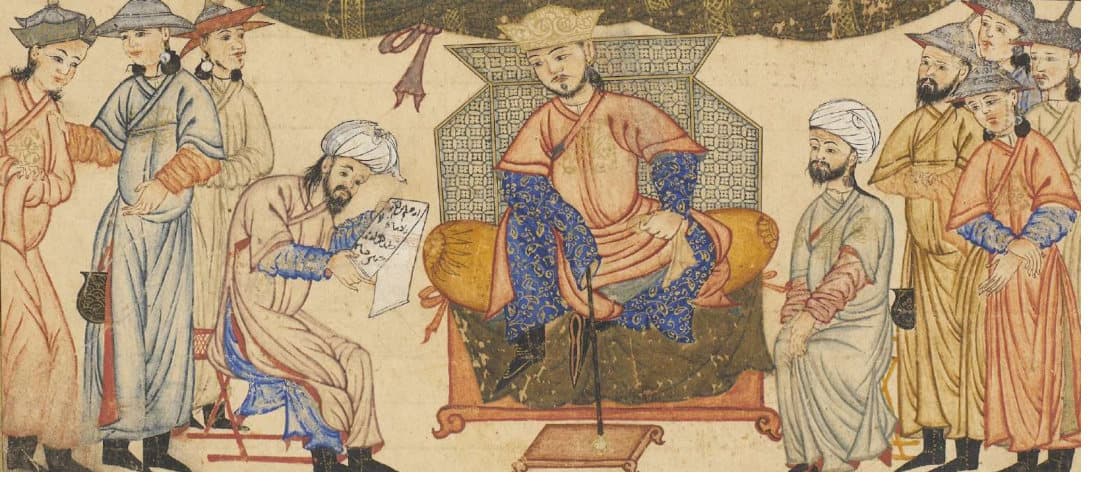
Picture 1 Seljuk Sultan Malik
Shah, (Rashîddin Fazlullâh-i Hemedânî, Jami'tTawarih)
Syria, and Anatolia. Some of these were opened after his death, but they all came to be known by the name Nizamiye Madrasa, inspired by the example of the Baghdad Nizamiye Madrasa.
The Baghdad Nizamiya Madrasa, although the most famous and magnificent among the Nizamiya madrasas, is not the oldest in terms of its founding date. Construction began in November 1065, and the madrasa was completed and opened for service in September 1067. The madrasa consisted of rooms, classrooms, a mosque, a library, dormitories, a dining hall, and a bathhouse, designed specifically for teachers and students, forming a complex. Nizam Al-Mulk established endowments to meet all the needs of the madrasa. Along with the market he built near the madrasa, he allocated the revenues from the land, bathhouse, and shops to the teachers (müderris) and students.
These madrasas constitute a turning point in history with their plan, organization, and educational program. Unlike previous madrasas, Nizamiye madrasas emerged under state patronage rather than being private institutions.
Educational institutions in North Africa and AlAndalus were influenced by these madrasas, and significant changes were made to the curriculum of madrasas by taking the Nizamiye madrasas as a model. Recent studies have revealed that universities established in the West, such as Salerno, Paris, and Oxford, were also inspired by the Nizamiye madrasas.76
The Quran, Arabic poetry, and literary studies formed the foundation of these madrasas. This situation closely parallels the first universities established in Europe, where the study of Greek classics was introduced. In these universities, students' meals were provided, and most of them were given pocket money. Some aspects observed in the organization of these madrasas were directly imitated and adopted by the first universities established in Europe.77
In reality, it is observed that some details of its organization were copied by the first universities in Europe. Established officially as a theological school, it was recognized by both the religious leaders of Islam (ulema78) and the State, indirectly providing its revenues through the
Picture 2 Konya Ince Minareli Madrasa. It was built by Seljuk Vizier Sahib
Ata Fahreddin Al in 1265.
State or the Caliph. Similarly, the University of Paris positioned itself alongside both the church and the state authorities.79
George Abraham Makdisi believed that Western scholasticism and humanism had roots in their Islamic counterparts that predated the West. In the 1990s, both Alan B. Cobban and Makdisi continued to publish studies detailing evidence of higher education and sophisticated learning. Makdisi's work outlined comprehensive parallels between Western schools and schools in the Islamic world. Despite criticisms suggesting there is very little evidence beyond the similarity in Makdisi's work, he directly responds to this criticism in his work titled Rise of Colleges, insisting on the low probability of chance parallel development.
According to Makdisi's theory, which delves into the organizational foundations of European universities, the university is a twelfth-century product of the Christian West, derived not only in terms of organization but also in privileges and patronage by the Pope and the King from Islamic models. Makdisi examines the waqfs (endowments) used for charitable purposes in the Muslim world. He suggests a connection between the practice of making donations to establish schools affiliated with mosques and the similarly donated schools in Europe.80
As is known, the Mu'tazila sect emerged a century after the birth of Islam, constituting a religious and philosophical movement that interprets the Islamic faith according to rational principles and rules. Adherents of the Mu'tazila sect are called rationalists in the Islamic world. The inclinations of Seljuk statesmen who embraced this religious understanding are also clearly evident in their religious practices. One of these statesmen is Tughril.
Picture3 16th century, İstanbul Gazanfer Aga Madrasa during class time, Dîvânı Nadiri.
This religious inclination observed among the members of the Seljuk Dynasty is understood to have originated from Danishmend Ali Taylu, a Turkmen from Khurasan who served as a tutor to the dynasty members. Danishmend Ali Taylu was raised in the religious environment of Khurasan and had the opportunity to be close to the Seljuk family at a very early stage. He established kinship with them by giving and taking daughters in marriage. Kutalmış, the ancestor of the Seljuks in Türkiye, was the son-in-law of Danishmend Ali Taylu.
After Tughril became the sultan following the victory at Dandanaqan, he appointed Kündurî as
Picture4 Abu's-Suûd Efendi
giving a lecture. Miniature depicted in Baghdad in the
mid-16th century.
Picture 3 16th century,
İstanbul Gazanfer Aga Madrasa during class time,
Dîvân-ı Nadiri.
his vizier. Kündurî, under Tughril's rule, established the Mu'tazila sect as the official religious doctrine of the state and initiated practices in this direction. The activities of NizamAl-Mulk, who adhered to the Ash'ari and Shafi'i sects, against Kündurî should also be evaluated in this context. As a result of these struggles, Sultan Alp Arslan arrested Kündurî, and he was later executed. It is widely accepted that Nizam Al-Mulk played a crucial role in his execution, and he became the vizier of the Seljuk state after Kündurî. In turn, Nizam Al-Mulk established the Ash'ari and Shafi'i sects as the official doctrines of the Great Seljuk State. To ensure the establishment and consolidation of this sect, he founded the “Nizamiye Madrasas.” It is indicated that twenty-three Nizamiye Madrasas were established in the Seljuk State's territories.
The first scientific, intellectual, and cultural activities in Anatolia began in the region of Danishmend and under the patronage of the Danishmendids at a very early date. The founders of this state, coming from a knowledgeable family and being connected to a scientific tradition, undoubtedly played a role in initiating scientific activities in Anatolia at an early date. Indeed, the first madrasas in Anatolia were built in the regions of the Danishmend State, such as Niksar, Tokat, Amasya, Sivas, and Kayseri, during the time of the Danishmendids. Even after the Danishmendids State was abolished by Sultan Alp Arslan in the last quarter of the 12th century, the scientific tradition established during the Danishmendids era continued for several more centuries in the region of Danishmend.
According to our current knowledge, the first written work in Anatolia was a book titled Keşfu’lakabe, an astronomy and philosophy treatise written in Persian. It was authored by İbnü-l Kemal İlyas Bin Ahmet el Kayserî, who served as the city custodian (muhafız) of Kayseri during the time of the Danishmends. The author presented his work to Gümüştiğin Melik Ahmed Gazi, the founder of the Danishmend State.
However, we also know that Kilij Arslan II had an interest in philosophical matters and participated in scientific discussions in this field. It is reported that Ghiyath al-Din Kaykhusraw was also an admirer of Ibn Sina. Similar reports indicate that during the Seljuk period (the first century and a half), statesmen in Anatolia were connected to the philosophical tradition and inclined towards the Mu'tazila sect. The construction of a medical center in Kayseri by Gevher Nesibe Hatun (Melike İsmetüddin Gevher Nesibe), the daughter of Kilij Arslan II, should also be attributed to the interest in natural sciences.
During the first 130 years of the period of the
Picture 5 Sultan Bayezid II's
foundation dated 1493 regarding the hospital, imaret, mosque, school,
madrasah, and other charities in İstanbul. BOA,
EV.d, 45144
Danishmendids and the Sultanate of Rum (Türkiye Seljuks), almost all of the works written in Anatolia were related to intellectual and natural sciences such as medicine, astronomy (heyet), mathematics, and philosophy. During this period, scientists in Anatolia were active in these fields. A significant portion of the works produced in Anatolia during this period was written in the Danishmendids' territory.
Contrary to popular belief, the tradition of writing Turkish works in Anatolia did not begin with the declaration of Turkish as the official language by the Karamanids. The tradition of writing works in Turkish in Anatolia started first in the region of the Danishmends and within the intellectual and cultural environment created by the Danishmendids. According to our current knowledge, the first Turkish work written in Anatolia was a medical treatise titled Tuhfei Mubârizî, penned by Hekim Bereket in the early 13th century in Amasya, within the region of the Danishmends. However, from the 13th century onwards, the religious policies of the Great Seljuk State and the religious atmosphere created by the Nizamiye Madrasas also influenced Anatolia.81
All of these narratives reveal that while the Nizamiye madrasas were setting an example for higher education from east to west, they also contained their own challenges from the inception. The transition from a scattered madrasa system to a well-organized educational system under state supervision symbolized progress. However, it also erected a barrier against an education system open to various ancient sources and diverse ideas, which had been a foundation for the flourishing era of Islamic civilization. Indeed, its effects would be noticed and criticized in the Ottoman Empire of the 16th century, albeit somewhat belatedly, thanks to the broad perspective of Sultan
Mehmed the Conqueror.
During the early years of the Ottoman Empire, there was a noticeable brilliance in education. However, it is evident that this intellectual brilliance and ascent could not be sustained in the 16th and 17th centuries. In the founding period, there was incredible dynamism in the world of education, especially in terms of academic travels, predominantly involving scholars coming from outside the Ottoman Empire and young aspiring scholars from the Ottoman lands traveling to prominent centers of knowledge. During this time, cities like Cairo, Damascus, and particularly Samarkand were highly renowned, especially in the fields of mathematics and astronomy.
The first criticisms of the educational programs of Ottoman madrasas, following the example of
Picture 6 Lecture in the madrasa, Hagia
Sophia 3279
Picture 7 From Fossati's Hagia Sophia album, right,
the madrasah rebuilt by
Mahmud I.
Nizamiye madrasas, came in the mid-15th century, primarily from Taşköprülüzade Ahmed Efendi. According to him, the science courses and philosophy, that is, courses related to Islamic philosophy, had diminished in madrasas, and they were no longer given the same importance as before.82
Katip Çelebi (d. 1658) takes these criticisms further. According to him: “During the early
years of the Ottoman state, scholars who evaluated rational sciences and Sharia sciences together were widespread. Fatih Sultan Mehmed Han, when building the Semaniye Madrasas, specified in the endowment deed that certain philosophical courses should also be taught. However, those who came later considered it more reasonable to remove these philosophical courses, stating that they were philosophical, and
Picture 8 Süleymaniye
Mosque and complex,
drawing by W.H.
Bartlett.
instead opted to teach legal lessons.”83
In the era just before Katip Çelebi, figures like Copernicus, Kepler, and Galileo were not the result of coincidences. Similarly, scholars such as Huygens, Boyle, Bacon, Newton, and Halley were all nurtured in that era. If we add thinkers contemporaneous with Katip Çelebi, such as Descartes, Locke, and Hobbes, it becomes possible to envision the state of Europe in the century in which Katip Çelebi lived.84 Given his criticisms mentioned above, it is evident that Katip Çelebi, a scholar educated outside the traditional madrasa system, had some awareness of the advancements in the Western world during his time.
Similar to many institutional structures, the Ottoman education system continued the Seljuk education system under public supervision. Madrasas in the Ottoman Empire, following the elementary school called sıbyan mektebi, served as educational institutions equivalent to middle school, high school, college, and university levels. Due to its Islamic identity, these institutions were attended exclusively by Muslims.
The İznik Madrasa, also called İznik Orhaniye, was founded in 1331 by Orhan Ghazi and is regarded as the earliest madrasa in the Ottoman Beylik. With twenty-one madrasas built by Murad I, Bayezid the Thunderbolt, Çelebi Mehmed, Murad II, and other statesmen, Bursa became an attractive center of knowledge. Although the academic and madrasa life in Bursa retained its significance, a new phase in the history of madrasas opened with the conquest of Edirne in 1361. During the reign of Çelebi Mehmed, two new madrasas were established, and in the era of II. Murad, nine more were built. Especially until the construction of Dârülhadis Madrasa and Sahn-ı Semân madrasas by II. Murad (1463-1470), it was considered the highest
Ottoman madrasa. From its founding years, it is determined that eighty-four madrasas were built throughout the country between 1326 and 1451. Out of these, fifty-three were in Anatolia, twentynine in Rumelia, and two in Jerusalem.
The new era that began with the conquest of İstanbul by Fatih Sultan Mehmed marked a significant period for Ottoman academic life and the structure of madrasa organization. Following the conquest in 1453, educational activities in İstanbul were initially conducted in some monk cells in the Zeyrek (Monastery of the Pantokrator ) and Hagia Sophia. In 1459, the Eyüp Madrasa was inaugurated. Within the Fatih Complex, completed in 1470, the Sahn-ı Semân (meaning eight courtyards), consisting of eight madrasas, and, situated behind them, eight tetimme (middle class) madrasas were established. These madrasas, with their location, physical and architectural features, provided financial resources, and especially the curriculum,
acquired the characteristics of an institution for higher education and research.
Bayezid II established madrasas within three significant complexes that he had built during different periods of his reign. One in Amasya (1481-1486), another in Edirne (1484-1488), and the third in İstanbul (1501-1505), named after himself in a district bearing his name.
Constructed a century after Sahn-ı Semân, the Süleymaniye Complex (1550-1557) consisted of four madrasas named as the medresei evvel (first), sânî (second), sâlis (third), and râbi (fourth), along with a medical school and a hospital (dârüşşifâ), representing the pinnacle of educational achievements in the Ottoman Empire.
Following Sahn-ı Semân, the Süleymaniye madrasas marked significant advancements in the Ottoman madrasa system concerning ranks, courses, funding sources, and administration.
In the Ottoman Empire, it was a common practice to build madrasas in newly conquered settlements. Particularly, emphasis was placed on establishing madrasas in Balkan cities. During the Ottoman era, 142 madrasas and 273 maktabs (primary schools) were built in Bulgaria, 182 madrasas and 315 maktabs in Greece, 223 madrasas and 1134 maktabs in former Yugoslavia, and twenty-eight madrasas and 121 maktabs in Albania, for a total of 575 madrasas and 1843 maktabs.
Madrasas were also widespread in Anatolia. For example, in the 19th century, there were twentytwo madrasas in Kayseri and thirty-three in İzmir. Records indicate the presence of madrasas even in the remotest villages. A list from 1528, showcasing the madrasas and their instructors in the Anatolian provinces, enumerates the names of 150 madrasas.
Some foreign travelers spoke highly of the madrasas in Anatolian cities. When Perrot visited Amasya in 1861 and witnessed the madrasa and educational life there, he referred to Amasya as the Oxford of Anatolia.
The curriculum in madrasas primarily included lessons in hesap (mathematics), hendese (geometry), heyet (astronomy), and hikmet (philosophy); belâgat (eloquent speech), logic, kelâm (Islamic philosophy), Arabic language, and literature; tefsir (Quranic exegesis), hadith, and fıkıh (Islamic jurisprudence). Specific books were followed in these lessons, mostly written in Arabic, while the language of instruction was Turkish, and the teaching method was generally based on oral communication.
Primarily, since a madrasa functioned as a foundation, its operations, financial resources, their utilization, and oversight were entirely conducted within the framework of foundation rules. However, given that the subject pertained to public education, the state always maintained strict supervision. Initially, all madrasas were under the jurisdiction of the qadi asker (kazasker), but starting from the late 16th century, higher-ranking officials were placed under the authority of the Shaykh al-Islâm (Sheikh-ul-Islâm or Şeyhülislam), while the others remained under the qadi askers. In the 19th century, the organization was transferred to the office of the meşihat.
The fundamental element of madrasa education was constituted by the müderris (professors). In the Ottoman system, what mattered was not where students studied but from which teachers they received instruction. Especially in the icâzetnâme (diploma), emphasis was placed on the teacher lineage.
Although the Ottoman State explored alternative
Picture 9 Reception of
the notables of the Ulema (Scholar) class
by Sultan Ahmed III
in 1720, Surnâmei
Vehbî.
solutions, the madrasa system could not renew itself. In the second half of the 18th century, with the establishment of Mühendishâne-i Bahrî-i Hümâyun and Mühendishâne-i Berrî-i Hümâyun, it lost the technical education it had previously offered to a limited extent. In the first half of the 19th century, with the establishment of the tıphâne for medical education and later the foundation of European-style schools, followed by the establishment of the mülkiye with state resources, the madrasa system largely drifted away from intellectual and administrative fields. In 1826, with the formation of the Evkâf-ı Hümâyun Nezareti and the transfer of all waqf (endowment) incomes to the state treasury, the financial means of the madrasa and the scholars diminished. With the establishment of nizamiye courts (secular court system) and later the emergence of the law school, it was largely distanced from the field of judiciary, becoming primarily a service for religious affairs.
In the 19th century, during the reigns of Mahmud II and Abdülhamid II, reforms and innovations were implemented in education. However, the madrasa, which was in great need of reform, was largely neglected. This approach was likely based on the belief that the reform of the madrasa and the mindset it represented was very difficult, if not impossible. After Abdülhamid II, during the period of the Young Turks, serious attempts were made to reform the madrasa under the leadership of Şeyhülislâm Musa Kazım and Mustafa Hayri Efendi. The Commission for the Reform of Madrasas was established, and various regulations were prepared. A completely new curriculum, different from its traditional structure and resembling that of schools, was implemented in İstanbul madrasas. However, due to World War I and the subsequent dissolution of the empire, these programs did not
last long.
The madrasas were transferred to the Ministry of National Education with the Law on the Unification of Education (Tevhîdi Tedrîsât Kanunu) on March 3, 1340 (1924), and thirteen days after the publication of the law, all madrasas were closed.85
Source: Innovation, Inventions and Quests Among the Turks