
Transport & engineering
1563
An attempt to build a canal between the
Don and Volga rivers
Sokullu Mehmed Pasha's dream
The Don-Volga Canal is a waterway that connects the Volga River and the Don River at the closest possible point, providing the shortest distance between them. The current canal has a total length of 101 kilometers, with 45 kilometers comprising rivers and artificial lakes. In the 16th century, Sokullu Mehmed Pasha, the Grand Vizier of the Ottoman Empire, and in the 17th century, Emperor Peter of Russia, attempted construction, but they were unsuccessful. During the Soviet Union era, construction resumed, but it was halted during the years of World War II. The efforts were recommenced in 1948, and the canal was completed, opening for use on June 1, 1952.119
With the fall of the Golden Horde, Eastern Europe saw the rise of competing powers like the Crimean and Kazan Khanates, the Grand Duchy of Lithuania, and the Grand Duchy of Moscow. By the mid-16th century, the political balance
shifted in favor of Moscow, leading to the Ottoman Empire's first encounter with a Russian threat in the north. The Astrakhan campaign became a significant conflict as it marked the initial dispute between the Ottoman Empire, aspiring to extend its influence over the northern Black Sea steppes, and the expanding Russian Empire moving southward. This conflict was a result of shifting political dynamics and Moscow's expansion towards the Caspian Sea, Caucasus, and ultimately the Black Sea, signifying a crucial moment in history.
In the beginning of 1547, Ivan IV was crowned as the first Tsar of Moscow. Moscow now regarded itself as the “Third Rome,” succeeding the fallen Byzantium. The Ottoman Empire, only deciding to take action in the north after signing peace with Austria in 1562, appears to have made preparations and plans. It was reported that an army would be sent to Astrakhan in the spring, a
Picture 1 A postage stamp commemorating
the Volga-Don Canal
Picture 2 Siege of Sevastopol
(painting of District Governor Seyit Bey, Naval
Museum)
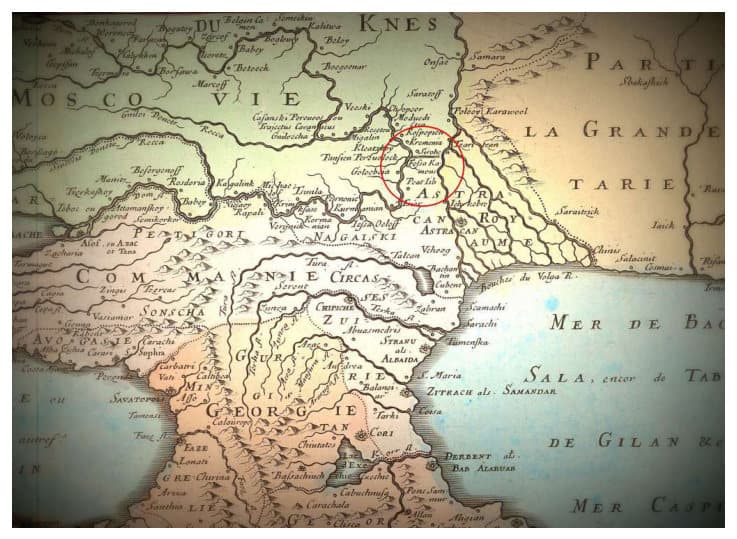
Picture 3 The Don-Volga Canal, shown unfinished on Nicolas Sanson's map
published in Paris in
1658
canal would be opened between the Don and Volga, and the Crimean Khan was notified to prepare for this campaign.
However, the Crimean Khan was only expecting auxiliary forces from İstanbul to reinforce his army against Moscow. The decision for this conquest surprised him, as it posed the risk of turning the Khanate into an Ottoman province in the Don-Volga region, just as Ottoman dominance existed in Kaffa and Azov. Devlet Giray, through diplomatic means, informed the Sultan of this decision and sought to leverage the threat to impose his own demands on the Tsar. From these negotiations, it is evident that the idea of constructing a canal between the Don and Volga rivers was already under consideration. According to the plan, the Ottomans would build two fortresses on the Don and Volga rivers and connect them with a canal. A third fortress near Astrakhan would solidify the Sultan's control over this region.
The Ottoman Sultan was compelled to take action not only to counter the political threat posed by the Russians in the Black Sea and Caucasus but also to preserve his religious influence as the “Caliph” among Muslims in North and Central Asia. He was considered the greatest ruler and protector of Islam. One of the most crucial attributes that made him the guardian of Islam was his role as the custodian of Mecca and Medina, the protector of pilgrimage routes. Meanwhile, during this period, it had become nearly impossible for Muslims in Central Asia to travel to Ottoman territories for pilgrimage or trade.
The interests of not only pilgrims but also traders were at stake. The Volga region had been closely connected to Khwarazm politically, culturally, and economically for centuries. After the fall of Astrakhan, the Khan of Khwarazm, compelled by
circumstances, sent envoys and gifts to the Tsar. Khwarazmi merchants began coming to Moscow, seeking trade privileges.
The Ottoman Empire, engaged in conflict with the Portuguese in the Indian Ocean for pilgrimage and trade routes, undoubtedly desired to revive the Central Asia-Astrakhan-Crimea route, a significant intercontinental trade route in the north. Eventually, the Ottoman government decided to address the matter seriously. With the resolution of the turmoil following the death of Sultan Suleiman and the inexperienced Sultan Selim II taking the throne, Grand Vizier Sokullu Mehmed Pasha, now in control with a stronger authority than ever, aimed to undertake two significant initiatives: connecting the Caspian Sea to the Black Sea and opening the Suez Canal. Sokullu's emphasis on these ventures was crucial for Ottoman global politics. The connection of the Caspian Sea to the Black Sea would facilitate transportation with Iran and Turkestan. This would streamline the transport of supplies and ammunition via the Don and Volga rivers for campaigns in Iran and, on the other hand, facilitate transportation between Turkestan and the Ottoman Empire. The Ottoman influence over the vicinity of Astrakhan (Ejderhan) was particularly crucial to ensure that the Muslims in the region could perform their pilgrimage duties. Until then, Astrakhan and Kazan had been under Nogai rule. Now, they had fallen into the hands of the formidable Ivan the Terrible. Astrakhan was considered an Islamic land, with clear traces of its past Muslim population, mosques, congregations, and madrasas. The subjugation of this significant Islamic city to Moscow's invasion caused distress among the Muslim rulers in Asia. However, the power and might of these rulers were not sufficient to deal a decisive blow to the
Russians. The protector of the entire Turkic and Islamic world, the most powerful and martial nation in both Asia and Europe, was the Ottoman Turks. For this reason, the rulers of Samarkand, Bukhara, and Khwarazm sought the liberation of the Muslims in this region, especially Astrakhan, from the Ottomans. They appealed to Sultan Selim II for protection and sought refuge under the authority of Sokullu Mehmed Pasha.
The initiatives of the Muslim rulers aligned with Sokullu's political considerations. Through this opportunity, launching a campaign towards Astrakhan and opening the canal between the Caspian Sea and the Black Sea under the protection of the deployed soldiers could also become feasible.120
At the beginning of the year 1568, the Astrakhan campaign matter was extensively discussed in the Divan. The idea of a northern campaign had long preoccupied the Ottoman government. Even during the tenure of Grand Vizier Semiz Ali Pasha in 1563, before Sokullu, there had been considerations for opening a canal between the Don and Volga and building fortresses on these rivers, but the plans were subsequently postponed. There were differing opinions among statesmen on this matter. Grand Vizier Sokullu Mehmed Pasha, an energetic statesman and advocate for war, strongly supported this idea and was determined to realize it. However, the new favorites who came with Sultan Selim II were trying to undermine Sokullu's absolute authority at every opportunity. They argued that this campaign was a fanciful endeavor that would unnecessarily burden the state with expenses and losses. Despite these efforts, based on information from those well acquainted with the situation in the northern regions, Sokullu insisted on his perspective and successfully persuaded the Sultan to proceed with the
campaign.121
Sokullu sought information from experts about the conditions in those regions and the distance between the Don and Volga rivers. Not content with this, he appointed Second Defterdar Cherkes Kasım Bey to the Sanjak of Kaffa. He dispatched a delegation to measure the distance between the Don and Volga rivers. The delegation determined that the distance between the two rivers was six sea miles. If this challenging task were accomplished, our soldiers would not face shortages of provisions in campaigns against Iran. Assistance could be provided to Shirvan, Karabakh, and Georgia.122
The expeditionary force Sokullu intended to send to Astrakhan comprised three thousand janissaries and twenty thousand cavalry. The lords of Silistra, Niğbolu, Köstendil, Amasya, Canik, and Çorum would participate in the campaign. The cavalry would bring their horseshoes and nails and ensure they had ample provisions. Additionally, around thirty thousand Nogai Tatars from the region joined the force sent by Sokullu.123
This extensively planned campaign held the promise of numerous significant political advantages for the state. The primary goal was to create an easier route for future trips to Azerbaijan and Iran. If a canal were opened at the point where the Don and Volga rivers come closest, direct shipment of supplies and equipment for Eastern campaigns could be facilitated from the Black Sea to the Caspian Sea. This would ease campaigns in the East, ensuring the submission of Shirvan, Karabakh, and all of Georgia, and providing the opportunity to extend the influence into the inner regions of Iran. Additionally, the liberation of Astrakhan from the Russians, conquests reaching the coasts, and raids into Russian and Circassian territory were
all considered.
As it appears, the plan for the campaign involved initially opening a canal between the Don and Volga, transporting ships to the Volga, and forwarding the army, especially the artillery, to Astrakhan via the Volga, ultimately reaching the Caspian Sea. Undoubtedly, the idea of opening a canal between the two rivers and capturing Astrakhan played a crucial role in utilizing this route for expeditions to Iran. At that time, the most significant concern for the state was the competition with Iran over Georgia, Azerbaijan, and Shirvan.
A fleet and large siege cannons, as well as various excavation tools such as anchors, oars, and digging instruments, were sent to Kaffa. Additionally, a significant number of paid laborers were enlisted from the local population for excavation works. Soldiers and laborers were also dispatched from Moldavia and Wallachia. Simultaneously, separate decrees were sent by the Sultan to the Circassian tribes and lords, ordering them to join forces under the command of Kasım Pasha.
On the other hand, the Khan, citing difficulties such as thirst, cold, and famine, and pointing out that the Tsar had sent a significant force to Astrakhan, argued that due to these reasons, the campaign would not yield positive results. He tried to convince the Sultan to abandon the plan, suggesting that better results could be achieved by sending these forces directly to the Russian territories with him. If it was absolutely necessary to proceed, he recommended conducting the campaign early in the spring and, if Astrakhan could not be taken, building a fortress in place of the old city to permanently pressure the Russians.
After a feverish winter of preparations, the fleet
landed the Ottoman army on the shores of Kaffa in the spring. The Crimean Khan's army joined them here, and they all set out together from Kaffa. The cannons, under the protection of a force of 500 men, followed the route from Azov to the Don River by ship. The army's provisions and equipment were stored in Azov, and they were allowed to take a 40-day supply. The Ottoman army advanced with great caution. After a five-week march, the entire force, labor groups, and all tools and equipment arrived at the predetermined location of Perevolok. Immediately, excavation of the canal began (early August 1569). The Ottomans worked continuously for about three months, digging one-third of the canal.124 However, it is said that more difficulties than anticipated were encountered in the work area. The terrain between the two rivers, where the canal was intended to be opened, was extremely rugged. Additionally, despite being under the command of the Ottoman government, the Crimean Khan, who fell victim to Russian intrigues, provided no assistance.125
The excavation of the canal was progressing slowly. As the season advanced, days shortened, and the severe cold of the north began to be felt, only one-third of the canal had been dug. Kasım Pasha wanted to transport the ships loaded with cannons and supplies for the journey to Astrakhan on sleds overland and across the Volga, similar to what Fatih Sultan Mehmed had done in the past. The Khan advised returning, and Tatar soldiers spread the belief throughout the army that wintering in these areas would be impractical. Simultaneously, envoys from the Astrakhan Tatars came, persuading Kasım Pasha to abandon the idea of transporting the ships across the Volga and the canal project, swiftly convincing him to march towards Astrakhan. In
mid-September, Kasım Pasha approached Astrakhan with his army. After the Russians captured Astrakhan, they had abandoned the old Muslim city and built a new fortress on an island about 12 kilometers south. Kasım Pasha, unable to dare an attack on this fortified fortress reinforced with well-armed guard soldiers, arrived. However, upon his arrival, the Muslims in the fortress, including children and armed individuals, joyfully welcomed him, slaughtered sacrifices, and encouraged the Ottoman army to attack the fortress. Due to the absence of cannons and the arrival of winter, Kasım Pasha did not attempt to besiege the fortress. Kasım Pasha was considering building a fortress on the ruins of the old city of Astrakhan to spend the winter there and launch an attack on the fortress in the spring. The Crimean forces were planning to return to their homeland for winter quarters. Upon learning of the commander's decision, a general uprising erupted in the army. They went before the Pasha and said, “We cannot winter here; we will die of hunger. Our Sultan provided us with provisions for three years, but you left them all in Azov and only gave us forty days' worth of food. The people of Astrakhan cannot feed us.” The janissaries were also in a state of rebellion. They said, “We will return with the Crimean Khan; you deceived the Sultan, and because of you, our Sultan did not listen to Devlet Giray.” However, what the Khan wrote to the Sultan and what he told you in our presence has all proven to be true.
The Crimean forces, preparing to return home, were terrifying the army with their descriptions of the severity of winter. On the other hand, news arrived that the Muscovite Tsar was sending a relief army to Astrakhan, and there were reports of an alliance between the Iranian Shah and the Russians. Rumors were also circulating about the
Nogays secretly making a deal with the Russians. In short, the resistance of the army had been completely broken, and defeat had set in. The army began to disintegrate and migrate in small groups. Finally, Kasım Pasha, realizing that the situation was untenable, decided to retreat, burning the fortified camp he had built from wood (September 20, 1569). The heavy equipment that could not be transported was buried by digging holes. Kasım Pasha had moved about 60 kilometers away from Astrakhan when he received an imperial decree from the Sultan in İstanbul. In this, the Sultan ordered him to winter before Astrakhan, assuring him that a strong army would be sent to assist him in the spring and that the Crimean Khan, along with his son-in-law (Piyale Pasha), would march towards Russia to engage the Muscovites. Sokullu, even if going to war with Moscow, seems determined to achieve a positive outcome from this initiative. However, the defeated army continued its withdrawal. The retreat through the barren steppes of Northern Caucasus to Azov, lasting a month, was extremely arduous. It is said that half of the soldiers perished in these desolate and waterless deserts. Undoubtedly, a new campaign from Azov was contemplated for the spring. However, upon the army's return, a massive fire in Azov's depots in October 1569 dashed all hopes.
Thus, the Astrakhan campaign, undertaken with such expense and efforts, ended in complete defeat. The ambitious initiative of Sokullu, a great statesman who aimed to establish Ottoman dominance in the Indian Ocean and the strategic routes of the world, as well as in the north of the Caspian, to truly make the empire a global power, was thwarted for petty interests and personal gains. The Sultan placed the entire responsibility for this venture on Grand Vizier Sokullu Mehmed
Picture 4 Map showing the
section of the Don River from the point where it joins
the Sea of Azov to the Volga
River (BOA.HRT.h, 78/2)
Pasha, reproaching him in the presence of viziers, stating, “All expenses and losses should be accounted for and imposed on you.” This outcome was also perceived as a defeat by foreign states.126
Sokullu Mehmed Pasha did not give up after this failure. Faced with the hindrance of connecting the Caspian Sea to the Black Sea, he sought solace in the opening of the Suez Canal. However, circumstances, especially the thoughts of Sultan Selim II, did not allow for this. The Sultan was making preparations against Venice and issuing orders for the conquest of Cyprus. Both of Sokullu's endeavors remained unsuccessful.127
In the heart of Eastern Europe, the fate of this newly emerging empire, positioned at the crossroads of the region's major rivers, would be determined by the blow dealt by the Ottoman Empire, then at the zenith of its power. This was
indeed a turning point in Eastern European history. The formidable Ivan, realizing the intricacies of the situation, sought reconciliation with İstanbul at any cost. Four years after ascending the throne, and under the pretext of congratulating the recent coronation of Sultan Selim II, he hastily dispatched an envoy to İstanbul in the spring of 1570. The envoy's mission was to persuade the Sultan of the Tsar's goodwill and to establish peace.
In 1678, Grand Vizier Kara Mustafa Pasha invaded Ukraine with a vast army. After bloody battles against the Tsarist forces, he captured and ravaged Chernihiv. This marked the Ottoman Empire's first actual conflict with Moscow. However, the Dnieper Cossacks, now aligned with Moscow, had become a threat to the entire northern coast of the Black Sea. It wasn't until 1695 that the Russians mustered the courage to launch a direct attack against the Ottomans in
the Black Sea. At this time, the Ottoman Empire found itself under a comprehensive assault from all its former adversaries, facing the imminent danger of complete collapse. In the ensuing third phase, which began after this date, we witness the direct invasion wars by the Tsars against the Ottoman Empire in the Caucasus, the Black Sea, and the Balkans.128
Inquiry about the Thoughts of the Tatar Khan Regarding the Requirements for the Conquest of Astrakhan
A letter of imperial decree written to the Tatar Khan, requesting information on the thoughts of the Khan regarding what is necessary for the conquest of Astrakhan. The letter mentions that Harezm Khan Hacı Mehmed Han had sent a letter about the need for the conquest of Astrakhan for the safe travel of Turkish pilgrims and traders through the region. It seeks an investigation into why Kazan and Astrakhan fell into enemy hands while being under the control of the Nogai, who among the Tatar mirzas remained in and around the area, and what preparations and arrangements are required for the conquest of Astrakhan.
December 30 1568
Letter to the Khan of the Tatars
A letter has arrived from Samarkand and Bukhara, particularly from Harezm Khan Hacı Mehmed Khan.
The content states that if the conquest of “Ejderhan” is achieved, it will ensure the safe and secure passage of pilgrims and other traders from those regions who intend to perform the tawaf of the Kaaba and visit the tomb of our Prophet.
Now, the fact that Kazan and Ejderhan, once
under Nogai's control, have fallen into the hands of the infidels raises questions. Who are the Tatar leaders within and around it?
I would like to know the details and explanations.
The conquest of that province is one of the most important tasks, and, with Allah's help, I have also come to the conclusion that it must be conquered.
For this reason, based on your longstanding loyalty and sincerity, I expect you to provide detailed and far-sighted guidance on how to proceed with the conquest of that province and what preparations are necessary. Please elaborate so that timely arrangements can be made, and with Allah's assistance, conquest and control may be granted.
A.DVNS.MHM.d, 7/2722
Source: Innovation, Inventions and Quests Among the Turks