

Transport & engineering
1568
Sokullu Mehmed Pasha's idea of building a
canal to Suez
The idea of connecting the Mediterranean to the Red Sea dates back to antiquity. In the 14th century BCE, Pharaoh II. Ramses took advantage of the smaller lakes in the area between the Red Sea and Crocodile Lake, opening a canal. However, this canal later fell into disuse due to the invasion of sand. In the 6th century BCE, it was again dredged by the Pharaohs but was subsequently abandoned.144
This canal extended from the Nile Delta towards Suez, passing through the Wadi Tumilat. It reached from the Nile to Crocodile Lake and from there to Suez. During this period, the Gulf of Suez was approximately 30 miles inland from its current location. The ancient Egyptians initially constructed these canals for irrigation purposes. Over time, many of these canals were not only utilized for irrigation but also served transportation needs.145
The same canal was restored during the reign of the Roman Emperor Hadrian (117-138) and later, under the governorship of Amr ibn al-As by the order of Caliph Umar (634-644). It remained in use until the 8th century.146 After the Arab
conquests, the idea of excavating a canal from Crocodile Lake to the Mediterranean was considered. However, Harun al-Rashid deemed it perilous due to concerns that it might enable Byzantine forces to reach Arab shores. It is said that the old canal, which had been effective for maritime transportation during the Roman and Byzantine periods, was closed during the reign of Harun al-Rashid. Subsequently, the canal was out of discussion for a considerable period, and the old canal beds were filled with sand. The notion of constructing canals that could connect the Mediterranean and the Red Sea was, for a time, forgotten and faded from memory.147
The Ottomans, utilizing the shipyards existing since the Mamluk era in Suez, gained the capability to navigate the Red Sea and open seas with the ships they constructed. In 1538, during his expedition to India, the Governor of Egypt, Hadım Suleiman Pasha, had his fleet's ships built in the Suez Shipyards. However, despite finding a route from the Mediterranean to the Red Sea and the Indian Ocean through the Suez, the Ottomans faced difficulties achieving the desired success.
Picture 1 Suez Canal
This was due to the fact that the fleet prepared in Suez, lacking a canal for direct connection, couldn't receive assistance from the Mediterranean fleet and proved insufficient for transoceanic expeditions. Hence, at the beginning of the reign of Sultan Selim II, a decree was issued in 1568 to the Governor of Egypt to investigate the possibilities for establishing a connection from the Mediterranean to the Red Sea, as the existing arrangements were deemed insufficient for achieving the desired success.148
For a significant period, there were no notable efforts to connect the Mediterranean and the Red Sea until the canal excavation attempts initiated by Napoleon Bonaparte during the occupation of Egypt in 1798. However, Napoleon's initiative proved unsuccessful due to observations indicating a difference in sea levels between the two bodies of water. Nevertheless, small waterways that allowed boat like vessels to pass through and connect the two seas were
consistently maintained in a clean and accessible condition. The construction of the Suez Canal began in 1859 under the administration of Said Pasha, the Governor of Egypt, by a French company during the Ottoman Empire. The canal was completed in 1869 during the rule of Ismail Pasha, the Governor of Egypt. In response to the opening of the Suez Canal, England, in 1882, occupied Egypt, taking control of the canal. During World War I, the Ottoman Empire organized the First and Second Canal Campaigns in an attempt to regain control of the Suez Canal. However, these campaigns ended in failure.
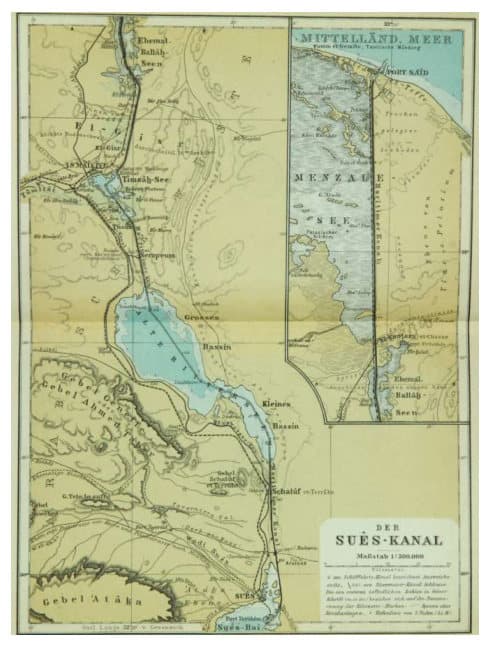
Initially, the Suez Canal was approximately 160-170 km in length, with a width of 120-200 m above the water level and 45-100 m at the bottom. The depth of the canal varied between 12-13 meters.149 In light of subsequent developments, efforts were made over time to find ways to expand the length of the canal. In 2010, new regulations were implemented to facilitate the
Picture 2 A map of the Suez
Canal
expansion of the canal. As a result, the Suez Canal has evolved to its current form, with a length of 193 km, a width of 205 meters, and a depth of 24 meters.
The project to excavate a canal in Suez with the aim of opening a route from the Mediterranean to the Indian Ocean first came into the Ottoman agenda due to the emerging Portuguese threat in the Indian Ocean. The struggle against the Portuguese continued after the Ottomans took control of Egypt, followed by Yemen and Aden. During the reign of Sultan Suleiman the Magnificent (1520-1566), a campaign to eliminate the Portuguese threat was envisioned, involving a potential expedition to India. In this context, a formidable fleet of 80 ships was constructed in Suez in 1530. It was during this period that the idea of the Suez Canal project was brought to the forefront. The canal, intended to reach from the Mediterranean to the Red Sea, began excavation between the Nile River and Suez. There is no information available in the Ottoman archives of that period regarding the canal. Halil İnalcık dates the first attempt of the Suez Canal to the years 1531-1532. However, some Western sources extend the excavation date of the canal to 1529. The second attempt to excavate the Suez Canal took place during the reign of Sultan Selim II (1566-1574) under the leadership of Grand Vizier Sokullu Mehmed Pasha.
The information reflected in Ottoman state records indicates preparations for the excavation of a water canal between the Mediterranean and the Red Sea. This endeavor was aimed at bringing the Ottoman navy, engaged in the ongoing struggle against the Portuguese in the Indian Ocean, from the Mediterranean to the Red Sea. For this purpose, Sultan Selim II, in 1568, sent a decree to the Governor of Egypt, stating that it was necessary to send the Ottoman navy, the Donanma-i Hümâyun, to aid Muslims in India
whom the Portuguese sought to colonize, to prevent the Portuguese from obstructing the path of Muslims coming from those regions to the Haramayn al-Sharifayn, and to eliminate deviant groups around the Haramayn.
In order to achieve these objectives, Sultan Selim II inquired about the feasibility of opening a canal from the Mediterranean to the Red Sea. He requested architects and engineers to conduct an
Picture 3 Suez Canal after
construction
on-site survey to determine150 whether it was possible to open a canal, and if so, what its length and width could be. However, due to opposition within the palace against Grand Vizier Sokullu Mehmed Pasha and the convincing of the Sultan to embark on the Cyprus campaign in 1570, these plans were not put into action.151
The Suez Canal Project was the brainchild of Sokullu Mehmed Pasha. The Ottoman Empire had achieved significant naval superiority in battles against European enemies in the Black Sea and the Mediterranean. However, the regions of the Indian Ocean and the Arabian Peninsula, especially, were under the threat of Portuguese raiders. The Ottoman desire to establish control over this region was not solely driven by economic and political reasons. The Holy Land was under a significant threat. During the Crusader invasions, there was a threat of the theft of the remains of Prophet Muhammad. In response to this threat, the renowned Turkish commander Nur al-Din
Zengi had the area around the tomb covered with lead.
During the reign of Yavuz Sultan Selim, it is said that the rumor of Admiral Alfonso d'Albuquerque invading the Jeddah region, capturing the remains of Prophet Muhammad, and taking them to the Vatican triggered the idea of opening a canal in Suez. In an attempt to execute Admiral Alfonso's plan, a vigorous attack was launched towards the Jeddah region in the year 1517.
Due to the absence of any canal through Egypt, the Ottoman navy had no means of reaching the region via the Red Sea. However, with the support of a limited number of Ottoman soldiers and the resistance from the local population, the European occupation of the Jeddah region was prevented.152
The main event that led Sokullu Mehmed Pasha to consider opening a canal in Suez was the appeal for assistance from Sultan Alauddin, the ruler of Aceh in Sumatra, to Sultan Suleiman the Magnificent. Some suggest that this plea for help
Picture 4 Sokullu Mehmed Pasha listens to the public at a divan
meeting. (Şehinşehnamei Selim
Khan, Topkapı Palace III. Ahmed manuscripts
3595)
was against Portuguese colonialists. However, the aid was sent late and proved inadequate, likely due to the delay and insufficiency caused by the Siege of Szigetvár. Still, there are those who claim that the setback at Astrakhan, which also hindered the Don-Volga Canal project, had shaken Sokullu's reputation, preventing further pursuit of this endeavor.153 Another attempt to open a canal in the Ottoman Empire was made by the Grand Admiral Kılıç (Uluç) Ali Pasha. In 1586, Kılıç Ali Pasha endeavored to revive the idea of the ancient canal between the Red Sea and the Nile and presented it to the Sultan. The aim was to enable Ottoman warships to move from the Mediterranean to the Red Sea, thus countering the emerging Portuguese threat. However, in 1588, due to the Ottoman navy in Suez driving the
Portuguese fleet out of the Red Sea and other pressing state matters, the canal initiative remained merely a proposal. Although there were some renewed efforts by the Venetians on the canal, they proved fruitless. In the subsequent centuries, Sultan Mustafa III (1757-1774) also considered the idea of opening a canal. However, his lifespan did not allow for the implementation of this plan.154
Conducting Preliminary Work for the Opening of a Canal to the Suez
Considering the necessity to aid the Muslims in India, rescue Muslims coming from those regions to the Holy Cities of Mecca and Medina from various dangers, and eliminate rebellious groups around the Holy Cities by dispatching the Imperial
Navy to those areas, it is proposed to investigate on-site by architects and engineers whether it is
possible to open a canal from the Mediterranean to the Red Sea. The inquiry should provide information on the feasibility of such a canal, including its potential length and width.
January 17 1568
To the Governor of Egypt:
Before me, my illustrious ancestors, under the divine light, spent their days and times in jihad and conquest, capturing numerous regions and territories from the west and the east, bringing them into the Ottoman lands. The renowned sultans and high-ranking rulers earned their glory and virtues through the services they rendered to the holy lands. Thanks be to God, this felicity has also been granted to me. The proper governance and affairs of those regions are my greatest aspiration.
The cursed Portuguese, casting their eyes upon the lands of India, have invaded them, closing the paths for Muslims who come from those regions to
visit the holy lands. Furthermore, Muslims living under the rule of the accursed infidels is unacceptable.
Putting our trust in the sublime assistance of Allah and seeking refuge in the blessed miracles of the Prophet Muhammad, it is intended to liberate the land of India from the hands of the infidels and remove some deviant sects around the holy lands. Therefore, an expedition is planned for that region.
For this reason, a considerable fleet is being prepared, and it is deemed appropriate to open a canal to move my ships from the sea to the Suez Sea. Therefore, I command that without delay or negligence, you gather knowledgeable architects and engineers who are efficient in their work. Let them investigate whether it is possible to open a canal in that land and report back on the length and width it might have and how many ships can pass side by side. Learn these details so that the necessary arrangements can be made for its opening.
When the canal is completed, with the help of Allah, there will be an opportunity for jihad in that land for the sake of Allah. It is hoped that both the holy lands will be purified from deviant sects, and the land of India will be liberated from the Portuguese infidels.
A.DVNS.MHM.d, 7/721
Source: Innovation, Inventions and Quests Among the Turks