

Transport & engineering
1591
The idea of opening a canal between the
Sea of Marmara and the Black Sea A waterway that has been discussed every century but never realized
Until the widespread use of railway transportation in the second half of the 19th century, the most cost-effective and convenient means of transportation globally had historically been seen as water-maritime routes. For this reason, during the 16th century, when the Ottoman Empire expanded its dominion to the furthest points, various initiatives were undertaken to make more effective use of water routes. Efforts such as connecting the Don and Volga rivers with a canal and linking the Mediterranean and Red Seas through the Suez Canal were all results of these endeavors. In the same century, another canal project emerged, suggesting the utilization of the Sakarya River and Lake Sapanca to create a waterway for ships to travel from the Black Sea to the Sea of Marmara.
The idea of constructing a canal between the Black Sea and the Sea of Marmara using the Sakarya River and Lake Sapanca was first raised during the reign of Sultan Suleiman the Magnificent
(1520-1566). It is mentioned that Mimar Sinan and Mimar Nikola were assigned to this project, and excavation work was initiated on a section of the route from Sapanca to the Gulf of İzmit. However, due to wars, the efforts were discontinued. It is also noted that the notion of connecting the Sea of Marmara with the Black Sea through such means dates back much earlier, and during the time of Roman Emperor Trajan (98-117), a similar idea had been considered.
The Ottoman Empire's second attempt to connect the Sea of Marmara with the Sakarya River in 1591 was primarily driven by the urgent need for ship lumber to quickly reach the sea via river transport. Subsequent endeavors incorporated economic reasons into this initiative. Despite being decisively planned in the 16th, 17th, 18th, and 19th centuries, this canal, each time, remained unfinished due to various pretexts. Initially, the main reasons for the canal were to fulfill the shipyard's demand for various types of lumber and
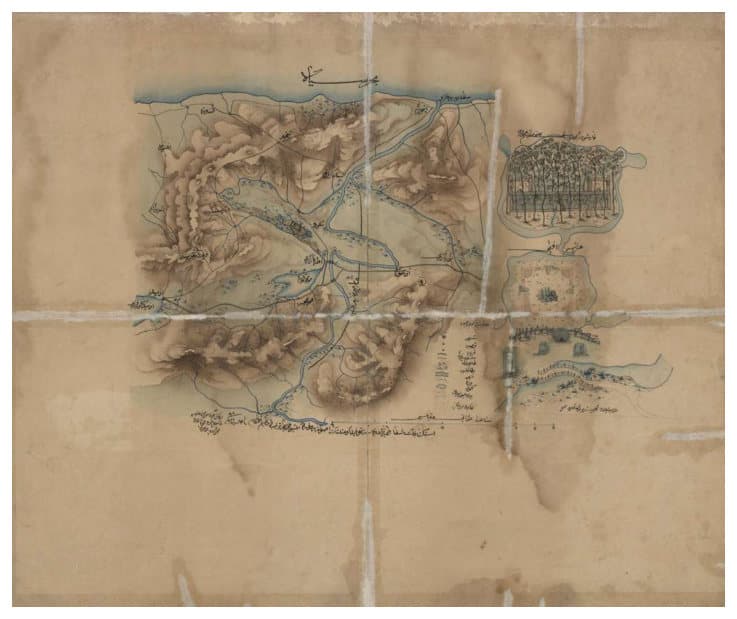
Picture 1 Map depicting the
Sakarya River Basin (BOA.
HRT.h, 584/2)
to easily meet İstanbul's winter wood requirements.
In the decrees written to the Bey of İzmit and the judges of İzmit and Sapanca in March 1591, it was mentioned that a team of architects and engineers was dispatched to measure the distance from the Kiraz River to Lake Sapanca, and from there to the Gulf of İzmit. The intention was to divert the water from the Kiraz River to Lake Sapanca and then to the Gulf of İzmit. The decree ordered the swift execution of this task. It was decided to provide 30,000 workers for the canal, and Sokulluzade Hasan Pasha was entrusted with overseeing the excavation.
The decree also stated that if any villages, farms, or estates were to be adversely affected by the canal construction, they would be relocated,
emphasizing the firm intention to proceed with the project.
The orders issued demonstrated a significant emphasis on the canal project. Decrees were sent to the governors of Anatolia, Karaman, Sivas, Maraş, and Erzurum, instructing them to send timariot alay (regiment) commanders along with laborers or workers (ırgats) to participate in the canal construction. Additionally, the qadi of Eyüp in İstanbul had received orders to mobilize the sewage worker guild within his jurisdiction for the project. Laborers or workers were to be provided from the landholders of each sanjak at the rate of one in every five thousand. In the event that an adequate number of laborers could not be found, the timariot sipâhi (professional cavalryman) would receive twenty-five akçes per day as compensation for supplying laborers. With this
Picture 2 Map depicting the Gulf of İzmit, Lake Sapanca,
the Sakarya River, and the
Black Sea (BOA. HRT.h,
584/1)
payment, laborers would be hired to ensure that the existing workforce was not depleted. If a sipâhi could not provide or hire laborers and wished to work as a laborer, they would be employed in the place of laborers at the rate of one in five thousand.
It was explicitly ordered that the excavation of the canal be completed as soon as possible, and for this purpose, the swift mobilization of the sewage worker guild within the jurisdiction of Eyüp Qadi was commanded. Additionally, the prominent figures and those seeking protection by taking refuge in gardens and various places were to be immediately sent to contribute to the project. The project to connect the Marmara Sea with the Black Sea, which was being closely supervised, abruptly came to a halt due to the need for ship procurement and naval activities. Specific
instructions were sent to those appointed for the canal project, ordering everyone to return to their respective positions. Regarding the main reason for abandoning the canal, Mustafa Efendi from Thessaloniki, who was alive during that period, wrote in his history:
“At this time, Grand Vizier Sinan Pasha wanted to personally see the location of the canal. He, along with Grand General Ferhat Pasha, Judge of Anatolia Ali Efendi, and some other state dignitaries, toured for three days with the public, architects, and engineers, made measurements and evaluations, and upon his return, reported the situation to Sultan Murad III.” Subsequently, indirect rumors were circulated to the Sultan by some statesmen; the suspicious Sultan feared this and said, “It should be abandoned; it is not a necessary matter for religion and the state. It is
Picture 3 Map depicting the canal to be opened between
Lake Sapanca and the
not right to exert trouble on the people, to do the work with oppression and coercion. The most important task for the state is to build ships for the navy. Obtain wood as it has been done so far, just like before.”
Sakarya River (BOA.HRT.h, 583)
Sinan Pasha's idea was to open the canal. Faced with some obstacles, he personally toured and measured the area, providing a report. His opponents, thinking that he would gain fame and reputation if successful in this project, spread some opposing views, frightening the Sultan and causing him to abandon the project. Those who frightened the Sultan claimed that the people would suffer and be oppressed due to the canal works, and this appears to be the reason for the
Sultan's fear.
Sinan Pasha's attempt to open the canal resurfaced sixty-five years later. In 1654, an engineer named Hindioğlu was sent to conduct a survey. In his survey report, Hindioğlu stated that due to the flat terrain, water flow could be achieved, but there would be difficulties in cleaning the river. Additionally, he mentioned that the canal would cause significant damage to some villages, farms, and animal pastures. Therefore, for the third time, the decision was made to abandon the canal project.
I. Mahmud’s reign (1730-1754) saw considerations, especially given İstanbul's economic difficulties. This time, the idea of connecting only Sapanca Lake and the Gulf of
İzmit was entertained without mentioning the Sakarya River. If this could be accomplished, İstanbul could receive various grains, wood, and timber from Sapanca and its surrounding villages and districts at a low cost. Once again, a survey was conducted, but due to the inability of some local leaders on that side to appreciate the situation, no result was obtained.
During this excavation work, the primary goal was to connect Sapanca Lake with the Gulf of İzmit. If it was not possible to divert the water from the lake to the Sea of Marmara, then an attempt would be made to connect the Sakarya River with Sapanca Lake. Reports and expense records were requested for both excavations.
The seriousness and importance of the matter led to the initiation of the excavation work. This time, a team was sent from İstanbul for the exploration of the canal. The work began, and after digging a certain amount of soil, water started to emerge. However, as winter arrived during this time, the operations were temporarily halted. Yet, once again, rumors and obstacles emerged, leading to the abandonment of the canal project for the fifth time due to interference from certain parties or other hindrances. In 1813, the Governor of Kocaeli and Bursa, Vizier Hacı Ahmed Aziz Pasha, wrote a letter to İstanbul emphasizing the economic importance of connecting the Sakarya River with Lake Sapanca and uniting this lake with the Sea of Marmara. Aziz Pasha mentioned that if the river were cleaned up to its source or towards the Beypazarı region, it would be possible to easily transport all kinds of products from the areas around the river to the Sea of Marmara. He requested the examination and measurement of this matter, sending an official accompanied by an engineer and architect for this purpose. This application revived the canal project, and Abdullah İffet Bey from the old Çavuşbaşı, along with the third chief engineer, Ahmed, and the
fourth chief engineer, Mehmed, were appointed and immediately sent with Architect Seyit Mustafa.
Following the departure of this delegation, considering the importance of the matter, it was deemed necessary to send three more engineers and craftsmen, and an additional scientific committee of seven people, including ship captains such as Mustafa Hoca Kaptan, Architect Ali Rıza Bey, and others, was appointed.
The reconnaissance team sent to İzmit and Sapanca conducted the necessary examinations, inspecting the water source up to the vicinity of Sapanca Lake and providing a detailed report on the matter. Subsequently, the canal project was entrusted to Aziz Pasha, and he received a firman with an appreciative tone. However, twenty days after the issuance of the firman, Aziz Pasha passed away, and the canal project remained incomplete due to his demise.171
Order Regarding Diverting the Sakarya River to Ayan Lake and İzmit Strait:
Considering the intention to divert the Sakarya River to Ayan Lake2 and then to the İzmit Strait, Chief Architect Sinan and Chief of Water Guides Davud, along with some experts knowledgeable in these matters, have been sent to İzmit for reconnaissance. It is commanded that the Sanjakbey of İzmit, along with the qadis of Sapanca and Geyve, should prepare trustworthy and knowledgeable individuals from the areas under their administration—individuals who understand these matters, are familiar with land surveying, and can guide through passages. Equip them with tools such as axes, picks, shovels, and scythes, and provide sufficient horses for transportation. As soon as the mentioned individuals arrive, they should proceed to the designated location, collaborate with each other,
and thoroughly document various aspects, such as the most suitable route for excavating the riverbed, the required depth, the feasibility of the
project, the necessary expenses, etc. They should provide detailed reports without leaving any aspect uncertain.
September 4 1582
Order to the Sanjakbey of Kocaeli and the Qadis of Sapanca and Geyve:
As the intention is to divert the Sakarya River to Ayan Lake172 and from Ayan Lake to the İzmit Strait, a reconnaissance team consisting of Chief Architect Sinan, Chief of Water Guides Davud, some knowledgeable water guides, and skilled workers, who understand the water balance, has been dispatched. I command that:
Upon receiving this order, all of you personally attend to this matter, and in the areas under your administration, gather trustworthy individuals who understand these matters, are knowledgeable in land surveying, and can guide through passages. Prepare yourselves with tools such as axes, picks, scythes, shovels, and spades at the mentioned location. As soon as the mentioned individuals arrive, they should immediately reach the designated location, cut the necessary forests, examine the river, determine where the excavation is feasible, whether it should be dug from below or from the upper mountain side, how zirâ173 (deep) it should be if excavated, whether it is possible to divert it to the İzmit Strait, and if Allah wills, how much money might be spent on the project. Collaborate with each other in a detailed, explanatory, and accurate manner, considering all aspects and without leaving any uncertain or
doubtful elements. Also, arrange a sufficient number of horses to ensure the transportation of the mentioned individuals to the specified
location, and have them ready at the İzmit Port so that they can mount these horses upon disembarking from the boats and reach the designated location directly.
A.DVNS.MHM, 48/188
Order for Diverting the Sakarya River to Sapanca Lake and Draining Sapanca Lake into the Sea at İzmit:
Considering the Sultan's desire for the Sakarya River to flow into Sapanca Lake and for Sapanca Lake to discharge into the sea in front of İzmit, it has been reported that architects, engineers, and experts have been dispatched for distance measurement and on-site exploration. The Sanjakbeyi of İzmit, along with the Qadis of İzmit and Sapanca, is commanded to personally lead three to four hundred laborers to the designated location. They are instructed to investigate and report on various aspects, such as the distances between the Sakarya River, Sapanca Lake, and the sea; the presence of villages, farms, and estates in the region; and whether these would be affected by the project. If there is potential harm, they should assess the feasibility of relocating them to other nearby areas. The Sanjakbeyi and Qadi of Kocaeli are also instructed to supply sufficient horses and provisions for the architects and craftsmen sent from İstanbul until they reach the designated region.
January 21 1591
Given to the Grand Vizier. Order to the Sanjakbey of İzmit and the Judges of İzmit and Sapanca:
Since it is my174 imperial will that the Sakarya River flows into Sapanca Lake and then into the sea in front of İzmit, I have commanded the dispatch of architects,engineers, and knowledgeable individuals for on-site exploration and detailed reporting on the distance between the Sakarya River and Sapanca Lake, as well as from
Sapanca Lake to the sea. I order you to personally attend to this matter without delay. Lead three to four hundred laborers to the designated location for accurate measurement and exploration. Determine the distances, assess the presence of villages, farms, and estates along the route, and investigate whether the project will adversely affect them. If harm is anticipated, consider the feasibility of relocating them to alternative locations. Conduct a thorough examination and promptly present the detailed results to my esteemed court. It is intended that this matter be fully completed, so approach it with diligence, avoiding neglect or laxity, and strive to provide a detailed and accurate report.
Given to the Grand Vizier. Order to the Sanjakbey and Judge of Kocaeli:
As it is intended to divert the Sakarya River into Sapanca Lake and from there into the sea, architects and skilled workers have been dispatched from İstanbul to conduct on-site exploration and assessment. Therefore, upon receiving this order, promptly and without delay, ensure the provision of an adequate number of horses, as well as food and other necessary supplies for these individuals. Accompany them to
the designated location and see to the completion of the task. Given the paramount importance of this matter, there is no room for neglect or laxity. Hence, promptly arrange for the necessary provisions and accompany them to the site to conduct accurate measurements and exploration, providing a truthful and detailed report of the results to my esteemed court.
A.DVNS.MHM_67/183, 184
Source: Innovation, Inventions and Quests Among the Turks