
Transport & engineering
1633
From Winged Flight to Rocket Takeoff
Turks with a Passion for Flying
In the realm of Turk-Islamic cultural heritage, the historical narratives pertaining to the earliest attempts at flight trace back to ancient times. Legends recount the endeavors of a Turkish scholar in the ancient city of Sayram, situated in the Seyhun basin, who delved into the physical dynamics of flight. It is told that this erudite individual embarked on an exploration of the correlation between the wing surfaces of birds and the relationship between their weights, all in pursuit of unraveling the secrets of flight. The significance of this groundbreaking study within the field of aerodynamics is duly emphasized.
In the early 11th century, another Turkish scholar born in the city of Farap in Turkistan, Cevheri, is noted for his daring attempt at flight. Cevheri undertook his experiment in Nishapur. Constructing two wings from trees and binding them together with a rope, he ascended to the roof of a mosque in Nishapur. Addressing the astonished and curious crowd that had gathered around the mosque, he proclaimed, “O people, no
one has ever accomplished what I have done until now. Before your very eyes, I am about to fly. The most significant feat one can achieve in this world is to soar into the skies, and I am determined to accomplish it.” With these words, he let himself fall from the roof of the mosque with his two wings. It is said that after flying for a while, he fell to the ground and met his demise. Historical sources date Cevheri’s ill-fated attempt at flight to around 1010.175
Approximately a century and a half after Cevheri's unsuccessful attempt, another Turkish endeavor into flight is recounted during a journey by the Anatolian Seljuk ruler, Sultan Kilij Arslan II, to Byzantium in the year 1162. During this year, Sultan Kilij Arslan traveled to İstanbul to negotiate a treaty with the Byzantine Empire. The Emperor welcomed the Sultan with magnificent ceremonies, and it is said that Kilij Arslan stayed in İstanbul for eight days or even longer. During his stay, he was presented with highly valuable gifts. Sultan Kilij Arslan, in turn,
provided financial assistance to the emperor and concluded a treaty with him. Khoniates, one of the Byzantine historians who chronicled this visit, writes that during this period, festivities were organized in honor of Kilij Arslan. The Turkish sultan had a particular interest in horse racing. According to Khoniates, a Turk accompanying Sultan Kilij Arslan II attempted to fly in front of a large crowd.
“Clad in a long, billowing white garment filled with inflated bladders and draped with numerous layers, this Turk ascended to the highest point of the hippodrome. The purpose of this garment was to serve the function of sails on a ship. The Turk believed that the wind, caught within the folds of the garment, would lift him into the air and enable him to fly. The Emperor sent a man to dissuade the Turk from his intentions. Sultan Kilij Arslan, on the other hand, was both concerned for the man from his own people and proudly anticipated the success of his endeavor. The unnamed Turk carefully controlled the direction of the wind. Extending his hands forward in an effort to catch the wind, the man flapped his arms, performing several warm-up movements. However, as the wind was not as strong as he desired, he postponed his attempt for a while. This waiting period stirred murmurs among the spectators, leading some to believe they had been deceived. Finally, convinced of the sufficient power of the wind, the Turk flapped his wings like a bird and launched himself into the void. Unfortunately, he failed to ascend and crashed to the ground like a heavy stone. All his bones were shattered, and he died on the spot.176
We understand that such attempts had almost become a tradition among the Turks through the accounts provided by Ogier Ghislain de Busbecq, who served as the Habsburg ambassador in İstanbul from 1555 to 1562. His reports shed light
on the endeavors of flying during the reign of Sultan Suleiman the Magnificent.177
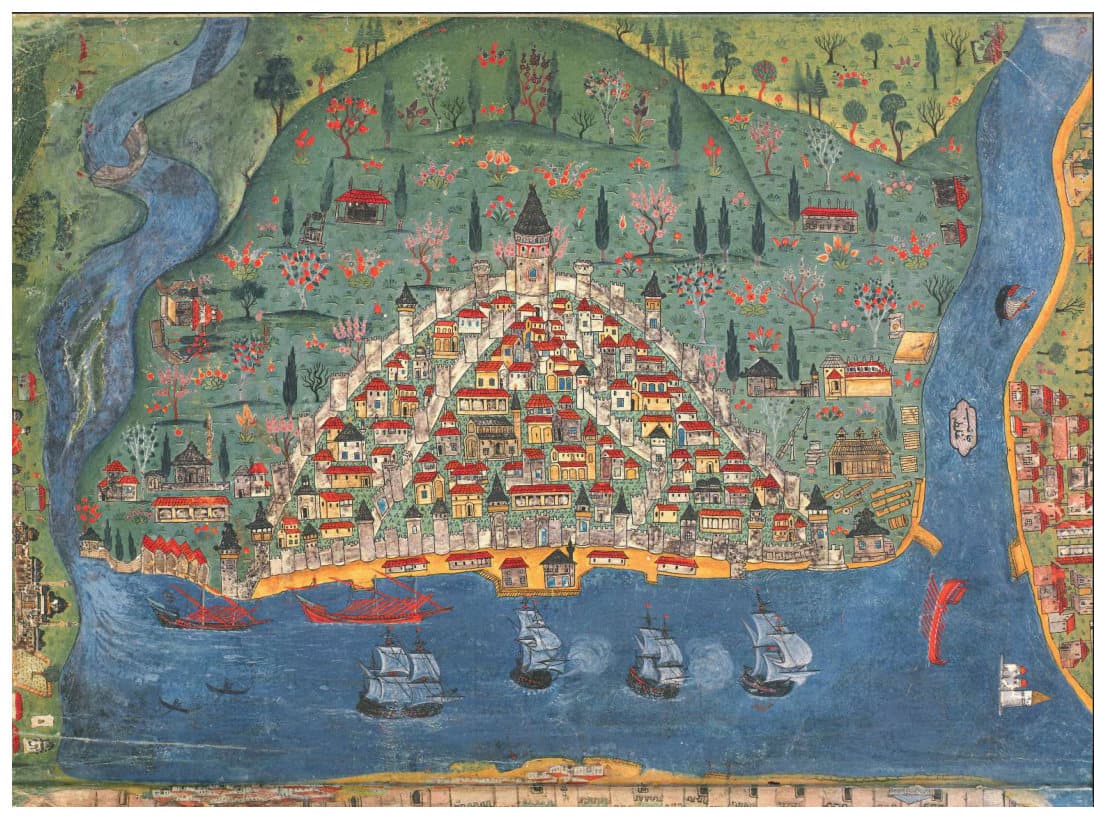
The primary attempt at flight in the Ottoman Empire is etched in memory with the flight of Hezarfen Ahmed Çelebi. Information about Hezarfen Ahmed Çelebi, who lived in the 17th century, is solely based on Evliya Çelebi's Seyahatname. Bestowed with the title “Hezarfen,” meaning “one who excels in a thousand arts and crafts,” due to his proficiency in various sciences and arts, Ahmed Çelebi conducted his research and experiments on flight in Okmeydanı. During periods of strong winds, he repeatedly flew using a device referred to as “eagle wings,” convinced that such flights against the wind would provide lift. Subsequently, he took flight from the Galata Tower, soared against the wind, and descended to the Doğancılar Square in Üsküdar. According to Evliya Çelebi, witnessing this event from Pearl Kiosk (Sinan Paşa Köşkü) in Sarayburnu, the contemporary ruler, Sultan Murad IV (1623-1640), granted Ahmed Çelebi a kese178 of gold, expressing, “This man is an extraordinary individual, capable of achieving whatever he desires. The permanence of such individuals is not permissible.” With these words, Sultan Murad IV exiled Ahmed Çelebi to Algeria.
The notion that Hezarfen Ahmed Çelebi covered a distance of 3,200 meters from the Galata Tower to Doğancılar by imitating the flapping of wings through arm and muscle strength seems implausible. Examined in the light of contemporary aerodynamics, this flight appears more likely to have been achieved through harnessing air currents—a principle seen in today's amateur sports involving single-wing gliders that can ascend and glide in the air, primarily found in holiday destinations. The feasibility of such an endeavor aligns more with
Picture 1 Galata in the
16th Century through the Eyes of Matrakçı
Nasuh (Beyanı Menazili Seferi Irakeyn, Description of
the Stations of the Campaign of the Two
Iraqs)
Picture 2 Hezarfen Ahmed Çelebi flies
the concept of a basic glider that relies on continuous, single wings to stay afloat and soar.179
During the same period, another attempt at flight was made, this time by Lagari Hasan Çelebi, who took to the air not with wings but with a rocketlike contraption he had crafted. Information about his life is derived from the contemporaneous account provided by Evliya Çelebi in his Seyâhatnâme. According to Evliya Çelebi, in the year 1632-33, during the festivities commemorating the birth of Sultan Murad IV's daughter, İsmihan Kaya Sultan, Hasan Çelebi invented a seven-armed rocket from 50 okka of gunpowder. In the presence of Sultan Murad IV at Sarayburnu, Hasan Çelebi mounted the rocket, declaring, “My Sultan, I entrust myself to God; I am going to converse with the Prophet Jesus.” With the assistance of his helpers, the rocket was ignited, propelling him into the air. As he lit other fireworks while in the air, the sea below illuminated, and as his grand rocket depleted its gunpowder, he descended gracefully by spreading the eagle wings in his hands in front of Pearl Kiosk. From there, he swam to the Sultan's presence, jesting, “My Sultan, Prophet Jesus sends his greetings.” Sultan Murad rewarded Hasan Çelebi with a kese of coins and enlisted him as a sipâhi with a daily wage of 70 akçe. According to Evliya Çelebi, Lagari later traveled to Crimea and passed away in the company of Selâmet Giray Han.
The incident of Hasan Çelebi ascending into the air with a rudimentary rocket, based on the propulsion force of gunpowder and operating on the principle of reaction, and then descending slowly into the sea, as recounted by Evliya Çelebi with the phrase yârı gārı sâdıkımız (our loyal companion), seems plausible based on calculations derived from Evliya Çelebi's
Picture 3 Lagari Hasan Çelebi taking off with his
self- invented rocket.
narrative. According to these calculations, Lagari might have ascended up to approximately 250 meters with this primitive rocket. The phrase deniz yüzünü aydınlattı (illuminated the surface of the sea) suggests that, while in the air, he likely altered his direction by igniting other fireworks he had with him. The object described as resembling eagle wings held in his hands likely served as a kind of parachute, enabling him to descend slowly and safely into the sea.180
Lagari Hasan Çelebi's ascent into the air with his own invention, a seven-armed rocket-like firework, followed by a safe descent into the sea using wings resembling those of an eagle, bears a striking resemblance to the modern method of parachute descent employed in space experiments today. In this regard, Lagari Hasan Çelebi's pioneering flight experiment with rocket technology holds a special place in aviation history.
Evliya Çelebi's account of Lagari's flight experiment captured the attention of Arslan Terzioğlu from a different perspective. According to Evliya Çelebi, after this experiment, Lagari went to Crimea to join Selâmet Giray Han and subsequently passed away there.
According to Russian rocket technology researcher Kuzmenko, studies on rocket technology in Russia began in the Ukrainian region, with the first records related to rockets dating back to the 17th century. The initial traces of rockets in Ukraine appear in the 1650s. Subsequent advancements in Russian rocket technology were built upon these early studies conducted in Ukraine, contributing to the success of contemporary rocketry.
According to Terzioğlu, the coincidence of the initial studies on Russian rocket technology in Ukraine occurring shortly after Lagari Hasan
Çelebi's residence and death in Crimea raises the possibility of the influence of Turkish engineer Lagari Hasan Çelebi and his students in the field of Russian rocket technology. Terzioğlu, who presented this thesis at the 13th Congress of the History of Sciences in Moscow in 1971, mentioned that Russian scientist Kuzmenko, who presented a paper on Russian rocket studies in Ukraine, shared the same viewpoint. Terzioğlu further stated that Kuzmenko informed him about conducting research in Russian archives to support this idea.181
In the subsequent century, it is evident that the Ottomans continued to make noteworthy advancements, particularly in the realm of firearms, and developed new weapons. During the reign of Sultan III. Ahmed (1703-1730), the
Picture 4 The rocket named
tulumba, invented by
Bayramoğlu Ali Agha
second caliph of the Artillery Corps, Bayramoğlu Ali Agha described in his work named Ümmü’l Gazâ the rockets he invented called tulumba, which were used in the sieges of castles.
In his work, Ali Agha discusses the art of war, equipment, his invented weapons, and tools. He talks about his roles in the wars conducted during his time, introduces various types of cannons and mortars, and enumerates the precautions to be taken in warfare. He narrates the fortifications made during the conquest of
certain castles, such as the Temeschwar Fortress. In this work, Ali Agha attributes failures in wars to stagnation in the invention and development of weapons. Consequently, he advises the Sultan to develop new weapons. In the Ottoman world, where very few works were written about weapons, it is quite surprising that a work like this exists, presenting the pictures of newly invented weapons. The scenes of war and the depiction of weapons in the work are vividly and beautifully portrayed.
One of the weapons mentioned by Bayramoğlu Ali Agha is the tulumbas, rockets completely of his own invention, used in castle sieges. In his work, he provides detailed descriptions of these rockets, along with illustrations. He mentions that they are 11-12 arşın (7-8 m) in length, a size challenging for a person to embrace. He emphasizes the significant impact of this new weapon by illustrating its images. Ali Agha also points out that the traditional tulumbas of the past emitted minimal fire and did not shoot lead. By juxtaposing images of the old and his newly invented tulumbas, he vividly demonstrates the effectiveness of his innovation.
In his work, he expresses this as follows: “... I have invented a potent tulumbas because the tulumbas used by our artillerymen only emit fire, but this tulumbas not only emits fire but also has ten muskets inside that shoot lead.” After emphasizing the effectiveness of this weapon in battles, especially in castle sieges, he underscores its immense utility as a valuable invention.182
Source: Innovation, Inventions and Quests Among the Turks