
Culture & communication
1727
Printing Press The Technology Struggling to Reach the Ottoman Empire
Printing and book production with the printing press is considered to have first taken place in Mainz, Germany, by Johann Gutenberg in the year 1440. Examples of the first books printed with metal type in the printing press in Mainz during 1454-1455 have survived to this day. The printing press, emerging in the 15th century in Europe, was brought to İstanbul towards the end of the century by Spanish Jews seeking refuge in the Ottoman Empire. This was followed by the establishment of printing houses by Rum and Armenians, and in 1727, the first Turkish press house was opened.
The introduction of the printing press in Europe as a weapon in the struggle between political and religious factions quickly gained importance and became widespread. A legal book printed by the brothers David and Samuel ben Nahmias, who had been expelled from Spain, is the first product of the Jewish printing press established in İstanbul (December 13, 1493). In this city, within 300 years, more than 400 works are printed, mostly with a religious focus, by twelve printing houses.
The first Armenian printing press in İstanbul was
established in 1567, and it quickly led to a remarkably active publishing life, comparable to the Jewish press. Armenian printing made a significant contribution to the training of various typography masters, including those skilled in Arabic script. The first Rum printing press in İstanbul was established as a tool in the struggle between churches and was opened in 1627 by Nicodemus Metaxas, who initiated printing activities in London.
At times during the reigns of Bayezid II and Yavuz Sultan Selim, it has been claimed that Muslims were prohibited from printing works in Arabic script, but it is not possible to document this. Arabic works printed with maghrebi typography in Europe were brought to Ottoman lands early on for sale. There are records indicating various attempts by foreigners to open a Turkish printing press before İbrahim Müteferrika, but it is not possible to fully verify their accuracy. The general perception that the opening of the first Turkish printing press in 1727 was considered a delay, lacks a valid basis in the numerical data of the works produced and sales quantities after the
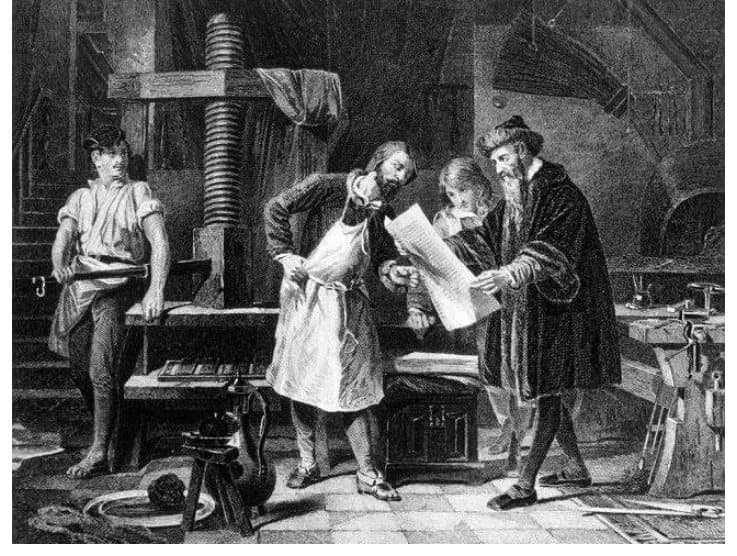
Figure 1 Johannes Gutenberg
and printing press.
opening of the press, as the existing literate population and students in madrasa were adequately equipped with the necessary books. The claim that this delay was due to the opposition of scribes who earned their living by copying works is more of a speculative assumption. Information indicating the presence of 80,000 scribes in Ottoman territories in the 18th century, with about 6,000 of them working in İstanbul, not only suggests that a sufficient number of works could be reproduced but also points to the existence of a significant group that could oppose it due to economic concerns. The claim that the scholars opposed the printing press as a factor in the delay lacks acceptable evidence.
Beyond obtaining legitimacy through the issuance of a fatwa by the Sheikh-ul-Islâm for printed works, it seems that the fact that those who took over the operation of the printing press after İbrahim Müteferrika were members of the judiciary, having served as scholars, has been
overlooked. These individuals, in addition to preparing books for printing, were also involved in their correction, a task carried out by committees of scholars.
Since the early days, it is evident that the works printed in Europe with Arabic letters using unsuccessful and unattractive typefaces did not appeal to the aesthetic sense of the East. They caused discomfort to eyes accustomed to the elegance of calligraphy. It took time for people to adapt to this, but the development of typecasting played a significant role in this process. It is understood that the first technical assistance for the Müteferrika Printing House came from nonMuslim printing houses operating in İstanbul. A printing press was acquired from an Armenian printing house, and assistance was sought from the Jewish community for typecasting. Additionally, certain necessary materials were imported from Europe.
Considering that a total of 17 works, compiled into
Figure 2. An example of the
printing press invented by
Gutenberg. twenty-three volumes, were printed in the Müteferrika Printing House, totaling 12,500 copies, the relatively low number of printed works raises questions, especially when compared to the greater quantity and variety of works produced in non- Muslim printing houses. Some attribute this difference to variations in literacy rates and the demand for printed works between the two communities. However, another crucial aspect to consider here is the issue of language. Regardless of the subject matter in the Ottoman literary works, there is often a significant difference between the language used and the plain Turkish spoken by the people. The majority of existing written books are written in a complex language with a predominance of Arabic and Persian, targeting individuals with a certain level of education. This language is quite distant from the language spoken by the people. As a result, books printed in the printing press could not reach the general public and remained limited to a narrow, elite circle that could afford and read them.
The widespread adoption of the printing press in Ottoman society occurred primarily in the second half of the 19th century, coinciding with the proliferation of newspapers. The influence of literary movements of that time also played a role in the transformation of the language used by these newspapers to levels understandable by the general public. With the end of the Nizâm-i Cedîd in 1807 and the subsequent period of coups and counter-coups, the printing press played a crucial role as an integral part of the new system that emerged, printing numerous books on contemporary technical education. It became a target among the reactions against the Nizâm-i Cedîd. Levend Ciftlik, an important symbol of the reform period, started its activities on the ground floor of the newly opened (1795) Mühendishâne-i Berrî-i Hümâyun in Hasköy in 1797. It continued its operations by relocating to a separate building
near the Selimiye Barracks in 1803. Unfortunately, it met the same fate as military institutions such as Üsküdar and Selimiye barracks during upheavals of the reform period (November 17, 1808), being burned, destroyed, and plundered.
Unfortunately, it met the same fate as military institutions such as Üsküdar and Selimiye barracks during the upheavals of the reform period (November 17, 1808), being burned, destroyed, and plundered. The printing press, which was relocated to the İstanbul side in April 1824, only became actively involved in new activities after 1826, entering a period of significant development. By the end of the century, the total number of printing presses in the provinces reached hundreds, marking a notable development with fifty-four major printing presses operating only in İstanbul.
During this period, the printing press not only provided significant services in the fields of intellectual awakening and modern education for the nations represented in the Ottoman Empire but also served as one of the most effective weapons in the political struggles that unfolded at the end of the empire.193
İbrahim Müteferrika‘s presentation of a few sample pages of the Vankulu Dictionary to the Grand Vizier
In the petition submitted to the Grand Vizier by İbrahim Müteferrika, he mentioned that he had selected and completed the beautiful work, Vankulu Dictionary, a Turkish translation of the rare Arabic book Sihahı Cevherî, which would facilitate obtaining knowledge for those who wanted to procure the necessary tools and equipment for book printing, as required by the decree.
He attached a few pages as examples. In return for
the completion of this task, he expressed some requests, including the issuance of an official decree for the printing of the book, the drafting of a commendation by the Sheikh-ul-Islâm stating
the usefulness and religious permissibility of the work, and the bestowal of an imperial order by the Sultan permitting the printing of dictionaries, philosophy, astronomy, medicine, mathematics, anatomy, engineering, and geography books. Other requests included assigning those individuals who had participated in the correction process to complete the final corrections, writing a preface that encompassed all these matters and placing it at the beginning of the book, and the employment of a Jewish individual named Yona, who had expertise in printing and had been working on this project. Furthermore, the petition highlighted that financial assistance was necessary for the completion of the project, given that eight years of effort and all available resources had been exhausted. Yirmisekizzade Mehmed Said Pasha had also contributed both through labor and financially, and his resources were now depleted. The petition emphasized the need for financial support for the printing press’s equipment, workers’ wages, and other necessities. The Grand Vizier, in his written order to the Chief Clerk, instructed the immediate preparation of the necessary documents to allow this beneficial work to proceed. Additionally, a document from the Head Accounting Office confirmed the provision of fifteen pairs of bread each day to the workers employed in the printing of the Vankulu Dictionary at the Imperial Press.
June 1727
“Esteemed Chief Clerk Pasha,
As this matter is a beneficial and facilitating endeavor for scholars and students, His Excellency Vizier Captain Pasha and Honorable Defterdar Efendi were consulted. It is ordered that you, after discussing and arranging the necessary documents, write and organize them for permission to be granted.”
May the Almighty Allah, who is free from all deficiencies, protect the illustrious and benevolent statesman, our gracious master, from illness, error, and mistake. May His abundant benevolence and sublime works continue to increase day by day. Amen.
Overwhelmed by your grace, kindness, and bestowal, here is the request of this servant:
The printing of books, the invention and creation of which had never been dreamed of by any worthy grand vizier in this land of great esteem for so many centuries and eras, has been completed with the help of the Almighty Allah by procuring the necessary tools and equipment in accordance with the decree issued by Your Excellency. Hopefully, as stated in the decree you issued, this will be a valuable work that enables those on the path of acquiring knowledge and students without the means to afford books to obtain inexpensive and beneficial books. May the Almighty Allah grant success.
It is well known to you, my gracious lord, that the multiplication of books and treatises is a means of acquiring knowledge, but such a great work depends on the help of Almighty Allah, the Ottoman Empire, and especially you, my gracious and benevolent lord, and your support for this servant of yours. Therefore, for the time being, the book that we have made available to allow the requests and relieve the burdens is the Book of Vankulu, the translation of Sıhâh alJawhari (Sihahı Cevherî), a rare work worthy of praise and esteem among the Arabic dictionaries, and a translation of which the scholars are in dire need.
A few pages from the beginning of this selected lexicon, after correction and typesetting, have been printed, and as a sample, they are presented to the distinguished presence of Your Excellency,
who comprehends intricacies. When seen and examined by your side, it is hoped that the completion of this work, its reward, and the permission to exhibit such an unparalleled skill and knowledge will be granted by Your Excellency, the Grand Vizier.
First Request: If Your Excellency desires it to be printed in this manner, to quickly come into existence, and for this servant not to face difficulties in the expenses, it is kindly requested that initially an imperial decree be issued by Your Excellency for the printing of only five hundred copies of this book. A copy of this decree should be placed exactly at the beginning of the book.
Second Request: This new profession, involving science and beneficial works, is akin to the art of drawing and writing, similar to the art of engraving faces on coins and stamping (minting beautiful coins). It is a kind of writing work where the shapes of letters are created, arranged line by line on a template, words are lined up, and then pressed like a seal onto paper. Therefore, for the correction and multiplication of books, being a commendable method and a fine art (science) that benefits people, it is desirable for people to show interest in it. In order for this work to comply with Islamic law, it is recommended that the Sheikh-ulIslâm write a commendation expressing that this is a beautiful job and granting permission for it. This commendation should be placed at the beginning of the book.
Third Request: There is no need to mention that this astonishing work, benefiting everyone and multiplying books, is a task that covers all Islamic cities and facilitates the acquisition of knowledge. Since such a new work and beneficial profession have become a cause for the names of those involved to be remembered until the end of time and for them to receive good wishes from people,
this book is worthy of being adorned with the imperial signatures of our illustrious Sultan. Therefore, it is requested that henceforth, an imperial order granting permission from His Majesty for the printing of dictionaries, philosophy, astronomy, medicine, mathematics, anatomy, engineering, and geography books be issued. This imperial order should be placed on the first pages of the books to serve as a reference and a point of trust.
Fourth Request: To ensure that this book is free from harm, error, mistake, and flaw, it is requested that a decree be issued for three or four virtuous individuals who are knowledgeable in literature and language, interested in this work, and have willingly contributed to the correction of these pages, which are prepared as a sample. They should be assigned the task of completing the correction from now on. The decree should be placed at the beginning of the book to ensure the accuracy of the book and serve as a means for perpetual blessings and good wishes for the Ottoman State. As these requests are related to the glory and greatness of the Ottoman State, it is suggested that a beautiful preface encompassing all these be written and placed at the beginning of all books for publication. (Note: Those who showed interest and participated in the correction of this book: respected Ishak Efendi, Sahib Efendi, Esad Efendi, Kasım Pasha, and Shaykh al-Islâm Musa Kazım Efendi.)
Special Requests: This humble servant of yours has been working tirelessly for eight years, exerting every effort to bring about this unique and seemingly impossible task. All praise be to Allah, with His infinite grace, and with the good fortune of being in the era of our beneficent master, this undertaking has come to fruition effortlessly. However, as you are well aware, I am
now in need of assistance in every aspect.
With the manifestation of this work at the earliest opportunity, may you be the recipient of the prayers of the entire world, bring joy to the servants of Allah, and undertake the necessary preparations for the completion of this work, including the expansion of the printing press, the increase in the number of presses, and the provision of wages for workers, until the printing of the initially published books is completed. I earnestly implore that your generous patronage and assistance be extended in a manner that you see fit, protecting this humble servant from neediness. Considering the magnitude of the task, your esteemed permissions and support in this matter are fervently sought.
Known as Yona veled-i (), is a skilled and knowledgeable Jew in the requirements of the printing art, having provided valuable service by possessing all necessary tools and equipment for the printing press, is deemed essential and significant for this great undertaking. Therefore, it is wished and requested that your benevolence and favor not be withheld regarding him, and a certificate exempting him and his descendants from taxes be granted, acknowledging his superiority and pride among his people and peers.
If, as written above, you find it fitting to grant your permission to this servant for his requests, it is hoped that determination will be shown to promptly initiate and complete this beneficial
task. With the assistance of the Almighty Allah and the unparalleled support of our esteemed benefactor, by swiftly enhancing calligraphy styles, such as nesih and talik, according to your desire in terms of beauty and decoration, you will contribute to the multiplication of beneficial books, thereby receiving the prayers of all humanity.
This humble servant, in the desire to acquire this unique art (science) and thus to emerge worthy in this era of your benevolence, providing a beautiful service that benefits everyone, has been exerting
all efforts and resources for such a long time. Finally, having depleted all, I find myself in a state of helplessness and weakness, necessitating seeking assistance. For the past two years, your servant Yirmisekizzade Efendi Said Aga has been contributing to this challenging task through both his efforts and financial support until this time, assisting in the completion of this difficult endeavor with the help of Allah. However, now he has no strength left to provide further assistance. Since this servant of yours has no income from the state or elsewhere, the completion of this valuable work is entirely dependent on your unparalleled support. It is well-known to you, esteemed master, that this humble servant is in need and compelled to receive a little assistance (hidmet) from you as you deem fit and to extend your generosity through other means. Therefore, now the order and decree are in your benevolent and gracious hands. In addition, with the help of Allah, when these books are completed and presented before your honorable presence, the most knowledgeable and wise, if a decree is issued in accordance with your esteemed orders and views, determining a reasonable and measured value that ensures neither overpricing nor underpricing for the ease of Allah’s servants when buying and selling, it would be a kind gesture from your side.
A document (copy) was issued in accordance with the decree that arose from the memorandum submitted for recording in the Chief Accounting Office regarding the provision of daily bread (tayinat) for the workers employed in the Printing House through the efforts of İbrahim Efendi, who undertook the task of printing the Vankulu Dictionary until the completion of the said book. This document (copy) was presented based on the memorandum for the record.
2 Cemaziyelevvel 1140 (July 25, 1727)
(Seal and signature)
HAT, 1665/56
Source: Innovation, Inventions and Quests Among the Turks