
Culture & communication
1789
Turkish Delight “Easy on throat when eaten,” a gift of taste from the Ottomans to the
world in the 18th century
Like coffee, another flavor introduced to the world by the Turks is Turkish delight. Prepared by slowly adding starch to cut sugar syrup and cooking it until it reaches a thick, waxy consistency, Turkish delight is a confection that emerged and gained popularity towards the end of the 18th century. At the time of its discovery, it was expressed with the Arabic term rahatü‘lhulkum (throat comfort). This phrase later evolved into the Turkish word lokum as we know it today.
The historical dimension of the subject is commonly narrated as follows:
“Hacı Bekir, a significant figure in Ottoman confectionery, opened his first shop in İstanbul in the last quarter of the 1700s. When Hacı Bekir opened his confectionery shop, İstanbul already had the production of akide (hard sugar candy) and lokum (Turkish delight). However, sugar and starch, in today’s sense, were not yet present.
Hacı Bekir, as it has been done for a long time, used honey and molasses as sweeteners in the first
lokums and flour instead of starch. In the late 18th century, sugar began to be abundantly produced in Europe from sugarcane brought from South America. With the arrival of sugar in İstanbul, it was observed that real sugar started to be used in confectionery. In 1812, starch was also discovered. Subsequently, Hacı Bekir‘s discovery of using cornstarch instead of flour as a water-binding and texture-building agent in the production of Turkish delight led to superior quality and taste in Turkish delight production. In the early 19th century, an English tourist who purchased Turkish delight from Hacı Bekir's shop in İstanbul and took them to England played a role in the recognition of these confections throughout Europe under the name “Turkish delight.”194
During the reign of Mahmud II (1808-1839), despite the production of all kinds of confections in the palace, Hacı Bekir's confections began to be purchased. Hacı Bekir was awarded the title of ‘chief confectioner’ in the palace. This title continued from father to son until Ali Muhiddin
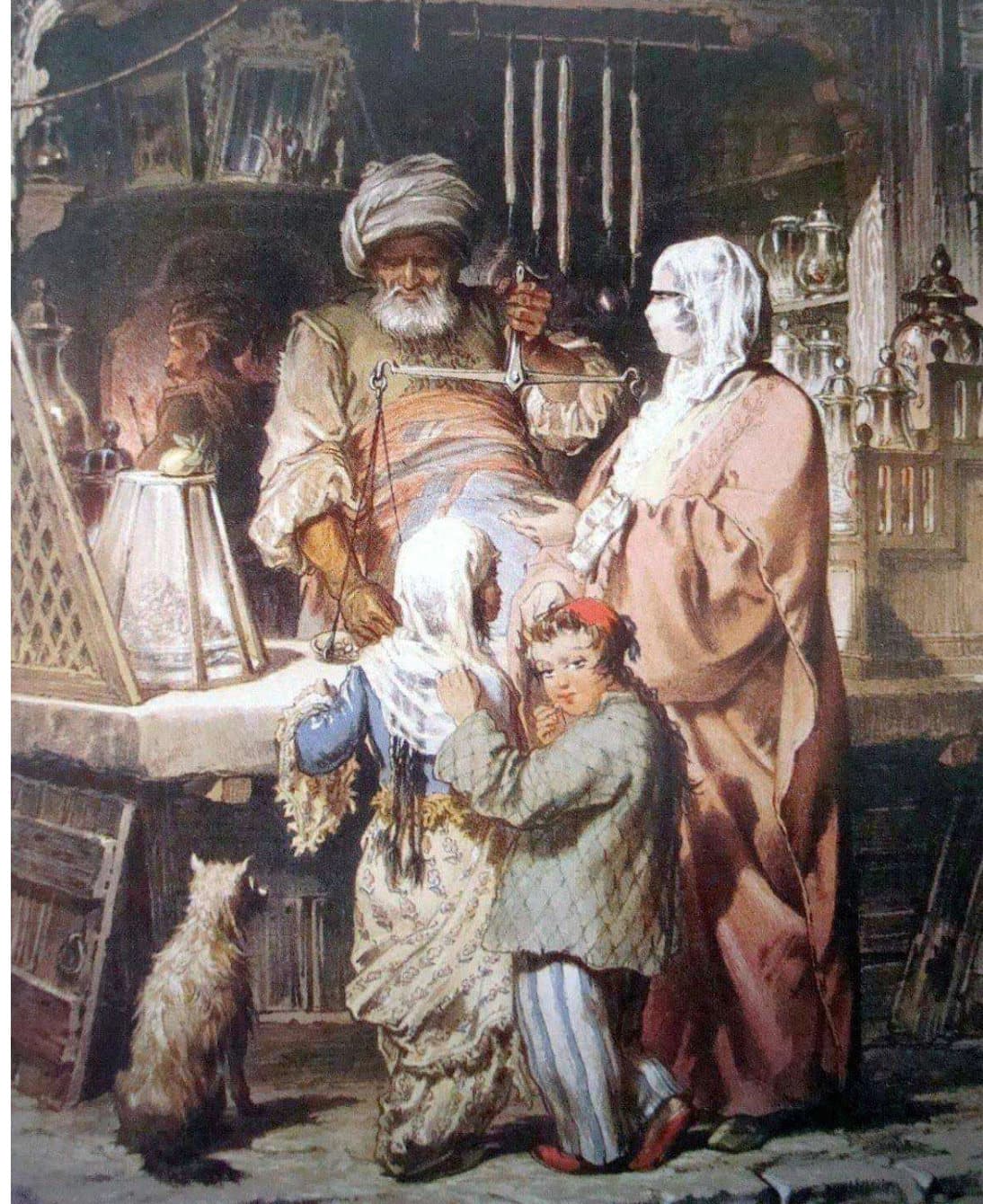
Figure 1. Hacı Bekir, drawn
by Preziosi. Hacıbekir. In 1851, the Maltese painter Amadeo Preziosi, who came to İstanbul, painted a picture of Hacı Bekir selling sweets in his shop.”195
The existence of a confection made from a mixture of molasses, honey, and flour, known by different names in various regions of Anatolia, has been known since the time when the Turks first arrived in these lands. It is also narrated that a confection similar to Turkish delight, made with honey or sugar, derived its name lu‘q (ϖ--όϟ) from the Arabic verb meaning “to lick.” Some even trace its origins back to the Babylonians. Historian Reay Tannahill suggests that Turkish delight is a variation of ahbisa, a type of Iranian confection.196
However, there is a consensus that Hacı Bekir is the person who popularized Turkish delight in Ottoman society and later introduced it to Europe and the world as a Turkish brand.
As summarized in the above narrative, the claim that the Ottomans encountered sugar in the late 18th century is not accurate. Sugar has been a known and produced substance in the Ottoman Empire for a long time, even being exported. The production of sugar from sugarcane is noted to have started in India in the 4th century BC. This technique then spread from India to Egypt and, by the 11th century, reached Cyprus. Later, it reached continental Europe first and then, following the route through the Canary Islands, made its way to the American continent. In the 16th century, sugar had become a commodity in international trade. Sugars obtained from sugar cane were produced and consumed from India to Cyprus, from the Portuguese territories to Brazil, in both the Old and New Worlds.
It is understood that sugar, spreading globally, was also consumed by the Ottomans from early times. Aşıkpaşazade (Dervish Ahmed) narrates the wedding of Sultan Murad I’s son Bayezid to the daughter of the Süleyman Şah Bey, the ruler of the
Germiyanids, in 1382, during which he describes the “pouring of sugars.” The same author also mentions that during a circumcision ceremony organized by himself in the presence of Mehmed the Conqueror, plenty of sugar was consumed. Initially imported from Egypt and Cyprus, sugar began to be domestically produced after these territories became part of the Ottoman Empire in the 16th century. The Ottomans also imported sugar from Europe. In the 18th century, sugar became a significant item among the foods imported from America and Europe.
Just like in every aspect of Ottoman economic life, the guild of confectioners was organized among themselves in the production and sale of sugar. This group, also known as the confectioner’s faction, had a say in production and price setting, especially in the capital. According to Evliya Çelebi, a traveler known for his special interest in artisans, in his own time (in the middle of the 17th century), there was a workforce of 100 people working in 70 confectionery shops in the capital alone. In addition to these, there were individuals who produced and sold sugar in Galata, particularly Chios Rum and Franks. In provincial towns, there were also artisans selling sugar or products made from sugar.197
In the late 18th century, sugar production began to be completely mechanized. The steam engine was first used in a sugar factory in Jamaica in 1768. Until the Napoleonic Wars between France and England from 1793 to 1815, sugarcane continued to be the main source of sugar in Europe. Due to the war, the entry of sugar into the European continent ceased. From these dates onwards, sugar beet cultivation rapidly spread in Europe with the aim of replacing sugarcane.198 For these reasons, there was an increase in sugar production worldwide from the mid-19th century onwards, leading to a decline in prices. Sugar, which was once consumed only by the palace and the elite,
Figure 2 The procession of helvacılar in the Surnâmei
Hümâyûn, which describes
52 days of festivities organized for the circumcision wedding of
Sultan Murad III‘s son Şehzade Mehmed in 1582,
Topkapı Palace Museum
Library H.1344
becoming a commodity within reach of the public in terms of both price and abundance, had moved away from being a luxury item accessible only to the wealthy and the aristocracy.
On the other hand, the other raw material of Turkish delight, starch, was not discovered in 1812. Starch made from wheat has been known and used for a very long time. It is known that the Ottomans have been using starch since earlier times. The discovery of cornstarch in 1840 led to significant developments in the starch industry worldwide.
Discovered in 1812 was not starch but glucose obtained for the first time from starch. The German-born Russian chemist Gottlieb Kirchhoff (1764-1833) had boiled a starch suspension (a substance suspended in liquid without dissolving) in water with a small amount of sulfuric acid added. Instead of starch, a substance that could dissolve freely in water and was sweet emerged when treated with sulfuric acid. This was a type of sugar, and it was given the name glucose, derived from the Greek word for “sweet.”199
A brief overview of the history of sugar and starch, as presented above, indicates that the claims suggesting the discovery of Turkish delight could be linked to the findings of sugar and starch in the early 1800s may not be accurate. Both sugar and starch were available and in use by the Ottoman Empire since its establishment. However, although sugar and starch are encountered in various forms in Ottoman sources from the beginning, there is no mention of a confection referred to as lokum (or rahatü'lhulkum) until the 1790s.
The document dated 1795 provides important clues on this matter. This earliest-known document mentioning the term rahatü'lhulkum is a petition submitted to the Sultan by Ali, the Chief Confectioner of the Palace (Helvacıyan-i Hassa).
Ali, the Chief Confectioner of the Palace:
“I am the Chief Confectioner of the Palace. In the helvahane of the palace, the production of a confection known as rahatü'lhulkum (lokum) made of sugar specifically for our Sultan is a practice exclusive to the private confectionery of the palace. It has been regulated by decree since old times that confectioners and sherbet sellers outside the palace are not allowed to make production.
Even though it is prohibited for confectioners outside the palace to make the Sultan’s unique Turkish delight and other sherbets, for quite some time, the confectioners and sherbet sellers have attempted to produce Turkish delight confectionery in violation of the regulations. This has led to the disruption of the order in the Imperial Confectionery of the Palace. I present this information for your consideration.
With utmost respect, we kindly request that the mentioned Turkish delight confectionery be made only in the Imperial Confectionery for our esteemed Sultan, following the old order. The aforementioned part of the artisans should be stopped from producing this confection in their shops or secretly in their homes. If there are still those who do not comply, a new decree containing threats and warnings should be issued to ensure that the necessary penalties are imposed.”200
According to the document, the confection called rahatü'lhulkum has traditionally been made exclusively for the Sultan and only within the palace confectionery. It is prohibited for confectioners and sherbet sellers outside the palace. For some time, the lifting of this ban has led to the production of Turkish delight by craftsmen outside the palace, affecting the income of the confectionery foundation. If craftsmen want to sell Turkish delight, they are required to purchase and sell the ones produced in the
confectionery. However, the Sultan responded to Chief Confectioner Ali, saying, “I do not consent to the monopoly of commerce in any way. Even though it is prohibited by decree, there have been some irregularities lately. Be attentive to these and respond. Avoid putting pressure on the poor and the people with such things.” He made it clear that a return to the old monopoly era was not possible. From now on, anyone could produce and sell Turkish delight, but at the prescribed quality. From another document we can deduce that the production monopoly was abolished by a decree dated 1203 (1788-89).201
The content of the document also shows that Turkish delight was first discovered in the palace confectionery a little before the year 1789. The fact
that this soft confection, first discovered and greatly liked, was called rahatü'lhulkum can be considered an indication that it originated from the palace. Since this is an Arabic term, it would be expected that a newly discovered confection in the vernacular would be given a simpler Turkish name. However, being referred to by such an Arabic term indicates that it is a name associated with the palace, familiar with Arabic and Persian education. On the other hand, the exclusivity of its production to the Imperial Confectionery and the prohibition of confectioners outside to produce lokum should also be considered as another indication that those who invented lokum were in the palace confectionery. If the Turkish delight had been discovered by craftsmen outside, it would be senseless to establish a regulation
prohibiting its production and allowing it to be produced only in the palace confectionery.
Towards the mid-1800s, the increase in production worldwide due to the mechanization of sugar and starch production, as well as the transition to sugar production from sugar beets, resulted in the abundance of both substances in the Ottoman Empire as well. The removal of the monopoly in production must have provided significant relief to the artisans. Furthermore, with Sultan Mahmud II (1808-1839) choosing to reside not in Topkapı Palace but in the palace that is located by the seaside in Beşiktaş, Topkapı Palace began to lose its significance. Previously, the confections made in the confectionery of Topkapı Palace, starting from the 1850s, would now be purchased from artisans outside for the sultans who moved to the newly constructed Dolmabahçe Palace. As Topkapı Palace, along with all its historical units, was being dismantled, some renowned artisans outside were now being given the title of şekercibaşı (head of confectioners).
Various sherbets, jams, halvahs, pastes, pickles, medicines, essences, and scented soaps were made in the Imperial Confectionery in Topkapı Palace. In the confectionery, syrups were made not only from flowers such as violet, rose, water lily, and black mulberry but also from fruits like mulberry, jujube, quince, sour cherry, and others. The jams made in the jam section, forming a part of the confectionery, were very diverse. Another important function of the confectionery was the preparation of medicines for various illnesses. Medicated pastes with healing properties were made, and these were distributed to the palace personnel and those in need. In the second half of the 16th century, there were eighteen confectioners working in the unit, and by the end of the century, there were ten confectioners and forty-nine or fifty assistants. The number of confectionery workers ranged between eighty-five
and ninety in the first half of the 17th century.202
Turkish delight, thanks to an English traveler, made its way to Europe and is noted to have first arrived in England in the 1860s. Quickly spreading and being admired in Europe, Turkish delight became a confectionery that many wellknown individuals had a special interest in and admiration for. Napoleon, C.S. Lewis, Picasso, and Charles Dickens are among some of these names. C.S. Lewis mentioned Turkish delight in his books, and the curiosity and demand for Turkish delight among the British who read his books increased significantly. Dickens, in one of his novels, sent the protagonist to a Turkish delight shop, and Picasso used Turkish delight as an energy source and a concentration tool to be taken before starting to work. It is said that Napoleon greatly enjoyed the taste of Turkish delight and ordered kilograms for his palace.203
Hacı Bekirzâde Mehmed Muhiddin Efendi was assigned to promote Ottoman confectionery at the fair organized in Vienna in 1873 under the patronage of the Austro-Hungarian Emperor Franz Joseph I. Mehmed Muhiddin Efendi, who observed that all the participants from Western countries used a brand name, returned home and created the first brand name of the Ottoman Empire and his company with the silver medal he won.
Later, in 1888, Mehmed Muhiddin Efendi participated in the fair organized under the auspices of the German Empress and Queen Augusta of Prussia in Cologne and won his second silver medal. In 1893, Mehmed Muhiddin Efendi participated in the fair organized in the city of Chicago on the occasion of the 400th anniversary of the discovery of America and introduced Turkish delight to the Americans by producing and selling the first Turkish delight there, and later participated in the Brussels fair in 1897 and added gold medals to his achievements.
Figure 3 Helvacıyan-ı Hassa
(Private Confectionery),
Fenerci Album
After the death of Mehmed Muhiddin Efendi, his son Ali Muhiddin ran the business. Gold medals are won at the France-Paris-Nice fairs in 1906, and Ali Muhiddin Bey is given the title of Ottoman Chief Confectioner.
Alongside his grandson Ali Muhiddin Hacı Bekir, the Hacı Bekir Establishment became an international enterprise, transforming into a global brand. As the last years of the Ottoman Empire approached, in 1911, Ali Muhiddin Bey was honored with the title of Şekercibaşılık (Chief Confectioner) by the Egyptian Palace. Hacı Bekir branches were established in the two major cities of Egypt, Cairo and Alexandria, with skilled personnel sent for this purpose.204
Freeing the production of Turkish delight, which was only made in the palace confectionery
The request of Ali, the chief of the Imperial Confectionery, complaining about the production of Turkish delight outside the palace by confectioners and artisans, which was previously exclusively made in the palace confectionery, has been rejected. The reason for the rejection is based on the argument that issuing a decree to remind of the previous prohibition would contradict the content of the decree that abolished the monopolization of shopping.
March 23, 1795
Blessings to His Highness the Sultan
My request is as follows: I am the chief confectioner of the imperial kitchen. In the palace, the production of a confection known as rahatü’l hulkum (lokum), made of sugar specifically for our sovereign, the Sultan, is exclusively reserved for the imperial confectionery, and it has long been regulated by decree that those outside, such as confectioners and sherbet makers, are not
permitted to produce it.
Although the production of the Sultan’s unique delights, including lokum and other sherbets, has long been prohibited for confectioners outside the palace, it has come to my attention that the confectioners and sherbet makers, in violation of the regulations, persist in manufacturing lokum confectionery. This unauthorized production poses a threat to the order of the imperial confectionery, and I submit it for your information.
Asking for your sublime mercy, we humbly request
that the aforementioned lokum confectionery be exclusively produced for our esteemed Sultan, just as in the old order, within the imperial
confectionery.
The mentioned craftsmen who persist in making this confection either in their shops or secretly in their homes should be persuaded to desist and prevented from doing so. If there are still those who do not comply, a new decree, firmly worded with threats and warnings, should be issued for the imposition of necessary penalties.
In this matter, the authority lies with our distinguished Sultan.
Your servant, Chief Confectioner Ali
The written request in this petition, which opposes the prohibition of monopolizing trade, has been presented to our esteemed Sultan since it is contrary to the decree. “I do not consent to the monopolization of trade in any way. Despite the ban by decree, there are currently various corruptions occurring. Pay attention to these and respond. Since there was a decree stating that the poor and the public should not be oppressed with such things,” it was ordered to annotate the record of the order given before, to record it separately in the Dîvân-ı Hümâyun Office, and to give an
annotation to the Chief Accountant.
March 23, 1795
C.İKTS, 9/431
Source: Innovation, Inventions and Quests Among the Turks