
Culture & communication
1839
Tanzimat (Reorganization) Foundations of the future in the Ottoman century of change
Tanzimât, the plural form of the word tanzim in Turkish, means “to arrange, to put in order, to reform.” In the literature, tanzimât is used to refer to the period of “reforming and reorganizing civil administration,” and it characterizes the era during which these reforms were implemented. The initial practices of this period, initiated by the Imperial Edict of Gülhane (Tanzimat Edict) declared on November 3, 1839, are said to date back to 1830, and even further. The debate regarding when this period ended is ongoing. However, a general consensus has formed suggesting that the era concluded with the closure of the parliament in 18781.218
Tanzimat is the fundamental event that explains the entire 19th-century history of the Ottoman Empire. It represents an attempt to rebuild a state that was on the verge of collapse due to the decay of its economic and social foundations with new principles. With the Tanzimat, the foundation for a significant change in the basic institutions forming the structure of the state was laid. From now on, in all laws and government practices, the “equality of all classes of subjects” was considered an immutable principle. This principle, gaining
significant importance in the establishment and formation of the state, played a fundamental role in Ottoman politics, becoming a cornerstone throughout the entire Tanzimat period.219
The Tanzimat Edict drew extensively from the political, legal, social, and economic ideas and institutions of its own era as well as contemporary Europe. It was influenced and shaped by the political, legal, social, and economic frameworks and understandings of its time and the broader impact of European contemporaneous developments. Reşid Pasha‘s proposed reforms can be examined from another perspective by identifying their connection with European state thought at the beginning of the 19th century and the points of contact between his ideas and liberalism. Reşid Pasha‘s goal can be described as the establishment of certain institutions to limit the actions of the ruler. This, again, aligns with one of the objectives pursued by liberalism in the early 19th century and the constitutionalism movement, which bestowed upon it some of its essential characteristics. There is a complete agreement between the goals sought by the constitutionalism movement and what Reşid
Pasha aimed to achieve.220
Tanzimat is not just a period that began when it was declared; the provisions contained in the edict address issues that were discussed long before. Especially the reform movements of Sultan Selim III can be considered as conscious reform activities and precursors to Tanzimat.
Mahmud II, on the other hand, stands out as a reformist sultan who attempted to implement the reform program of Sultan Selim III and, in some respects, surpassed him. Unfortunately, Mahmud II did not live long enough to declare the Tanzimat-ı Hayriye, which he had prepared and even addressed its financial aspects; the proclamation of the edict would be granted to his eldest son, Abdülmecid.221
Mahmud II, after abolishing the Janissary Corps, completely overhauled the Ottoman central organization from the early 1830s onwards. In 1831, he abolished the office of silâhdarlık, a significant institution in the palace, and transformed the position of sır kâtipliǧi into the Mâbeyn başkâtipliǧi, forming the palace secretariat. Two years later, he established the Mâbeyn Müşirliǧi and reorganized the room system of the Enderûnı Hümâyun. Additionally, he changed the names of institutions in Bâb-ı Âli and formed ministries with clearly defined areas of responsibility, which functioned as specialized units.
Besides high councils like the Meclis-i Vâlâ, he established certain councils to assist ministries in their duties. On March 24, 1838, he formed the Meclis-i Vâlâ, defining its purpose as the establishment of reforms he contemplated, which he characterized as Tanzîmât-ı Hayriyye (Administrative Reforms), determining its method of investigation and discussion. This nomenclature was the general name for the reforms he designed.
Towards the end of the reign of Mahmud II, the long-standing issue of Mehmed Ali Pasha of Egypt, who had been troubling the state for about eight years, resurfaced. The expenses of the army dealing with the rebellion had put a strain on the treasury. Following a severe defeat of the Ottoman army by the Egyptian forces in Nizip on June 24, 1839, Mahmud II passed away on July 1. His son, Abdülmecid, succeeded him.
Before the declaration of the Tanzimat, a consultative council was convened in the Bâb-ı Âli under the leadership of Grand Vizier Koca Hüsrev Pasha by the order of Sultan Abdülmecid. The principles agreed upon in this council, attended by thirty-eight high-ranking bureaucrats and members of the religious establishment, were also approved by the Sultan. Half of those with a seal under the council minutes were from the religious scholars (ulema). Although the order may change, the principles in the minutes are almost identical to those in the Imperial Edict of Gülhane. This indicates that the Tanzimat Edict emerged more as a product of the internal dynamics of the Ottoman Empire rather than external influences.
On November 3, 1839, the Minister of Foreign Affairs, Mustafa Reşid Pasha, read the Tanzimat Edict in the Gülhane Square in the presence of ambassadors, dignitaries, religious scholars, Rum and Armenian patriarchs, the Chief Rabbi, representatives of the tradesmen, envoys, and others. Sultan Abdülmecid observed the ceremony from the Gülhane Palace. The edict begins with the observation that the state had been strong, the country prosperous, and the people prosperous since its foundation, but that this situation later turned into weakness and poverty, and that, considering its geographical location, the fertility of its lands, and the industriousness of its people, if the necessary measures were taken, the state would regain its former status within five to ten years. In the meantime, the drawbacks of the
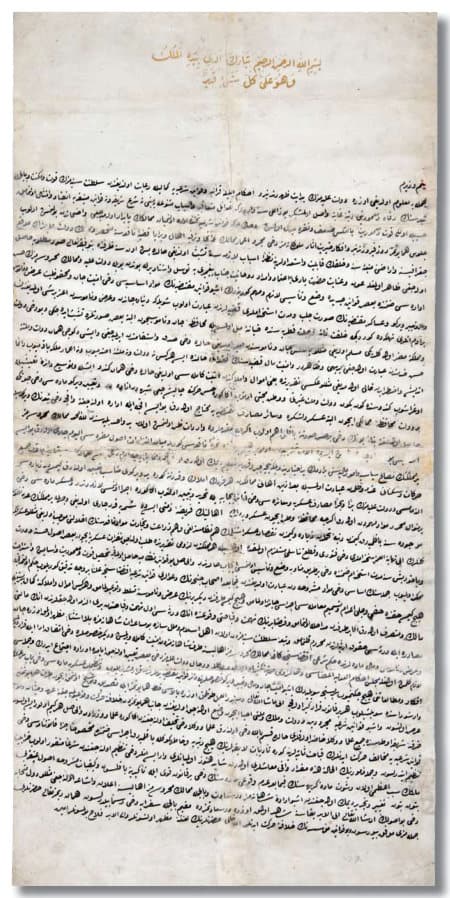
Figure 1. The Tanzimat Edict of 3
November 1839.
iltizâm method, which caused losses to the people and the treasury, were mentioned, and a signal was given that it will be abolished. It is emphasized that taxes should be collected according to everyone’s ability and that no one should be asked for anything extra. There were complaints about the uncertainty of the duration of military service and the random recruitment of soldiers, rather than a proportionate one. It was emphasized that this practice negatively affected agriculture, trade, and population growth, and therefore the duration of military service should be set at four or five years. A decision was made not to impose the death penalty without trial for anyone, allowing everyone to dispose of their property as they wished. The rights outlined, including equal enjoyment for both Muslim and non-Muslim subjects, were to be discussed by the expanded Meclis-i Vâlâ (Supreme Council). It was also decided that both vükelâ (ministers) and ricâl (notables) could occasionally attend the council’s meetings. Military arrangements would be deliberated and determined in the Dâr-ı Şûrâ-yı Askerî (Military Council). To prevent bribery that led to the country’s devastation, an effective law was to be drafted and announced to both domestic and foreign public opinion.
After reading the imperial edict of Reşid Pasha, cannons were fired, and sacrifices were made. Sultan Abdülmecid swore to adhere to the declared provisions in the Hırka-i Şerif (Sacred Mantle) Chamber. Five days after the proclamation of the decree, a regulation was enacted, and the vükelâ, prominent scholars, and leading statesmen decided to begin their duties by taking an oath in the presence of the Sultan, Grand Vizier, Sheikh-ul-Islâm, Serasker, Director of the Mint, and Minister of Foreign Affairs.
This decree brought about innovations that would fundamentally shake the traditional structure. The equality of Muslim and non-Muslim subjects was
proposed to prevent the departure of non-Muslims who adopted a nationalist stance, particularly in the context of Greek and Serbian uprisings, and was the initial step in a significant project aiming to form an Ottoman nation, which was later emphasized frequently.
The governors were asked to gather the notables of the people in the squares, read the edict, explain its contents “well” to everyone, and immediately implement its provisions, except for taxation and military service, the details of which were to be determined later. Each group of Ottoman subjects interpreted the edict in their own way; Muslims did not like the new rights granted to nonMuslims, while non-Muslims were filled with great expectation and hope. On the other hand, the scholars, the ayan, and even the governors, whose interests were harmed, provoked the people by claiming that the Sharia was being violated and that Muslims were being put on the same level with the unbelievers. The envisaged reforms were not implemented throughout the country, but first in places relatively close to the center, where they could be easily supervised.
The wealthy classes, including governors, mütesellims (local administrators), notables, ayan, money changers, tax farmers, and voivodes, whose interests were harmed by the new system aiming to prevent the misuse of treasury revenues by local administrators, incited the public and resorted to various obstacles to undermine the success of the Tanzimat reforms. This was because they would pay more taxes with the tax rate based on income, and they also lost the exemptions that had been granted to them in the past.
Military matters, one of the most important articles of the Tanzimat Edict, could not be addressed for three years. Since the abolition of the Janissary system, recruitment had been haphazard, and the duration of military service had not been determined. The duty of conscripted
young men continued as long as they remained alive and able-bodied. In 1843, Rızâ Pasha (Security Chief) was assigned the task of resolving this issue, and the new regulations were discussed by a temporary council in the Seraskerlik (Ministry of War). On September 6, 1843, it was decided that conscripts would be determined by lot, that the duration of actual military service would be limited to five years and militia to seven years as of March 1844, and that 20% of the existing soldiers would be replaced with new ones every year. Additionally, a new military system was introduced, and five armies were established: Hassa, Dersaâdet, Rumeli, Anadolu, and Arabia, each with its own council. In 1845, Zaptiye Müşirliǧi (Gendarmerie General Command) was established to oversee the security of İstanbul, Üsküdar, and the Bosphorus.
In 1844, a general population census was conducted, determining the Ottoman population to be approximately 35 million. With the issuance of the reform named Tashîh-i Ayâr (meaning correction of measures) in 1844, a new order was established regarding currency, introducing the principle of 1 gold lira = 100 silver kuruş and transitioning to a bimetallic system from.
The Tanzimat reformers addressed the crucial issue of education, which was considered a key element for the success of the reforms, albeit later in the process. Sultan Abdülmecid emphasized the relationship between the success of reforms and the need to expand schools in 1845. Consequently, Meclis-i Maârif-i Muvakkat (Temporary Ministry of Education) prepared drafted proposals for the establishment of temporary sıbyan (elementary) and rüşdiye (secondary) schools, along with the opening of a dar ülfünun (higher education institution). On June 27, 1846, with the formation of the Meclis-i Maârif-i Umûmiyye under the control of the Meclis-i Vâlâ and the Ministry of Foreign Affairs, educational affairs under the
supervision of the Sheikh-ul-Islâm came under government control. To implement the decisions of the council, Mekâtib-i Umûmiyye Nezâreti (Ministry of Public Instruction) was established on November 13, 1846.
On September 28, 1846, Mustafa Reşid Pasha was appointed as the Grand Vizier. Hazîne-i Evrâk Nezâreti (state archive) was established in Bâb-ı Âli, contributing to the classification and preservation of documents. In 1847, the first state gazette was published, and the first secondary school was opened. The Commercial Court was transformed into a mixed court with half of its fourteen members elected by ambassadors. With the imperial decree dated April 23, 1847, and the subsequent preparation of the Tapu Nizamnâmesi (Land Registry Regulation), equal inheritance rights for male and female children from their fathers’ estates were ensured.222
The Tanzimat Edict not only aimed at securing and safeguarding citizenship rights in a modern sense, putting an end to mismanagement, and establishing a new order, but it also carried the expectation of placing the Ottoman Empire among the liberal states of Europe. Additionally, it sought to gain the favor of England and France, thereby preventing Russian encroachments and ultimately finding a positive solution to the Egyptian and the Straits (Boǧazlar) issues. Some argue that the edict is a product of these expectations, with a more realistic assessment of its outcomes.
It was undoubtedly anticipated that the equality envisioned between Muslims and non-Muslims with the Tanzimat Edict would lead to the restructuring of the state on new foundations. This matter was unequivocally and clearly addressed in the Islahat Fermanı (Imperial Reform Edict) announced in 1856, leaving no room for doubt.223
However, the attempt to maintain the unity of the state by granting legal equality to Christians
proved unsuccessful after half a century of effort. The era of Sultan Abdulhamid II can be seen as a reaction within Ottoman politics, marked by a strong response to Christian rebellion attempts and the pursuit of an Islamist policy. With the Second Constitutional Era (1908), Ottoman politics once again came to the forefront. However, in this field, two contrasting views emerged in the Parliament: İttihat ve Terakki Fırkası (Committee of Union and Progress) advocated a strong centralism, aiming to assimilate the nations within an Ottoman society. The opposition, on the other hand, advocated the idea of creating a federal empire around the Ottoman dynasty by granting autonomy to the nations. The tragedies of the Balkan Wars put an end to this period as well. Afterward, Ottoman politics were abandoned, and Turkish nationalism swiftly took its place.224
Source: Innovation, Inventions and Quests Among the Turks