
Culture & communication
1840
Our first paper currency
Kaime
The printing and use of paper money in the West date back to the late 17th century. The first paper money was printed and circulated by the Massachusetts government in the United States in the 1690s, while in England, goldsmiths were responsible for its issuance. The widespread use of paper money became more prominent with the establishment of the Bank of England in 1694 and later the founding of other central banks in various countries.
Since the 1660s, Sweden has been a pioneer in the use of banknotes, and between 1745 and 1776, it established a fiat currency standard. In 1786, Russia issued state banknotes that could not be converted into metal coins. During the American War of Independence from 1775 to 1781, paper money was used to finance the war. Between 1792 and 1815, European states involved in the prolonged years of war resorted to issuing fiat currency. In 1790, France issued money based on the income from nationalized state lands. The necessities arising from the war led to hyperinflation, as it caused circulation beyond official revenues, and it was abolished in 1796. These temporary measures, resorted to due to the
needs of the war, continued until 1819.225 The initial experiments with fiat currency, despite their positive outcomes, quickly ended in failure. States made banknotes convertible, but they frequently suspended convertibility in emergency situations.
Until the 19th century, the Ottoman Empire primarily relied on a metallic coin system. In this system, coins made of copper were commonly used to fulfill the need for small change, while gold and silver coins were also in circulation. The use of paper money began in the Ottoman Empire in the 19th century, following a trend similar to Western countries. The kaime was the first Ottoman paper currency or banknote.226
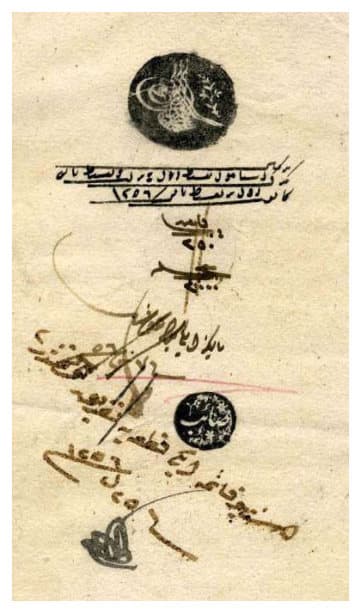
The term kâime in the dictionary is named for its meaning as “a substitute for something,” and it circulated in the market representing coins. It emerged with the development of the existing esham (share) system in the Ottoman finances. The initial kaimes were released in handwritten form into the market due to the urgent need for currency, without waiting for the molds to be prepared and printed. The first kaimes, totaling 160,000 liras (32,000 kese), were issued in 1840. These kaimes were of large size and were
Figure 1 An example of the
first handwritten kaime
considered as cash money, with a circulation period of eight years. Additionally, they yielded an annual interest of 12.5%. Although the kaimes had no equivalent value, the interest payments were covered by the revenue from the İstanbul customs. Due to unfamiliarity with such a practice, the public did not respond positively to the kaimes in the market. On the other hand, handwritten kaimes quickly attracted the attention of counterfeiters. Initially, kaimes were used throughout the entire country, but detecting and controlling counterfeit kaimes proved to be challenging. With the added factor of public resistance, the circulation of kaimes in the provinces was eventually prohibited after a while. To prevent counterfeiting, handwritten kaimes were replaced with printed ones within two years starting from the New Year of 1841. In order to
prevent imitation, they were reprinted in different forms in 1844 and 1847.
In 1851, a 100,000 lira (20,000 kese) interestbearing kaime was withdrawn from circulation, and in its place, a 20 kuruş interest-free kaime was introduced. This development is significant in terms of the kaime being used as a real means of exchange. Later, the practice of interest-free kaime was somewhat expanded. The government often introduced kaimes to the market without public knowledge.
The first serious attempt to abolish the kaime was the application for compulsory public aid under the name of iânei umûmiyye in 1848. Only a quarter of the 1.5 million liras collected throughout the country was spent for this purpose. The rest was spent on suppressing the disturbances that broke out in the country.
When the government‘s efforts proved to be unsuccessful, a decision was made to issue an additional 12.5 million liras (2.5 million kese) of kaime to be circulated throughout the entire country, excluding sensitive political areas such as Cidde and Yemen, starting from the end of March 1862. In early September 1862, it was officially announced that the kaime was completely abolished from circulation.
The second kaime implementation was initiated to finance the army during the unrest in the Balkans and the approaching 1877-1878 Ottoman-Russian War. With the 1863 concession agreement, the authority and monopoly to issue kaime in the Ottoman Empire were transferred to Bank-ı Osmanî-i Şâhâne (Imperial Ottoman Bank). Consequently, the approved kaimes could be obtained by paying a 1% commission and compensation to the bank. A decision was made to issue a total of 3 million liras in kaime emission, with 2 million liras to be issued immediately and the remaining amount to be issued as needed.
Figure 2 100 kuruş printed
kaime
Figure 3 20 kuruş printed
kaime
The Ottoman Empire resorted to the implementation of the third kaime to finance the First World War. When the government‘s request for the issuance of 15 million liras in banknotes, to be handed over to itself, was rejected by the Ottoman Bank, the task of issuing the kaime was temporarily transferred to Düyûn-ı Umûmiyye. Düyûn-ı Umûmiyye accepted the proposal under the condition that the equivalent of the kaime be secured in gold. On March 27, 1915, a debt agreement of 150 million francs was signed with Germany. Due to difficulties in bringing the money in cash, it was transferred to the branch of Düyûn-ı Umûmiyye in Germany. In exchange for this money, kaime notes totaling 6,519,139 liras were released into circulation starting from July 10, 1915.
During the war, the Ottoman Empire issued a total of 161,018,663 liras in seven installments of kaime. While some of them were withdrawn from circulation and destroyed, corvées amounting to 153,748,563 liras continued to be in circulation in the Republic of Turkey until its own currency was issued. The first paper banknotes of the Republic era, printed in England, were released on December 5, 1927. Ottoman kaimes were withdrawn from circulation within six months from this date.227
Issuing paper money to be circulated instead of cash
The Sultan sought approval to issue paper money to be circulated instead of cash, which would relieve the treasury from the burden of paying
interest, and to find a solution by discussing the capital required for this work.
January 6, 1840
Your Highness
As you are aware and as was recently presented, it is anticipated that there may be a slight delay in treasury revenues due to the implementation of the Tanzimât in certain places without exception, starting from March of this year, leading to the abolition of the harmful farming system, iltizâm. Since safeguarding the smooth operation of treasury affairs is among the foremost concerns of your loyal servants, the need for external borrowing has been discussed and debated several times in the parliament to find a solution for this situation.
The issue of esham as an alternative method, with an appropriate time limit, has also been brought up by some of your supplicant servants. The maturation of the necessary conditions and procedures for this has been entrusted to those who should present and express them to the parliament.
The writings previously and subsequently presented by treasury officials and the draft prepared by Ismet Beyzade Arif Hikmet Beyefendi, a former Grand Vizier and member of the Council of Judicial Ordinances, was read in the advisory council convened this Sunday. The minutes of some discussions on this matter, along with other documents, have been submitted to your consideration and presentation.
As can be understood from the aforementioned letters and the documents attached, it is understood that it was envisaged to give interest in the installments of the esham to be issued as originally thought and to be issued almost like esham in order to collect kaimes by giving the down payment after one and a half years, and the draft bill envisaged that the esham to be issued
would be converted into cash after, for example, twenty-one days in order to facilitate the transactions.
Considering the perceived difficulty in transactions due to the temporary and conditional nature of the conversion to cash in the previous form and the resulting decrease in the down payment, it is thought that issuing esham based on the subsequent evaluation would be easier in transactions and, therefore, more appropriate. This form seems to be more accurate compared to the other.
However, since it is necessary to find capital in return for the esham to be issued, if the case involves capital, the issuance of cash papers, which will not be in the form of esham at all but will be circulated as cash, will not require interest to be paid, as opposed to the loss of interest by opting for the later form.
Since it is clear that the treasury will not only avoid the loss of paying interest but will also benefit the treasury by two percent or more if these papers are converted into cash in accordance with the procedure written in the memorandum, it was unanimously decided among those present to issue these papers without interest.
However, since the issue of capital, which is a condition of this procedure, would need to be formalized, it was referred to the Minister of Finance and the Treasurer to discuss this issue and find a solution.
If this is deemed appropriate by you and ordered to be done in this way, the said memorandum will be sent to the Minister of Finance, and the expression of the action to be taken accordingly will be referred to him.
It is hereby submitted that,
With this letter, the mentioned letter, certificate, and other documents have been presented to the Sultan, and he has been informed by reading it thoroughly. It has been deemed appropriate that when cash notes are issued to circulate as if they were cash, the treasury will undoubtedly be relieved of paying interest, which will be advantageous to the treasury in every aspect. This approach has been found suitable and commendable by our sovereign. As requested, permission has been sought to issue these notes without interest, and considering that a solution needs to be found regarding the capital issue, the certificate has been forwarded to the Minister of Finance for deliberation. Whatever decision is reached will be presented to our sovereign for approval. The mentioned letters, certificate, and documents have been returned.
İ.MSM, 1/5
Source: Innovation, Inventions and Quests Among the Turks