
Transport & engineering
1855
Railways A new means of transportation for the Ottoman lands in the 19th century
The world’s first modern railway, in operation between Liverpool and Manchester, commenced on September 15, 1830. In the following years, railways powered by steam locomotives began to be constructed in other countries. In France, the initial railway line was established between St. Etienne and Lyon in 1832. In Germany, the Nuremberg-Fürth railway was built in 1835, and in the same year, the first railway in Belgium was constructed between Brussels and Mechelen. The first railway in the United States was completed in 1830, connecting Baltimore to Ohio. The first international railway line was inaugurated between Liege in Belgium and Cologne in Germany in 1843. Following this, there was an explosion in railway construction, to the extent that by 1852, there were only three cities left in England where the railway had not yet reached.243
Shortly after the first train, initiated by the British engineer Stephenson, began operating between Liverpool and Manchester in 1830, the railway quickly became a topic of discussion in the Ottoman Empire. In the context of the British attempts to shorten the route to India, Colonel
Francis Rawdon Chesney initiated the construction of a railway between İskenderun, Hatay and Birecik, Şanlıurfa in 1836. However, the project could not be completed. Although initially, there was contemplation in the Ottoman Empire about constructing railways using state resources, due to the lack of sufficient capital and technical personnel, privileges were granted to foreign companies.
In the late months of 1855, the Ottoman government issued a call through the press to European capital circles. According to this announcement, the government expressed its desire to build a railway between İstanbul and Belgrade, stating that it needed the experience and capital of Europe for this purpose. The state was considering its first railway investment in Rumelia during these years, aiming to facilitate the suppression of increasing rebellions in the Balkans and to streamline the transportation of troops in the event of a potential war with Russia. During these years, there was a desire for political integration with Europe, and a railway connecting to European lines would facilitate this integration.
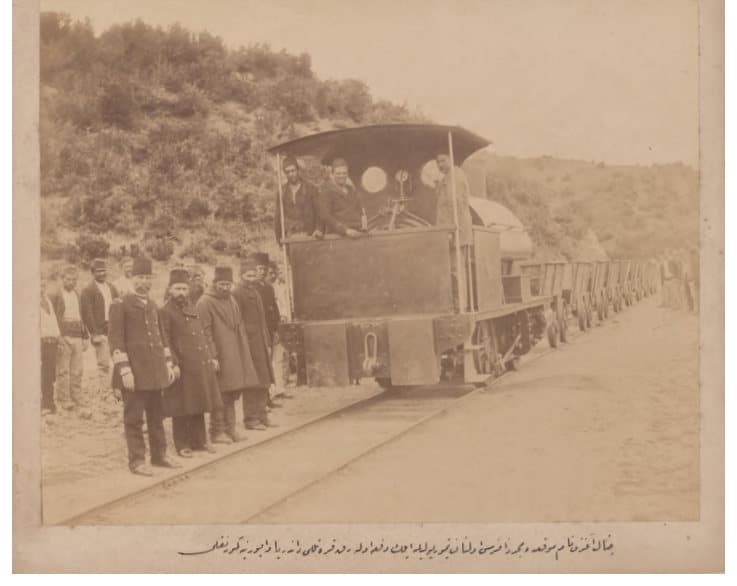
Figure 1 Coal transportation
for the first time with the
newly laid railroad in
Çatalaǧzı
Additionally, the agricultural products of the Balkans could be easily transported by railway, and the trade of the Balkan principalities would be conducted through the Ottoman Empire, leading these principalities to feel the need for greater connection to the state. The first response to the Ottoman Empire’s call came from the British parliamentarian Labro, and a contract was signed with him on January 23, 1857. Accordingly, Labro was granted the concession to build a railway from İstanbul to Ruse via Edirne and Şumnu and from Edirne to Enez on the coast of the Aegean Sea. This concession was given to him for a period of ninety-nine years. Labro immediately began preparations, but due to the inability to secure the necessary capital, his concession was revoked. Meanwhile, various concessions were granted to British companies, leading to the construction of the 211-kilometer Alexandria-Cairo railway
between 1851 and 1856, the 66-kilometer Constanta-Cernavoda railway between 1857 and 1860, and the 130-kilometer İzmir-Aydın railway between 1856 and 1866. These constituted the first railway lines in the country, spanning Africa, Europe, and Asia.244
(BOA.FTG, 188S)
The construction of the İzmir-Aydın railway, the first one to be put into operation in Ottoman Anatolia, began with a grand ceremony on September 22, 1857. Due to the rapid progress of the work, the company officials expressed that the first section of the railway would be completed by the end of 1858. In a remarkably short period, more than 1.5 kilometers of track was laid, and the terrain was adjusted to install a temporary line. Concurrently, activities were initiated in the mountainous region considered the second
Figure 2 1913 map showing
Ottoman railways
(BOA.HRT, 140)
section. While over 500 workers were laboring to dig the tunnel, an agreement was reached with the Robert Stevenson Company to procure the necessary machinery for the railway.
Despite the challenges faced, the seven-mile section of the line being constructed from İzmir to Üçpınar was inaugurated on December 26, 1860. A special commission was established to oversee the expenses of the line on-site. On September 9, 1861, the 11 kilometer long Torbalı-Çellatkahve section was also completed and put into operation. In a telegraph sent to the Sadaret on October 27, 1861, by the Governor of İzmir, Rıza Pasha, it is reported that the line was completed up to two miles beyond Kozpınar. Despite all these financial and natural difficulties, outbreaks of diseases also hinder the construction, and due to a malaria epidemic, the construction is halted for a while. Nevertheless, the official opening ceremony for
this seventy-kilometer section is held on November 14, 1861. On September 15, 1862, the section up to Ayasuluk (Selçuk) is also put into operation, and the foundation of a large station is laid here the next day. Thus, after facing various challenges, the İzmir-Aydın railway was completed on July 1, 1866, within what could be considered a relatively long period of ten years.245
İzmir railway contract
The agreement between the İzmir-Aydın Railway Company and the Ottoman State outlines the profit guarantee given to the company and its conditions, details the construction of stations and bridges along the route, as well as the filling and other works on the railway bed. It specifies how the incurred expenses will be handled and clarifies the ownership of these costs. Additionally, it covers details regarding the company’s shares,
bonds, and other relevant matters.
September 24, 1856
Contract for the İzmir Railroad.
Article 1: The Ottoman State grants an annual profit guarantee amounting to one hundred and two thousand liras (dividend guarantee fund) to the Railway Company for the entire railway line constructed from İzmir to Aydın. Additionally, permission is granted by the Ottoman State for the company to issue three hundred thousand liras worth of privileged shares.
Article 2: The said company commits to completing the most essential tasks at the stops along the aforementioned railway line within two months from the official announcement of the approval of this agreement at its agency in İstanbul. These tasks will be carried out by the company according to the plans (drawings) promptly provided by the Ottoman State. If, by the end of this period, these tasks are not completed, the profit guarantee for the second part (branch) of the said railway line will be proportionally reduced, depending on the delay in completing these tasks.
Article 3: The said company is obligated to complete, as deemed necessary or indicated by the Ottoman State, the works falling under the
categories of strengthening, industrial improvements, and constructions such as inclined surfaces (slopes), embankments, and trenches. Similarly, the construction of wooden bridges in flood-prone areas and arid locations, designed to be fire-resistant during the summer, must be carried out. Although a specific timeframe for the completion of these tasks has not yet been determined, the expenses incurred for the completion of these works and any alterations resulting from the administration and reinforcement of certain locations will be covered by the company’s capital. Additionally, expenses
arising from the enlargement and duplication of the mentioned stops, as well as the acquisition of necessary tools and equipment due to changes, will be financed from the company’s capital.
Article 4: Until the completion of the aforementioned works, within the recognized twomonth period, if, unexpectedly, any hindrance arises leading to the suspension of operations on the said railway for more than twenty days, the profit guarantee amount determined by the Ottoman State for the second section will not be applicable during this hiatus.
Article 5: The company shall commit to the payment and coverage of all existing debts and future expenses through the currently held three hundred thousand lira preferred shares and the three hundred and four thousand lira borrowing (debt) securities issued as the second installment. In the event that the need for additional capital arises for the extension of the railway from İzmir to Aydın, the company will take the necessary measures without increasing its capital, consisting
of shares and bonds.
Article 6: As of the date of this agreement, the Company will be subject to the terms and conditions of the general specifications provided to the Town Railway Company, excluding the
provisions of Articles eighteen and nineteen regarding the purchase of the railway in the completion of the concession period specified in the contract dated September twenty-three of the year one thousand eight hundred and fifty-six.
Comparison was made.
A.DVN.MKL, 74/1
The railroad laid by the British army to Sevastopol was purchased by the Ottoman Empire and laid between İzmir and Manisa
The railway laid by the British army to Sevastopol was brought to İstanbul and purchased by the Ottoman Empire. Following discussions at the Encümen-i Meşveret (Advisory Council), it was decided that this railway, which was twenty-one and a half miles long, would be extended between İzmir and Manisa. İzmir, being the most wellmaintained and prestigious port on the Anatolian shores and simultaneously a trade center, was considered for the railway extension. As the existing railway length would not be sufficient to cover the entire distance between these two cities, it was proposed to bridge the small gap with additional railway tracks. After the discovery of this need, it was suggested to establish a company, conduct a detailed exploration by sending the previously hired engineer to İzmir to assess the situation, and sell shares to interested parties. Consequently, a letter was sent to the Ministry of Commerce to carry out the necessary actions in line with the order given by the Sultan.
January 21, 1857
To the Ministry of Commerce
As is known to Your Excellency, the railway laid by the British Army in Sevastopol, later transported to İstanbul and subsequently purchased by the Ottoman Empire, is deemed necessary by the esteemed orders of His Majesty the Sultan to be
established in a suitable location beneficial to the Ottoman State and its people. Considering that the construction (vaz’) of a railway from the most
prosperous and prestigious port and trade center of İzmir to Manisa on the Anatolian shores would undoubtedly bring numerous benefits to the state and the public, it was discussed in the Council of Consultation as follows:
The extension of these railway materials (equipment) to the İzmir route is necessary, as one of the two routes between İzmir and Manisa is nine hours away, and the other is one or two hours further. It has been observed that the purchased twenty-one and a half miles of railway equipment, while having some reserve, are only sufficient for a distance of six hours. However, due to the slight difference in distance on the İzmir route, it seems possible, with the grace of His Majesty the Sultan, to obtain additional railway materials needed beyond the existing ones. The amount of expenditure for this route will be determined by the state after the survey is conducted. It is considered appropriate and auspicious to establish a company (kumpanya) and sell shares to those interested, with the possibility for members of the company established in İzmir for this purpose to join if they wish. To achieve this, it is proposed to send the engineer previously brought in to conduct surveys and assessments of which of the two routes would be cheaper and easier to build, how much additional railway equipment will be needed beyond what is currently available, and the estimated cost of constructing and completing the railway. These matters were discussed, found suitable, and presented to His Majesty the Sultan for approval, and His Majesty has ordered accordingly. Therefore, this letter (tezkire) has been prepared for Your Excellency to take the necessary actions.
A.MKT.MHM, 105/83
Evaluation of a proposal to build a railroad for the first time in the Ottoman Empire
The letter regarding the construction of a railway
between İstanbul and Belgrade and the proposals submitted by certain individuals for evaluation were discussed and approved in the Meclis-i Âlî-i Tanzimat (Sublime Council of Tanzimat), which convened to assess the conditions of this railway project. A detailed record outlining the general path to be followed in the construction of railways was deliberated and accepted in the Meclis-i Mahsûs (Council of Ministers.) Subsequently, it was found suitable and approved by His Majesty the Sultan.
August 1, 1855
Monsieur Edmond Leahy, Monsieur Edouard Blak, and Monsieur Edward La Fontaine submitted a proposal and offer letter to the Meclis-i Âlî-i Tanzimat concerning the construction of a railway from İstanbul to Belgrade. This document was opened for discussion to examine its contents and make a decision on the matter. The discussion approached the topic from two perspectives: one involved scrutinizing the clauses contained in this letter to reach a decision, while the other aimed at evaluating the overall outline of this project and establishing fundamental principles. As Your Excellency is aware, the construction of this railway is a new initiative for the Ottoman Empire and is considered a crucial matter for the state and the country. Therefore, it is imperative to proceed with a solid and accurate foundation on this matter. Considering that the construction of railways is one of the main elements among the reforms entrusted to the Meclis-i Âlî-i Tanzimat, a decision was made to initiate discussions on this issue, primarily to establish a foundation and determine its essence. To provide a basis for the discussions, the following points were considered:
First, is there a need to build roads in the Ottoman country? Second, if roads are to be built, should they be ordinary roads or railroads? Third, if it is necessary to build railroads, should the Ottoman
Empire build them itself or should they be built by companies? Fourth, if it is necessary to be built by companies, should these companies be formed internally or should foreign capital be used? Fifth, if foreign capital should be used, what should be the method of bidding? A summary of the results of the debates that took place in the Assembly on these issues is presented and declared separately as follows:
The first issue is inherently clear and will resolve
itself, as it is widely known. The fundamental principle of prosperity is the presence of easy transportation methods and roads, as evidenced by books written on this subject. Regarding the Ottoman Empire, it is a well-known fact that facilitating transportation is crucial for prosperity, and there is no need to reiterate reasons that are already widely acknowledged. Therefore, it suffices to state, “Constructing roads in the Ottoman Empire is the most important and
necessary task,” as there is no additional benefit in repeating what has already been extensively discussed and written about.
The summary of the considerations on the second issue is as follows: The purpose of a road is to facilitate transportation on land. This happens in three degrees. One is on horseback, the second is by ordinary carriage, and the third is by steamer carriage. The horseback road is the current situation. The goal is the two later forms. Carrying things on the back of a cart means, for example, having two animals carry things that should be carried on the backs of twenty animals. To have a clean carriage road is to put the load of two carriages traveling on a bad road into one carriage. Likewise, the purpose of a railroad is to carry the load of, for example, fifty carriages in one steam vehicle. In this case, of course, railroads are preferable to all of them, but it is not possible to make railroads everywhere because of the cost and difficulties involved. For this reason, the construction of large railroads to be a main commercial road (mecrâi azîmi ticâret) and the construction of ordinary wagon roads to transport goods from the surrounding area to them, as far as the power and means allow, is a method adopted everywhere and should be followed in the Ottoman country as well. Constructing railways, either overland or by sea, to connect commercial ties with other countries would bring benefits that cannot be achieved through ordinary roads. Therefore, there is no doubt that spending money, even if minimal, on constructing such significant commercial main routes in the form of ordinary roads would be futile. The need for ordinary carriage roads to complement railways is evident. However, once the primary main routes, the railways, are established, it becomes easy to demonstrate the benefits of constructing the others through practical application. For this reason, the necessity of constructing several major railways in the Ottoman Empire is evident. Considering the geographical location of the
Ottoman State, situated at the figurative center of Europe due to the geographical positions of its territories, and being one of the major components constituting Europe, it is natural that the Ottoman State cannot remain static while European countries progress to such extents. In this respect, it is desperately obliged to follow their general movements.
Railways will be one of the primary connections uniting us with Europe, making it abundantly clear that the time has come for the Ottoman State to construct railways based on this assessment. Although it can be argued, as mentioned above, that railways will serve as major commercial main routes and should be constructed everywhere as trade expands, it is initially conceivable to consider constructing railways for the four or five major main roads (avenues) that lead to the largest trading routes in Rumelia and Anatolia, connecting to the ports where steamships dock.
However, among these, it is most preferable to choose a road that will provide the maximum benefit and whose advantages will be immediately visible both domestically and internationally. Therefore, starting with the construction of a railway from İstanbul to Belgrade is the most suitable option, setting an example for others to follow. Indeed, İstanbul, as a major city (sevâdı âzam), is inherently a center of trade, serving as the sole destination for the necessities required from the interior of the country. Therefore, trade directed towards İstanbul alone will greatly benefit from the railway that will connect many places from Belgrade to İstanbul, circulating through various regions. In addition, since İstanbul is one of the most beautiful ports in the world, its foreign trade will bring great benefits to this railway line. Besides all these considerations, the road that will provide connectivity with Europe overland will generate many material and immaterial benefits. It is undoubtedly expected to contribute to the prosperity of both İstanbul and
many other suitable places in Rumelia in a short time. In summary, roads should be built in the Ottoman country, the major ones being railways, with priority given to the railway line to be built between Belgrade and İstanbul.
The conclusion of the evaluations in the third matter is as follows: Since every state is engaged in general administrative affairs, and the benefits and advantages in trade and industry emerge for the benefit of the society as a whole, they content
themselves with only encouraging the public in this regard. In this respect, even if they have financial resources, states still leave such matters to the public. Throughout all of Europe, this principle is adhered to, and railway lines are also left to companies. Among them, only the Austrian State, despite facing some difficulties in finding money, managed to build a few railways. However, as it couldn’t cope, it was later forced to sell them to a company. In this regard, even if the Ottoman
State hypothetically finds a solution to have such a railway built by spending its own money, the experiences in Europe show that its management cannot be handled. Therefore, it is necessary to have this railway constructed by companies in accordance with the universally applicable principles and rules.
As for the fourth matter, if the country had enough wealth and power domestically to undertake such projects, it would be sufficient to rely on domestic capital without involving anyone from outside. However, considering the current situation, this seems impossible. The Ottoman country is like an untapped mine, and as the natural riches bestowed by Allah emerge continuously, it is hoped that the people will have the power to undertake such projects. Hopefully, with the grace of His Majesty the Sultan, this will be seen in the near future. However, at present, it is not possible to find such a large amount of money domestically.
Obtaining this in the future depends on bringing in the capital necessary to prepare the reasons for the expansion of wealth inside. Moreover, at this time, money has no nationality. In other words, it does not conform to or bind itself to any specific state. Money, by its nature, belongs to the whole world, serving equally everywhere. For example, if one were to ask whose money was used for the large-volume transactions and businesses seen in England, the answer would be that it was done with the money of all of Europe. Similarly, it is clearly evident that the capital for major projects elsewhere also comes from the money of all of Europe. Whenever a railway is to be built, its management will undoubtedly be subject to the government of that area, but its shareholders can be from anywhere. The decisions of the shareholders in this matter are only in the form of benefiting from this business, and ownership belongs to the state that owns the country. In light of these considerations, to build and manage a railway, it is necessary to accept the capital
coming from abroad, seek and bring in individuals from abroad who will participate in the company, and make Ottoman State citizens shareholders in this company.
The fifth matter is the implementation method of the previous issue. Once the decision to construct a railway is made and it is deemed appropriate to accept foreign capital for this purpose, it is necessary for the state to initially subject this matter to examination and evaluation and determine some basic conditions. For every state, when a company is established either with only domestic capital or with a combination of domestic and foreign capital, the necessary procedures and conditions are determined by the state. For the Ottoman State, this issue should be approached from two points: one is how to negotiate with the companies that will undertake these railways since this is something to be done for the first time, and the other is what the basic conditions will be. So far, some individuals have come forward to provide proposals and drafts for such matters. With the present text, a proposal is being made for the construction of a railway up to Belgrade. However, whether the requested conditions and permissions are profitable or detrimental is not known at this point. These things naturally come about through comparison and measurement.
In other words, when the Ottoman Empire decided to build a railroad, if there were more than one contractor, competition would arise between each other. This would naturally lead to demands, one of which would be inferior to the other. In this case, the proposals will be put forward and compared with each other, and the most profitable and beneficial one will be preferred and accepted. In this way, a conclusion will be reached more easily and without deception. Another point is that, so far, those who have come forward to undertake these projects and submitted proposals and draft writings are neither major capital owners nor representatives of large
companies. They practically engage in lobbying and brokerage, requesting certain permissions from the Ottoman State and seeking a decree. If they manage to obtain it, they then sell this document to individuals who undertake to establish a company and take it to Europe, thereby benefiting themselves through this process. It is evident that if they cannot find a contractor, they return the state decree one year later. Since those who submit proposals and draft writings in this
regard have no reputation of their own, they rely on the credibility of the decree that the Ottoman State will provide. In that case, there is no doubt that it would be more effective for the Ottoman State to directly appeal to European capitalists. Although there is no harm for those who request decrees and then fail to conclude the business, the honor and reputation of the Ottoman State are tarnished in this way. Furthermore, if the requested permissions are withheld, it creates an
impression that the Ottoman State is not inclined towards such reforms concerning the country, leading to the state being subjected to certain implicit remarks. Therefore, if the Ottoman State openly appeals to European capitalists and declares that it will negotiate with those who come forward based on the fundamental conditions it sets and will accept the offer that proves to be more profitable in the bidding process, it would be much more beneficial and advantageous than dealing with intermediaries. Additionally, it is quite evident that such an announcement would yield numerous gains in terms of Europe and politics. Granting long-term privileges in dealings with such companies, as stated in this proposal, is a common practice. As indicated in the presented text, if a commitment is made, ensuring a certain level of profit by the government—in other words, guaranteeing that if the revenue capital left by Belgrade falls below four and a half percent, the Ottoman State would cover the difference—is a necessary aspect of the proposals put forth on this matter. While there is no objection to the duration of the privileges, the foremost consideration regarding the guarantee of the profits to be obtained is this: Since this undertaking will be entrusted to a company, the profits and losses should rightfully belong to that company.
However, even in Europe, sometimes such guarantees are given depending on the situation, and this is considered a precautionary measure for companies. In essence, the government’s acceptance of this is because it is known that no commitment leaves less than four and five percent profit. As a presumption, even if the government were to provide, for example, one or two percent in the first couple of years, it is understood that this is in proportion to the country’s earned profits and benefits. In this case, the Ottoman Empire must also accept this rule. However, since the guarantee requested in this article seems to be too high, it is highly probable that there will be bidders with much less than this and perhaps even
contractors who will give up this guarantee completely with the extension of the concession period. It is clear that this will only come to light through auctioning as mentioned above and ensuring the necessary competition, and that whichever of the offers is deemed profitable, beneficial, and trustworthy by the state will be accepted. Therefore, if the decision is made to construct the Belgrade railway initially, the fundamental conditions should be determined as follows: “The Ottoman State will build a railway from İstanbul to Belgrade under the following conditions. For this purpose, through the Ottoman embassies in Europe, the situation will be announced in a procedural manner, stating that the proposals submitted by the emerging companies will be collected, compared, measured, and evaluated, and the one deemed more profitable and beneficial will be preferred.” A timeframe, such as six months, may be set for this announcement, during which the proposals from the companies willing to undertake the project will be collected, compared, measured, and evaluated. Subsequently, a contract will be made with the company that best aligns with the fundamental conditions and the interests of the Ottoman State. This method is considered the most beneficial approach. Regarding the fundamental conditions, firstly, the company’s name and title should always be “Şirket-i Osmaniyye.” Secondly, its shareholders should include both Ottoman State citizens and foreigners. Thirdly, the construction and general management of the roads should be under the supervision of the Ottoman State. Fourthly, the general management should adhere to the laws of the Ottoman State. Fifthly, the route of the railway should be determined by the Ottoman State, and the ownership rights should remain with the state. Sixthly, the coal mines around the railway should be auctioned to the railway company under special conditions. These
fundamental conditions are in accordance with the state procedures of the Ottoman State and its relations with foreigners based on treaties. Determining and adhering to these conditions is the most important and necessary aspect. It is hoped that these conditions will be accepted internationally as well. The last clause regarding the auction of coal mines around the railway is designed to provide convenience for the companies and, at the same time, take into consideration the benefits that the country will derive from this project.
These are fundamental conditions, and their details will be discussed and decided upon after the emergence of the companies interested in the project. Since the specifics will become apparent after comparison, measurement, and evaluation based on the choices made by the companies, it is not deemed possible to determine them in advance.
If this decision is deemed appropriate by Your Excellency, it is considered appropriate to inform the authors of the mentioned proposal and draft, allowing them to be relieved of waiting. It could be stated that, “If they, within the specified period, undertake to establish a company and engage in competition with other emerging companies, then their proposals and draft writings will be considered at that time.”
As a result of our evaluations, if it is deemed appropriate to discuss this matter in the presence of Your Excellency through negotiations among representatives, and if it is found suitable to proceed in this direction, and if the wise decrees of His Majesty the Sultan also align with this, it is considered that, according to this decision, the form of the announcement to be made in Europe will be arranged after being discussed by the Assembly. It is also known that the original and translation of the mentioned proposal and draft are presented with this decree. In this regard, your orders and decrees are awaited.
9 Şaban 1271
(Seal)
Mehmed Pasha
Although present during the negotiations, he was unable to be present during the sealing of the document as he had traveled to the island of Lesvos for a change of weather.
(Seal)
Mehmed Rif’at
(Seal)
Hıfzı
(Seal)
Mehmed Fuad
The decree of the Meclis-i Âlî-i Tanzimat, which was presented during the meeting of the Meclis-i Mahsûs-ı Meşveret (Advisory Council of Ministers) held on the fifteenth day of the current month, was read. The implementation of the mentioned railways in the Ottoman country, thanks to His Majesty the Sultan, is known to bring numerous material and nonmaterial benefits. The evaluations, both in terms of the essence and the details of this matter, have been extensively explained and seem entirely comprehensive and appropriate. Therefore, they have been completely accepted and approved. Nevertheless, as indicated in the mentioned decree, the options outlined include either limiting the construction of the road to Rumelia for the time being or commencing construction on both sides simultaneously, with a suitable location determined on the Anatolian continent. In this regard, it has been unanimously agreed that, as initially expressed in the decree, initiatives should first be taken in Europe for the construction of the road from İstanbul to Belgrade. After deciding on and understanding the nature of this phase, the consideration of construction on the other side will be addressed in the future. However, as the wise decrees of His Holiness the Caliph determine
the course of action in this matter, and only goodness and accuracy will prevail in his decisions, it is known that when his will is revealed, your orders and decrees will be implemented accordingly.
15 Zilkade 1271
(Seals of the members of the Meclisi Vükelâ)
Gracious sir,
The decree drafted by the Meclis-i Âlî-i Tanzimât, containing evaluations regarding the construction of the railway, which is one of the primary and fundamental reasons for the development of the country, thanks to His Majesty the Sultan, was read in today’s Meclis-i Mahsûs (Meclis-i Vükelâ) meeting. The provisions within were unanimously deemed appropriate. Additionally, the annex written was sealed by those present in the Council and submitted, along with the entire set, to be seen and examined by His Majesty the Sultan. In this matter, the actions will be taken according to His will.
16 Zilkade 1271
Your servant submits
The document, along with your letter that has reached my hands, has been seen and examined by His Majesty the Sultan. Considering that the detailed evaluations in the decree and the points mentioned in the annex of the Special Council’s letter are appropriate, the necessary actions are requested to be taken as indicated in your submission letter. Therefore, the documents are returned to you, Gracious Grand Vizier. Now, your orders and decrees are awaited in this matter.
17 Zilkade 1271
İ.MMS, 5/182
Source: Innovation, Inventions and Quests Among the Turks