

Culture & communication
1856
Islahat Fermanı (Imperial Reform Edict)
Ottoman Muslims and non-Muslims now have equal rights
The decree was issued as a result of the Western powers’ dissatisfaction with the Edict of Gülhane, declared on November 3, 1839, which proclaimed equality before the law for all Ottoman subjects and ensured the state’s protection of life, property, and honor for everyone, irrespective of their religion. The Western powers, not content with the Imperial Edict of Gülhane, claimed that there were some political and legal differences between Muslim and non-Muslim Ottoman subjects, prompting the issuance of a more comprehensive reform decree. This decree holds significant importance in Ottoman history.
The Crimean War (1853-1856) began as a result of the increased pressure from Western powers on the Ottoman Empire during the conflict with Russia. This pressure intensified due to the rejection by the Bâb-ı Âli of Russia's proposals for official protection rights for the Ottoman Orthodox Christians, which stemmed from dissatisfaction with the handling of certain sacred sites in Jerusalem and its surroundings,
considered holy by Christians. During the war, the Western powers supporting the Ottoman Empire against Russia were concerned about the potential for Russia to use its Christian cause to mobilize European public opinion against the Ottoman Empire. To counter this danger, the Bâb-ı Âli was strongly urged to implement new regulations specifically addressing the rights of Christians. Indeed, the fourth principle established during the conference in Vienna, convened to determine the basis for the peace treaty, required the announcement of a new reform program that would grant equal rights to non-Muslims, putting them on par with Muslims.246
The Crimean War dragged Britain and France into the conflict alongside the Ottoman Empire. With Austria gradually joining this front in December 1854, the alliance of the “Three Great Powers” was formed. In April 1855, during the conference held in Vienna, where preliminary peace conditions were discussed, the Great
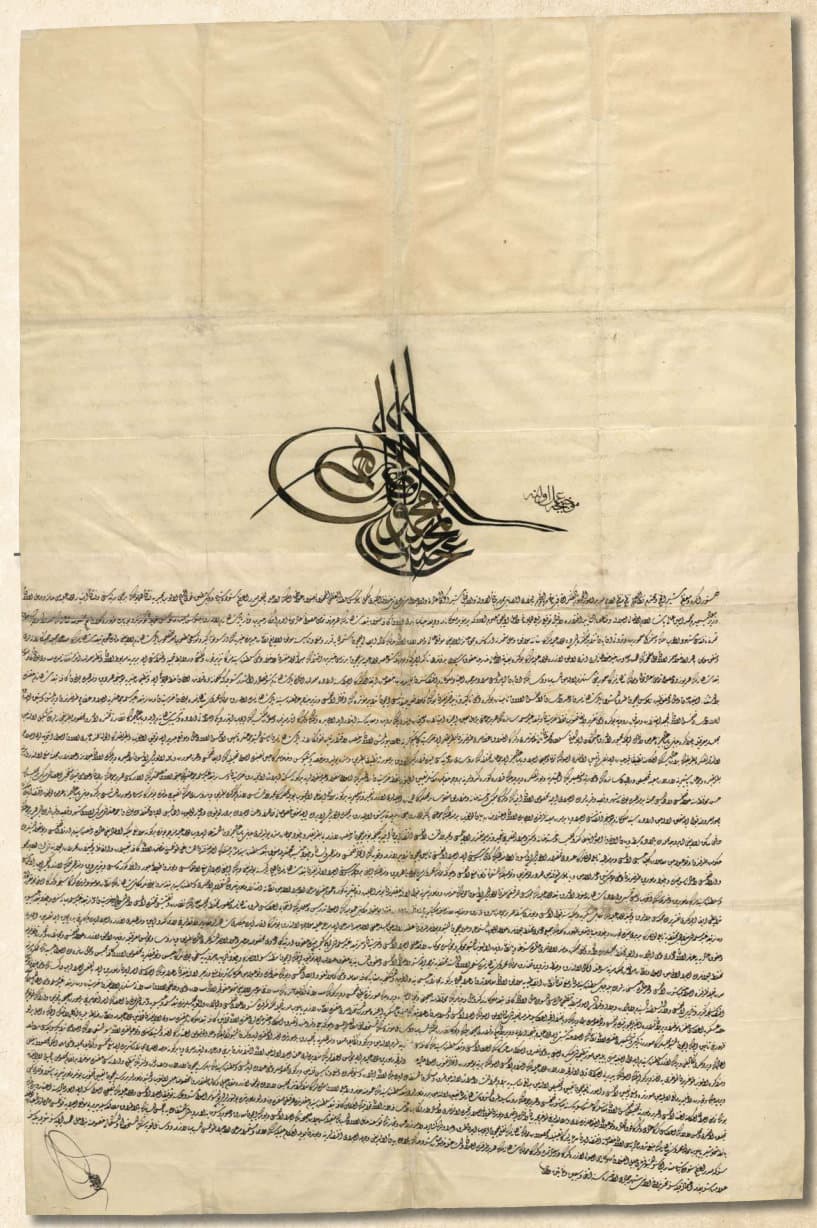
Figure 1. The Imperial
Reform Edict. Powers decided to ensure that Russia's claims or implications of guardianship over the nonMuslim subjects of the Ottoman Empire would be prevented. This decision made it imperative for the Bâb-ı Âli to initiate reforms on its own initiative to improve the situation of the nonMuslim population.
The statement by these three states, each possessing considerable land and naval power, that they left the initiative to the Ottoman government was nothing more than a diplomatic courtesy. Naturally, with the British army in Üsküdar and the French army in Maslak, it did not require much effort to prompt the Bâb-ı Âli to use this initiative. Ultimately, the dependent status of the Ottoman Empire during the war years was the fundamental factor in accepting this proposal.247
The reform program was decided to be announced in the form of an edict to create the perception that the Sultan, of his own volition, granted some privileges to the non-Muslim subjects. The program was promptly formulated into a decree and ceremoniously read in the Bâb-ı Âli on February 18, 1856. The ceremony, held in the presence of the acting Grand Vizier Kıbrıslı Mehmed Emin Pasha, was attended by prominent state officials, the Sheikh-ul-Islâm, patriarchs, the chief rabbi’s deputy, community leaders, and representatives of foreign states. Copies of the Edict of Reform were also given to the states participating in the Paris Congress.
The Reform Edict was more detailed than the Tanzimat Edict. While the Tanzimat Edict laid down general principles concerning all Ottoman subjects, the Reform Edict included provisions specifically for the non-Muslim Ottoman subjects and foreigners. It significantly altered the former status of non-Muslims in Ottoman society and reorganized their situation. The Edict aimed to
equalize the legal status of non-Muslim elements within the Ottoman subjects with that of the Muslim population. However, it also included elements that could directly concern the Muslim community, subtly embedded between the lines. The provision stating the freedom to practice any religion or sect in the Ottoman territories and that no one would be compelled to change their religion or sect was articulated in a way that encompassed not only non-Muslims but also the Muslim community. The Tanzimat Edict and the Islahat Edict also differed significantly in terms of their drafting. The first, prepared by Ottoman statesmen under the pressure of internal dynamics rather than external influences, stands in contrast to the second, which was entirely prepared in conjunction with foreign representatives due to external pressures. While the Tanzimat Edict was communicated to states without entering into any commitments, the fact that the Islahat Edict was specifically mentioned in the Paris Treaty constituted a commitment for the state.248
The most challenging provision of the Edict for Muslims was the one stating that Christians would be equal to Muslims in legal matters even if they did not fulfill the military obligations, which are the most significant duties of the subjects. The Muslim population, long accustomed to the material prosperity and superiority of the non-Muslim subjects who thrived in trade and industry, found solace in their political superiority stemming from ancient rights. However, with the reforms, they began to fear that not only their material wealth but also their participation in state administration and the political equality enjoyed by Christian citizens would be curtailed.249
Contrary to expectations, the Reform Edict faced the greatest opposition from non-Muslims.
Although ostensibly equal to Muslims, the dominant community, especially the Rum, rejected the principle of equality. They were willing to accept the superiority of Muslims, but they vehemently opposed being equated with Armenians and Jews. One of the issues that sparked the reaction of non-Muslims was the military obligation. Religious leaders also disapproved of the edict. The abolition of the dues they received from their congregations and the transition to a salary system, as well as the requirement for them to pledge allegiance to the state when taking office, led to significant protests from patriarchs and metropolitans.
The granting of special rights to non-Muslims and foreigners through the Reform Edict, adding political rights to the material wealth they had acquired in the empire, also led to reactions from Muslims. Some Muslims believed that the national and sacred rights earned by their ancestors through their blood were being lost and that the status of being the dominant nation was being forfeited.250
In 1859, European states issued a memorandum to the Ottoman Empire, claiming that the provisions of the edict were not being implemented. In response, inspectors were sent to Rumelia, but this measure could not prevent the complaints and pressures. To alleviate the pressures, the Bâb-ı Âli declared in February 1861 that it would reform the justice and tax system.251
While states increased their interventions in the implementation of the Reform Edict by taking advantage of the rights granted to them by the Paris Treaty, Abdülmecid, who had promulgated the edict, passed away on June 25, 1861. Upon the resignation threats of Âlî and Fuad Pashas, the new Sultan Abdülaziz reissued the Reform Edict, reaffirming its principles. The
announcement of the continuation of reforms eased the concerns of Western states. In accordance with the Reform Edict, Bâb-ı Âli reorganized the provincial organization, implementing the 1864 provincial law based on the departmental system in France.252
From 1860 onwards, the community regulations granted to the Rum in 1863, Armenians in 1865, and Jews were almost constitutional in nature. Thus, each of these three communities acquired a second council dealing with administrative matters alongside the clerical councils responsible for their religious affairs. However, the attempts to create closeness and unity among the subjects resulted in the opposite effect, causing the communities to drift further apart. According to the Reform Edict, non-Muslims who began to be employed in state service resisted fulfilling their military obligations and, by paying a fee, managed to be exempted from military service, which the state found challenging to implement. Again, as a result of pressure from major powers, based on the Reform Edict, foreigners were granted the right to freely acquire property in Ottoman territories, excluding the Hijaz province. With Tabiiyet-i Osmaniye Kanunnamesi (Ottoman Nationality Law) issued in 1869, renouncing citizenship became subject to government approval, and everyone, Muslims and non-Muslims alike, residing in Ottoman territories was considered Ottoman.253
Source: Innovation, Inventions and Quests Among the Turks