
Transport & engineering
1873
Galata Tunnel The world’s second subway
The term “funicular,” used for rail systems pulled by cables in hilly terrains, comes from the French word funiculaire. Essentially, a funicular is a transportation system established to carry people and goods on inclined terrain, interconnected by ropes and capable of moving on rails.
Funicular systems are generally designed to serve within the areas with a wide elevation difference between each other. In principle, a funicular can be thought of as a system consisting of two vehicles connected by a pulling cable and a tension cable, both driven by a motor, traveling between two stations on inclined or horizontal terrain. A funicular consists of at least two vehicles connected by a steel cable wound around a pulley at the upper station. These vehicles move on parallel tracks located on both sides of the central track. As the vehicles travel a certain distance, the two tracks merge into a single track, reaching the stations. The weight of the descending train helps assist in pulling the ascending train on the
inclined track and prevents the ascending train from losing control. Funicular systems share similar technical characteristics with commonly used inclined elevators.
The first passenger-carrying funicular was built in 1861 in the town of Dusino, Italy, and the second one was constructed in 1862 in Lyons. The world’s first urban funiculars, known as “cable cars,” were built in 1873 in San Francisco, USA. The first underground funiculars entered service in 1875 in İstanbul under the name “Tünel.” The operation was powered by steam at that time. After the London Underground, it was the world’s second categorically recognized subway system. The first underground funiculars in Europe were built in Switzerland in 1877, connecting Lausanne to Ouchy.264
Eugène-Henri Gavand, a French engineer who visited İstanbul for a sightseeing trip in 1867, observed a significant number of people traveling between Galata and Beyoǧlu. When people wanted
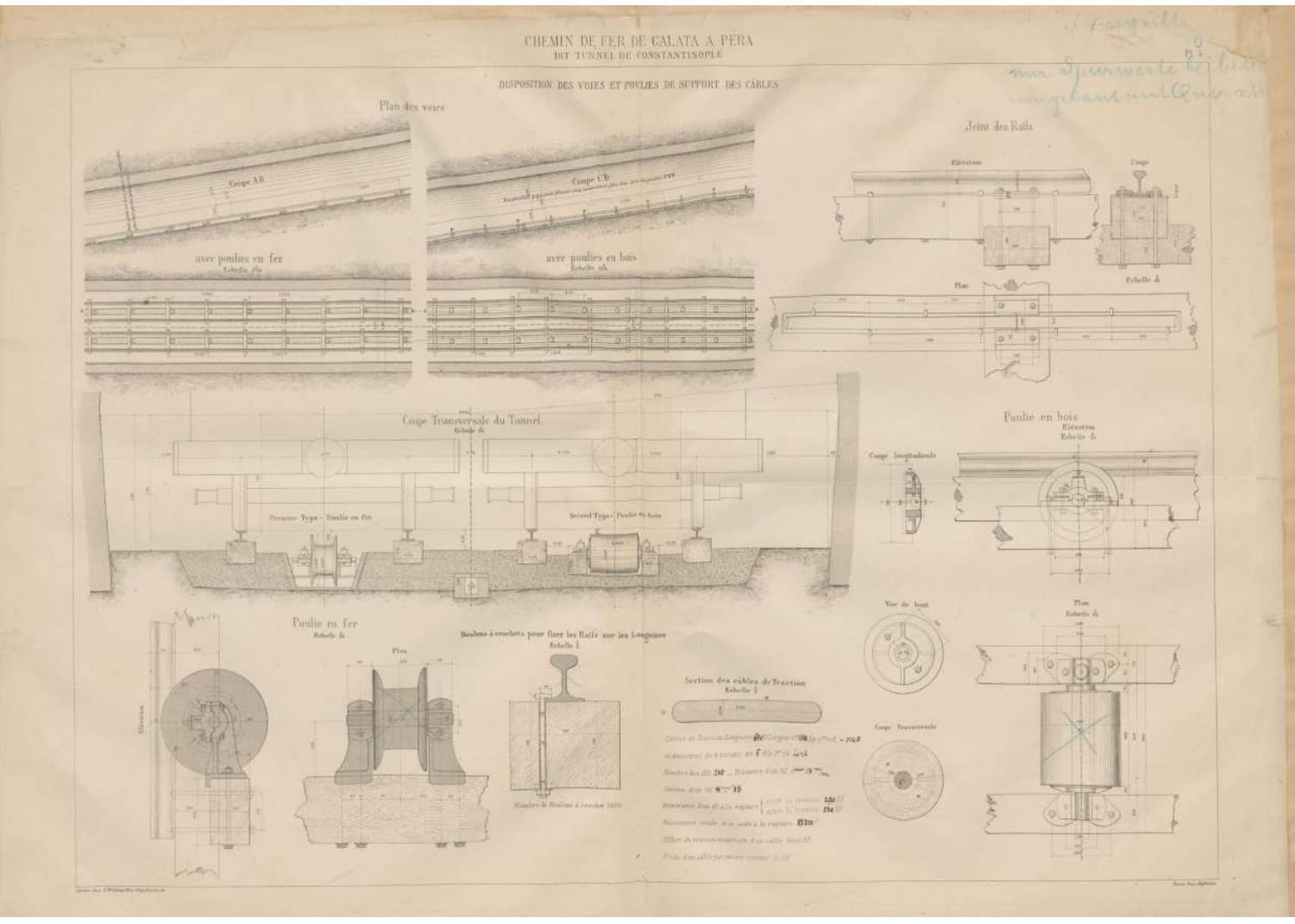
Picture 1 Technical drawings
of the Galata Tunnel (Eugène-Henri Gavand, Tunnel de Constantinople,
Paris 1876)
to go up from Galata to Beyoğlu or descend from Beyoğlu to Galata, they had to pass through Yüksek Kaldırım, a steep, neglected, and challenging road connecting these two central areas. The Yüksek Kaldırım Avenue, with a steep incline of 24% and a width ranging from 4 to 6 meters, posed a challenging and strenuous path for pedestrian traffic. Applying with a project to connect Galata and Beyoǧlu underground using a
railway (tunnel), Gavand proposed to construct a tunnel that would link Galata and Beyoǧlu, laying rails inside the tunnel and transporting passengers and cargo with carriages pulled by a stationary steam engine through cables.
After operating for 42 years, the tunnel was supposed to be handed over to the state. Gavand had no demands from the state for this project; in other words, he proposed a build-operate-transfer
Figure 2 Galata Tunnel transport vehicles (Eugène-
Henri Gavand, Tunnel de Constantinople, Paris 1876)
model. The project was deemed appropriate, and with the decree dated June 10, 1869, the concession was granted to Gavand. Unable to secure sufficient financial support from France, Gavand then formed a British company (Metropolitan Railway of Constantinople) to initiate the works. By the end of 1874, the tunnel was prepared for service. Trial sessions were held in November and December. In the meantime, the
British company ousted Gavand, assuming sole control of the tunnel. The Tunnel was inaugurated on January 17, 1875, with a grand ceremony. However, Gavand, the architect of the project who had been excluded and offended by the company, did not participate in this event. The train consisted of two wagons arranged as first and second class, illuminated for the passengers. The front wagon had a platform designated for
animals, goods, and carriages. Between January 18 and 31, in 14 days, the company transported 75,000 passengers; in February, 111,000; and in April, 127,000. With a price reduction in June, the number of passengers increased to 225,000.
Connecting Galata and Beyoğlu, two important centers of İstanbul, the Tunnel was the world’s second subway.265 The first subway was established in London between Farringdon Street and Bishop's Road in 1863, with a length of 6 km. In this subway, the wagons were pulled by a steam locomotive.266
The tunnel is 555.8 meters long, has a diameter of 6.7 meters, a height of 4.9 meters, and the length of the railway passing through the tunnel is 626 meters. The railway, constructed as a double track, has a slight slope at the beginning of the Galata side to ensure that the wagons gain enough speed to overcome the later incline. Gavand designed the tunnel in a parabolic shape for two reasons. The first reason is to keep the houses above the tunnel at a sufficient distance from the ground. The second reason is to facilitate the transfer of movement from the upper carriage to the lower carriage by taking advantage of the steep slope in Beyoǧlu. The wagons are moved by the engine located at Beyoǧlu Station and pulled by a single cable. Each wagon has a dual brake system.267
Since trains traveled back and forth on the same track without changing lanes, there was no possibility of collision. The wagons were propelled by a stationary steam engine located in Beyoǧlu. The construction cost a total of 4,125,554 Francs.268
The expropriation of the land in Beyoǧlu for the construction of the ongoing Galata Tunnel
The Council of State decision regarding the expropriation and allocation of the land required
for the underground railway construction from Galata to Beyoǧlu to the construction company.
September 18, 1873
A report with attachments sent from Nâfia Nezâreti (Ministry of Public Works) to the Council of State regarding the swift allocation of the land required for the underground railway construction from Galata to Beyoğlu, specifically from the
cemetery located across from the Mawlawi House, has been discussed in the Tanzimat Department.
The approved map of this tunnel in the Ministry of
Public Works was requested. Upon inspection, it was determined from the approved map attached to the contract that the location required for this railway corresponds to the area behind the buildings of the Sixth Division. It was understood that although initially, the location was planned to be broader, according to the verbal statement of the Road Commissioner, the amount of land to be acquired from the current state of the cemetery is 1,610 (approximately 1,220 meters). It has been understood that part of this location is a road, and according to the provisions of the contract, it is necessary to separate the area that is a cemetery. In the event of acquiring real estate and land around the location of the tunnel in Beyoğlu for the public interest, it has been decided to determine the actual value of the land in that amount in comparison to the estimated values, and it will be collected from the company director, Gavand. The delivery of this land will be agreed upon after measuring how many meters it reaches.
The cemetery area has been previously claimed and intervened by the Galata Mawlawi-khana (Galata Mawlawi House) and the Sixth Arrondissement and later by the Ministry of Evkaf (Evkaf-ı Hümâyun Nezâreti) regarding ownership. As it had been considered at one point to be given to Darüşşafaka and the the Academy of Fine Arts (Mekteb-i Sanâyi-i Nefîse-i Şahane, or shortly, Sanâyi-i Nefîse Mektebi), the determination of where the land fee to be collected from the concessionaire should be given depends on the decision to be made by the Grand Vizier’s Office.
It is for you to decide and give orders.
zira
September 18, 1873
Seal
(Council of State)269
A.MKT.MHM, 465/52
Source: Innovation, Inventions and Quests Among the Turks